


Smart Manufacturing Secrets: Key Takeaways from the SPARK Matrix™ IIoT Report
The global industrial landscape is undergoing a profound digital transformation, driven by the increasing convergence of operational technologies (OT) and information technologies (IT). At the center of this transformation lies the Industrial Internet of Things (IIoT) Platform, which is rapidly evolving from a connectivity enabler into a strategic foundation for intelligent and autonomous industrial ecosystems. QKS Group’s comprehensive market research on this domain provides a detailed examination of emerging technology trends, market dynamics, and the future outlook shaping the next generation of industrial innovation.
The study highlights how industrial enterprises are moving beyond traditional IoT deployments focused solely on device connectivity and data collection. Today’s industrial organizations are prioritizing platforms that can deliver real-time intelligence, predictive insights, and autonomous decision-making capabilities. This shift is driven by the need to enhance operational efficiency, reduce downtime, and enable more agile and resilient production environments. As a result, the Industrial Internet of Things (IIoT) Platform market is witnessing significant innovation, with vendors investing heavily in advanced analytics, artificial intelligence (AI), and machine learning (ML) capabilities.
One of the most transformative trends identified in the research is the emergence of Unified Namespace (UNS) architecture. UNS is redefining how industrial data is structured and accessed by creating a centralized, real-time data layer that bridges the gap between IT and OT systems. This approach eliminates data silos and enables seamless interoperability across diverse industrial assets, applications, and environments. By providing a single source of truth, UNS empowers organizations to make faster, data-driven decisions while improving collaboration across departments.
In parallel, there is a strong industry-wide shift toward open, containerized architectures. Traditional proprietary systems, which often limited scalability and integration, are being replaced by modular and extensible platforms built on open standards. These modern platforms leverage containerization technologies such as Kubernetes and microservices-based architectures to provide greater flexibility, scalability, and portability. API-driven interoperability further enhances this ecosystem by enabling seamless integration with third-party applications, enterprise systems, and edge devices.
The research also emphasizes the growing importance of edge computing in industrial environments. As data volumes continue to increase, processing information closer to the source has become critical for reducing latency and ensuring real-time responsiveness. IIoT platforms are increasingly incorporating edge capabilities to support use cases such as predictive maintenance, quality control, and process optimization. This distributed intelligence model allows organizations to act on insights instantly, improving operational efficiency and minimizing disruptions.
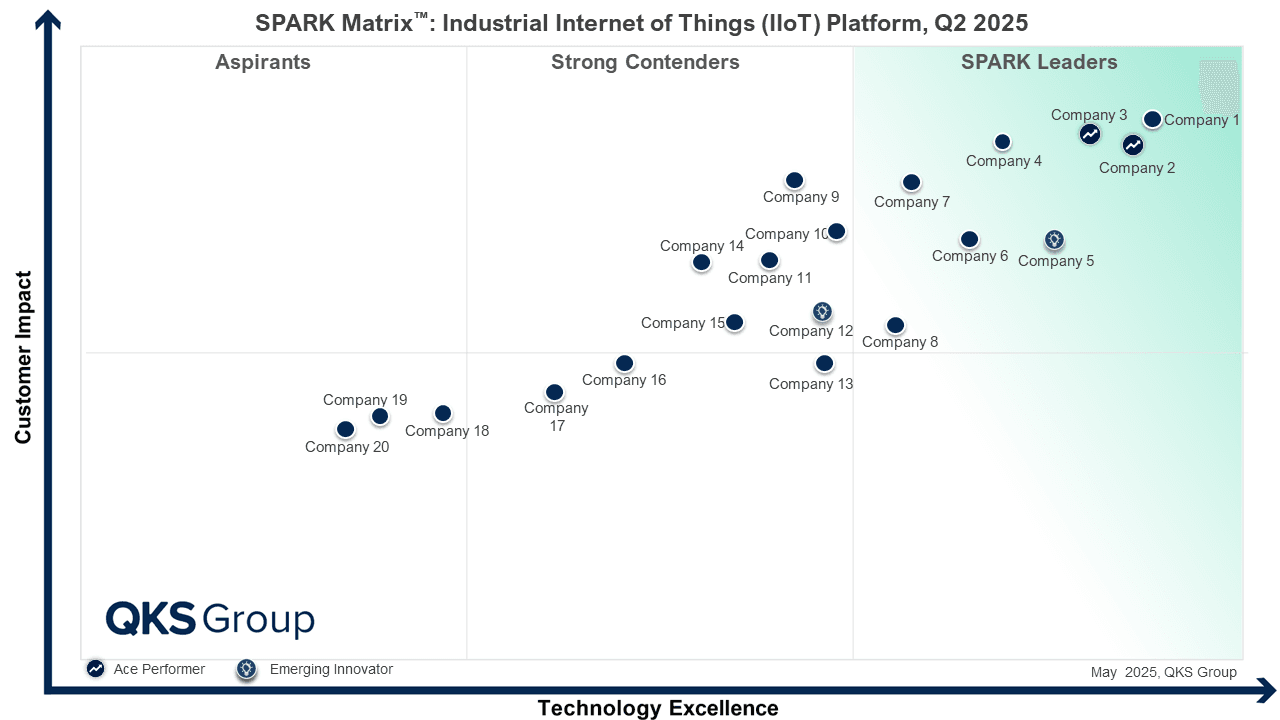
Another key aspect covered in the report is the competitive landscape, analyzed through QKS Group’s proprietary SPARK Matrix. This framework provides a comprehensive evaluation of leading vendors based on their technology excellence and customer impact. The SPARK Matrix offers valuable insights into how vendors differentiate themselves in terms of innovation, scalability, integration capabilities, and industry-specific solutions.
The vendor analysis includes a diverse mix of global technology leaders and specialized IIoT providers such as ABB, Actility, Altizon, AWS, Braincube, Cisco, Cumulocity, Davra, Eurotech, Exosite, Inductive Automation, Litmus, Losant, Microsoft, PTC, ROOTCLOUD, Samsung SDS, Siemens, Telit Cinterion, and Univers. Each of these vendors brings unique strengths to the market, ranging from deep industrial expertise and advanced analytics capabilities to robust cloud infrastructure and edge computing solutions.
Cloud hyperscalers like AWS and Microsoft are playing a significant role in shaping the market by offering scalable, secure, and globally accessible IIoT platforms. Meanwhile, industrial giants such as Siemens, ABB, and PTC are leveraging their domain expertise to deliver industry-specific solutions tailored to manufacturing, energy, and utilities sectors. Emerging players and niche vendors are also contributing to innovation by focusing on specialized use cases, rapid deployment models, and user-friendly interfaces.
Sustainability has emerged as another critical driver in the evolution of IIoT platforms. Industrial organizations are increasingly leveraging these platforms to monitor energy consumption, reduce emissions, and optimize resource utilization. By integrating sustainability metrics into operational workflows, IIoT platforms are enabling companies to achieve their environmental goals while maintaining profitability. This alignment of operational efficiency and sustainability is becoming a key differentiator in the market.
Security and data governance are also receiving heightened attention as industrial systems become more interconnected. The research underscores the need for robust cybersecurity frameworks that can protect critical infrastructure from evolving threats. Vendors are addressing this challenge by incorporating advanced security features such as zero-trust architectures, encryption, and continuous monitoring into their platforms.
Looking ahead, the future of the Industrial Internet of Things (IIoT) Platform market will be defined by the rise of AI-native ecosystems. These platforms will go beyond providing insights to enabling autonomous operations, where machines and systems can make decisions and take actions with minimal human intervention. This evolution will be supported by advancements in digital twins, simulation technologies, and real-time analytics, allowing organizations to optimize processes and predict outcomes with unprecedented accuracy.
In conclusion, QKS Group’s market research offers a comprehensive and forward-looking perspective on the IIoT platform landscape. It highlights the critical trends shaping the industry, including the adoption of Unified Namespace, the shift toward open and containerized architectures, the integration of edge computing, and the growing focus on sustainability and security. Through detailed competitive analysis and the SPARK Matrix evaluation, the research provides actionable insights for both technology vendors and end-users.
For technology providers, the findings underscore the importance of innovation, interoperability, and customer-centric solutions in gaining a competitive edge. For industrial enterprises, the research serves as a valuable guide for evaluating platform capabilities, understanding market dynamics, and making informed investment decisions. As the industrial sector continues to embrace digital transformation, IIoT platforms will play a central role in enabling smarter, more efficient, and more sustainable operations.
Catégories
Lire la suite
" According to the latest report published by Data Bridge Market Research, the Sperm Bank Market The global sperm bank market size was valued at USD 5.80 billion in 2025 and is expected to reach USD 8.64 billion by 2033, at a CAGR of 5.1% during the forecast period. The supreme Sperm Bank Market research report has been built by skilful and experienced team players who work hard...

The demand for skilled data professionals has grown rapidly across industries in India. From healthcare and finance to e-commerce and digital marketing, companies are relying on data-driven decisions more than ever before. This shift has created strong opportunities for students and working professionals looking to build an analytics career with future growth potential. However,...
How to Download Kheloyar App on New Phones in 2026 A new smartphone purchase is thrilling, but the installation of your favorite apps is equally crucial. If you're trying to set up the Kheloyar app on your new Android phone, following the correct process can help you avoid mistakes during installation as well as compatibility issues and security issues. In this tutorial we'll show you how to...

North Miami Beach, FL – When a loved one needs support to continue living independently at home, finding a trustworthy and compassionate care provider becomes the top priority for any family. For residents of Miami-Dade County, All County Staffing Dade, Inc. offers a professional and personalized solution to bridge the gap between hospital care and the comfort of home....

" According to the latest report published by Data Bridge Market Research, the Turmeric Supplements Market The global turmeric supplements market size was valued at USD 537.78 billion in 2024 and is expected to reach USD 806.73 billion by 2032, at a CAGR of 5.20% during the forecast period Competitive analysis carried out in the credible Turmeric...