


Importance of Statistics in GEO to Dominate AI Search Results
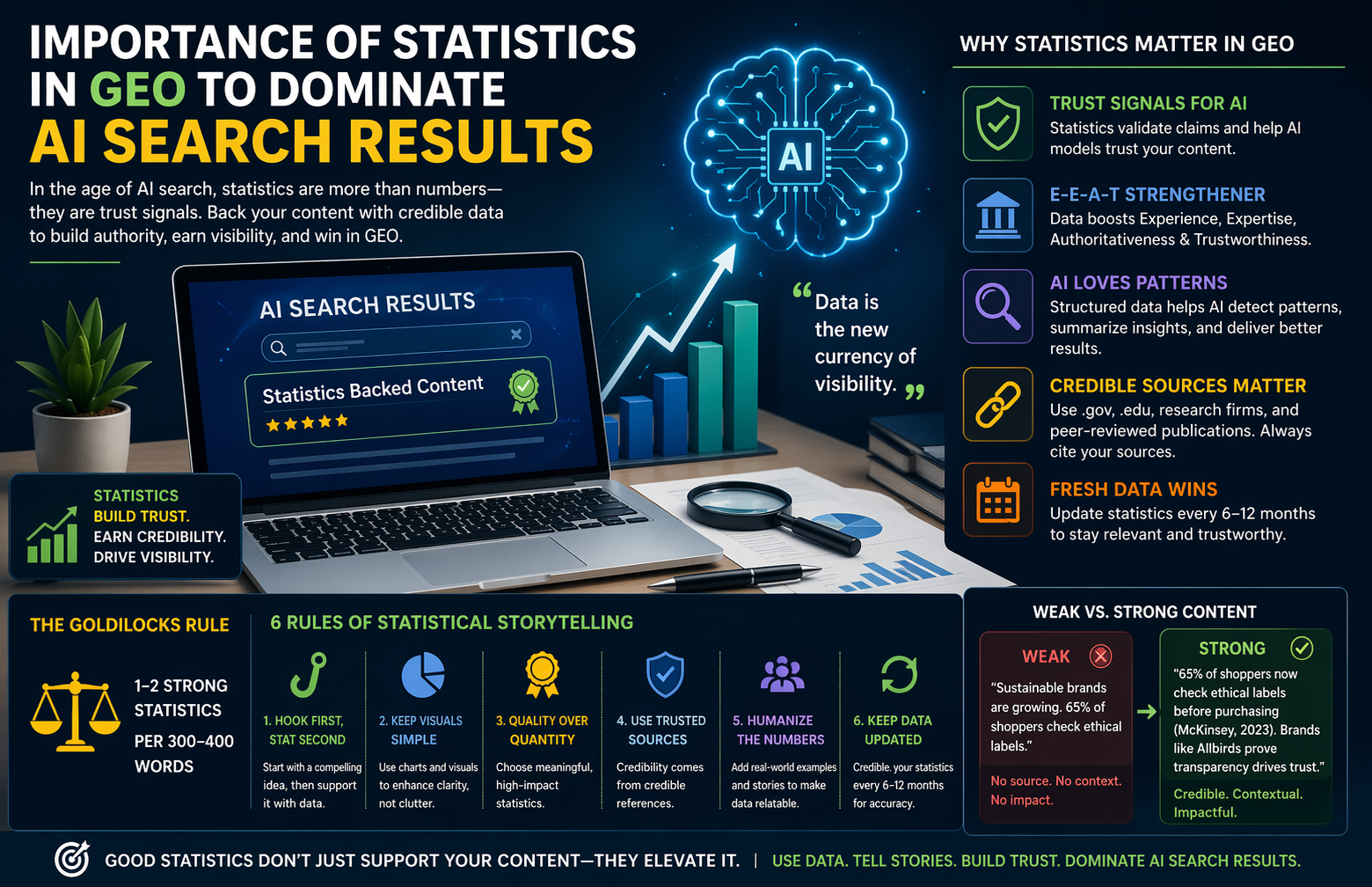
In the rapidly evolving world of search, the rules have changed. Traditional SEO tactics—keywords, backlinks, and metadata—are no longer enough to guarantee visibility. Today, Generative Engine Optimization (GEO) is redefining how content is ranked, discovered, and trusted by AI systems like ChatGPT, Google’s AI Overviews, and other large language models (LLMs).
At the core of this transformation lies a powerful principle:
👉 Statistics are no longer optional—they are essential.
If you want to dominate AI search results, you must understand how to use statistics strategically to build trust, authority, and relevance.
The Shift from SEO to GEO
Search engines are no longer just indexing pages—they are understanding content.
Unlike traditional search, generative AI:
- Interprets meaning instead of matching keywords
- Synthesizes information from multiple sources
- Prioritizes credibility and factual accuracy
This shift means your content is now evaluated not just by algorithms, but by AI models trained to detect trust signals. And one of the strongest signals? Data-backed insights.
Why Statistics Matter in AI Search
Statistics act as proof.
When AI systems analyze content, they look for signals that indicate:
- Reliability
- Authority
- Verifiability
A vague statement like “AI improves marketing” carries little weight. But a data-backed claim such as “AI-powered personalization increases engagement by 30%” instantly becomes more credible and useful.
Statistics help AI models:
- Validate claims
- Compare information across sources
- Identify high-quality content
- Deliver more accurate responses
In short, statistics transform your content from opinion to evidence.
Statistics as Trust Signals
One of the most important roles of statistics in GEO is their ability to act as trust signals.
AI systems prioritize content that demonstrates:
- Accuracy
- Depth
- Authority
When your content includes relevant, well-sourced statistics, it signals to AI that:
👉 “This content is reliable and worth showing to users.”
This directly impacts your visibility in AI-generated responses.
The Role of E-E-A-T in GEO
Generative AI evaluates content using the framework of E-E-A-T:
- Experience
- Expertise
- Authoritativeness
- Trustworthiness
Statistics strengthen all four pillars.
Experience
Real-world data reflects practical knowledge.
Expertise
Using accurate statistics shows subject mastery.
Authoritativeness
Referencing trusted sources builds authority.
Trustworthiness
Verified data increases confidence in your content.
Without statistics, it becomes much harder to meet these standards.
Why Generative Engines Crave Data
Large Language Models (LLMs) are built to process massive amounts of data and identify patterns. Statistics are inherently structured, making them ideal for AI systems.
Here’s why they matter:
1. Pattern Recognition
Statistics help AI detect trends and relationships.
2. Credibility Signals
Data-backed claims are more likely to be trusted.
3. Better Summaries
AI uses statistics to generate concise, meaningful insights.
4. Ranking Advantage
Content with credible data is more likely to be surfaced in AI responses.
In essence, statistics make your content AI-friendly.
The Importance of Credible Sources
Not all statistics are equal.
AI doesn’t just analyze numbers—it evaluates their source. Data from credible institutions carries significantly more weight than unsupported claims.
Trusted sources include:
- Government websites (.gov)
- Educational institutions (.edu)
- Research firms (e.g., Statista, Nielsen)
- Academic journals
When your statistics come from reputable sources, your content becomes:
- More trustworthy
- More authoritative
- More likely to be cited by AI
Always link back to original sources whenever possible. Transparency is key.
Weak vs. Strong Statistical Content
Let’s look at how statistics can be used effectively.
Weak Example
“Sustainable brands are growing. 65% of shoppers check ethical labels.”
This statement:
- Lacks context
- Has no source
- Feels incomplete
Strong Example
“Fast fashion’s environmental impact is driving change—65% of shoppers now actively check ethical labels before purchasing (McKinsey, 2023). Brands like Allbirds are reinforcing this shift by embedding sustainability into their storytelling.”
This version:
- Provides a credible source
- Adds context
- Includes real-world relevance
- Strengthens the narrative
The difference is clear: data alone isn’t enough—context matters.
Improving Engagement with Statistics
Statistics don’t just improve rankings—they enhance user engagement.
When readers encounter credible data:
- They stay longer on your page
- They trust your content more
- They are more likely to take action
This increased engagement sends positive signals to AI systems, reinforcing your content’s value.
The Goldilocks Rule: Finding the Right Balance
Using statistics effectively is about balance.
Too few statistics:
- Make your content feel weak
Too many statistics:
- Overwhelm readers
- Reduce clarity
The ideal approach?
👉 Use 1–2 strong statistics per 300–400 words
Focus on:
- Relevance
- Accuracy
- Clarity
A single powerful statistic can outperform multiple weak ones.
The Art of Statistical Storytelling
To truly dominate AI search results, you need to go beyond numbers—you need to tell a story.
Here are six essential rules:
1. Hook First, Stat Second
Start with a compelling idea, then support it with data.
2. Keep Visuals Simple
Use charts and visuals wisely—avoid clutter.
3. Prioritize Quality
Choose meaningful, high-impact statistics.
4. Source Like a Pro
Use credible, verifiable sources.
5. Humanize the Numbers
Add real-world examples or case studies.
6. Keep Data Fresh
Update statistics regularly.
Humanizing Data for Better Impact
Numbers alone can feel impersonal.
To make your content more engaging:
- Add real-life examples
- Include case studies
- Use relatable scenarios
For instance, instead of saying “70% of startups fail,” you could describe a founder’s journey. This makes the statistic more memorable and impactful.
The Importance of Fresh Data
Outdated statistics can harm your credibility.
AI systems prioritize recent and relevant data, so keeping your content updated is essential.
Best Practice:
👉 Refresh your statistics every 6–12 months
Fresh data ensures:
- Continued relevance
- Higher trust
- Better performance in AI search
GEO as a Competitive Advantage
Generative Engine Optimization is not just a trend—it’s the future.
Businesses that embrace GEO will:
- Gain higher visibility in AI-driven search
- Build stronger authority
- Stay ahead of competitors
Statistics are a key component of this strategy. They help your content stand out in an increasingly data-driven environment.
Final Takeaways
To dominate AI search results using statistics, remember:
- Statistics build trust and credibility
- AI prioritizes verifiable data
- Credible sources are essential
- Balance quantity with quality
- Storytelling enhances impact
- Fresh data maintains relevance
Conclusion: Data Is the New Currency of Visibility
We are entering a new era where AI decides what content gets seen and trusted.
In this environment:
- Opinions are not enough
- Claims require proof
- Trust determines visibility
Statistics bridge the gap between information and authority.
When used correctly, they don’t just support your content—they elevate it.
So before you publish your next piece, ask yourself:
👉 Is this backed by credible data?
👉 Are my sources trustworthy?
👉 Does this statistic add real value?
Because in the age of GEO, data isn’t just important—it’s your competitive edge.
Nach Verein filtern
Read More
Coagulation analyzers have become essential diagnostic instruments in modern healthcare laboratories due to the increasing prevalence of blood clotting disorders and the growing demand for accurate hemostasis testing. These analyzers are widely used in hospitals, diagnostic laboratories, and research facilities to evaluate blood coagulation function, monitor anticoagulant therapies, and...

Montessori Teacher Training in Padappai – Your Complete Guide to a Rewarding Teaching Career If you are passionate about shaping young minds and building a meaningful career in early childhood education, enrolling in Montessori teacher training in Padappai can be your perfect starting point. With growing demand for qualified Montessori educators, now is the ideal time to...

Weiss Watches: Luxury watches continue to attract collectors and style enthusiasts around the world, and Weiss has become one of the standout names in independent watchmaking. Known for exceptional craftsmanship, mechanical precision, and minimalist styling, Weiss Watches represent a fresh approach to luxury timepieces. Unlike mass-produced fashion watches, Weiss focuses on...

Infertility affects many couples, and can be emotionally and physically stressful to start a family. Fortunately, technology has improved in the field of fertility and couples who are unable to conceive can find hope through the technology of today. When looking for the Best IVF Centre Ghaziabad, it is crucial to find a reputable fertility clinic that has cutting-edge technology, skilled...

YouTube is one of the top platforms for music, podcasts, lectures, and video content. While streaming online is convenient, it often uses a lot of data and requires a stable internet connection. A YouTube to MP3 converter provides a simple solution, allowing users to extract audio from videos and save it as MP3 files. Tools like YTMP3 make this process fast, secure, and easy for anyone to use...
