Hydroprocessed Esters and Fatty Acids (HEFA) Market to Reach USD 70.4 Billion by 2034 at 16.0% CAGR Driven by Rising Air Traffic, Sustainable Aviation Fuel Demand, and Global Climate Initiatives
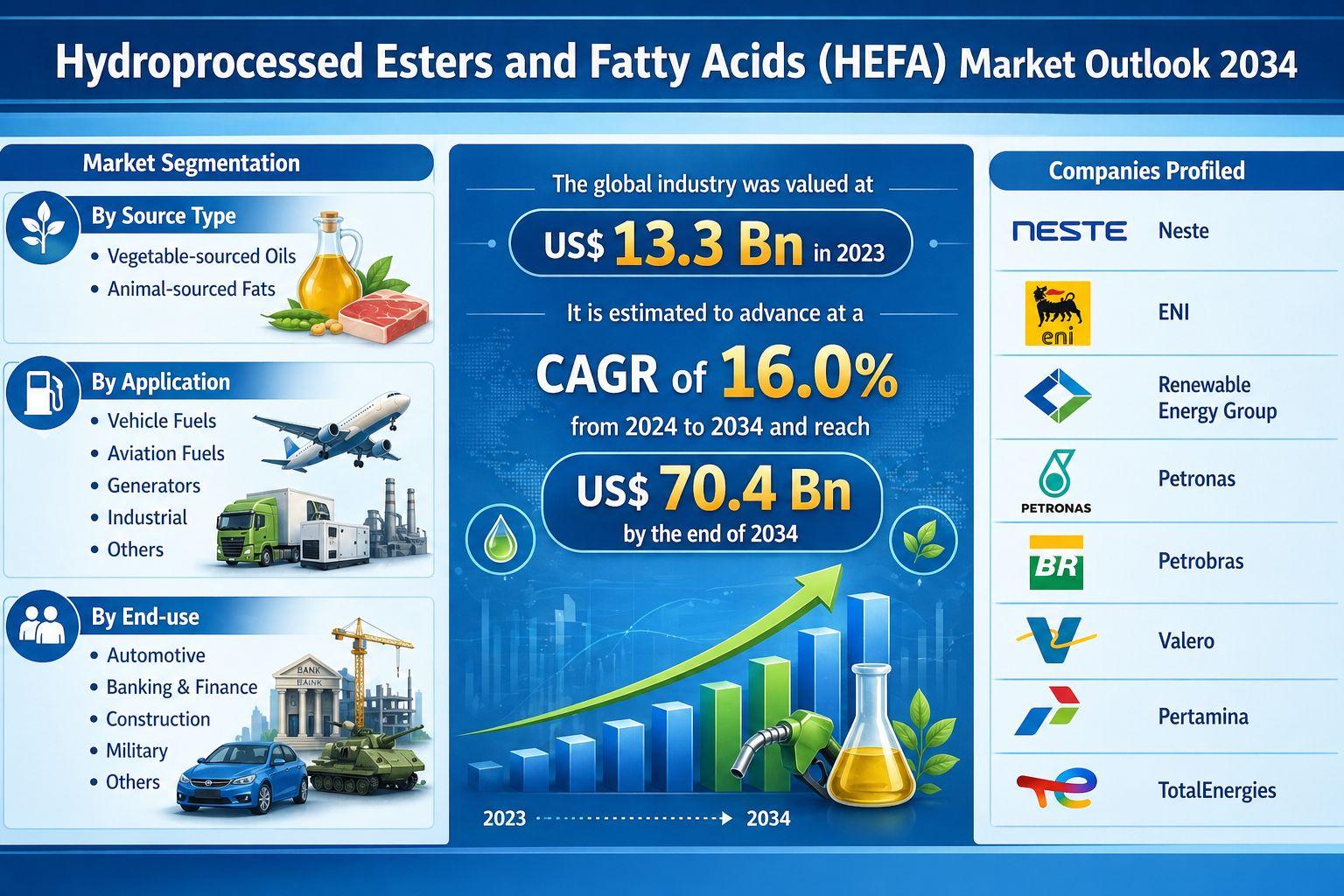
The global Hydroprocessed Esters and Fatty Acids (HEFA) market is emerging as one of the fastest-growing segments within the renewable energy and sustainable fuels industry. Valued at US$ 13.3 billion in 2023, the market is projected to witness remarkable expansion at a CAGR of 16.0% from 2024 to 2034, reaching an estimated US$ 70.4 billion by the end of the forecast period. This exponential growth trajectory reflects the increasing global shift toward low-carbon fuels, rising environmental concerns, and the rapid expansion of the aviation sector.
Analyst Viewpoint
The HEFA market is gaining strong momentum due to the rising demand for Sustainable Aviation Fuel (SAF), driven primarily by increased global air traffic and stringent environmental regulations. Governments and aviation authorities worldwide are implementing biofuel mandates to reduce carbon emissions, positioning HEFA as a key solution due to its compatibility with existing infrastructure and engines.
Unlike traditional biofuels, HEFA fuels are nearly indistinguishable from petroleum-based fuels, making them a seamless alternative. Their ability to significantly reduce greenhouse gas emissions while maintaining performance standards is accelerating their adoption across industries, particularly aviation. Additionally, advancements in feedstock processing and refining technologies are further enhancing production efficiency and scalability.
Market Introduction
Hydroprocessed esters and fatty acids (HEFA) are renewable diesel fuels derived from vegetable oils, animal fats, and other lipid-based feedstocks. Through a hydroprocessing technique, these raw materials are converted into high-quality hydrocarbons suitable for use in transportation and industrial applications.
HEFA fuels are widely utilized in:
- Aviation fuels (Sustainable Aviation Fuel – SAF)
- Vehicle fuels (renewable diesel)
- Power generators
- Industrial energy applications
Among these, aviation fuel represents the most significant application segment due to the urgent need to decarbonize the aviation industry. HEFA-based jet fuels closely mimic the chemical composition and performance of conventional jet fuels, making them a leading alternative in the transition toward greener aviation.
Key Market Drivers
Rise in Air Traffic Driving Market Growth
The steady increase in global air traffic is one of the most critical drivers of the HEFA market. According to the International Air Transport Association, global air traffic grew significantly in 2023, with a 36.9% increase in revenue passenger kilometers (RPKs) compared to the previous year.
This surge has intensified the demand for cleaner aviation fuels. HEFA-based Sustainable Aviation Fuel (SAF), particularly HEFA-SPK (Synthetic Paraffinic Kerosene), plays a crucial role in meeting this demand. The HEFA process converts fatty acids and esters into hydrocarbons that can be directly used in aircraft engines.
The aviation sector is under mounting pressure to reduce its environmental footprint, making SAF adoption not just an option but a necessity. As airlines expand operations and passenger volumes increase, the demand for HEFA fuels is expected to rise proportionately.
Increasing Focus on Climate Change and Emission Reduction
Global efforts to combat climate change are significantly boosting the HEFA market. According to the International Energy Agency, aviation contributed approximately 2% of global energy-related CO2 emissions in 2022. While this percentage may appear modest, emissions from aviation are growing faster than those from other transportation sectors.
Governments across the globe are introducing policies and incentives to promote biofuels as part of their decarbonization strategies. HEFA fuels, due to their lifecycle emission reduction capabilities, are gaining strong policy support.
Biofuels derived from HEFA are aligned with the natural carbon cycle, enabling substantial reductions in net carbon emissions. This makes them a preferred choice for achieving sustainability targets in both developed and emerging economies.
Emerging Market Trends
Advancements in Feedstock Utilization
Key players in the HEFA market are actively exploring diverse feedstocks such as:
- Vegetable oils (soybean, palm, rapeseed)
- Animal fats
- Waste oils and greases
- Microbial and algal lipids
The use of renewable and waste-based feedstocks not only improves sustainability but also reduces dependency on traditional agricultural resources.
Investment in Alternative Fuel Technologies
The industry is also witnessing increased investment in alternative fuel production methods, including Fischer-Tropsch (FT) technology. FT-based Synthetic Paraffinic Kerosene (SPK) offers another pathway for producing SAF with reduced lifecycle emissions.
These technological advancements are expected to complement HEFA production, creating a diversified and resilient biofuel ecosystem.
Regional Outlook
Asia Pacific Leading the Global Market
Asia Pacific dominated the global HEFA market in 2023 and is expected to maintain its leadership position throughout the forecast period. The region’s growth is driven by strong government initiatives, rising energy demand, and increasing investments in biofuel infrastructure.
Countries like India, China, and Malaysia are actively promoting biofuel adoption:
- India’s National Policy on Biofuels targets 20% ethanol blending and 5% biodiesel blending by 2030.
- Malaysia is expanding its biodiesel production capacity, with output expected to reach 1.8 million metric tons in 2024.
These initiatives are significantly boosting the demand for HEFA fuels in the region.
Other Key Regions
- North America: Strong regulatory framework and early adoption of SAF
- Europe: Aggressive climate policies and carbon neutrality goals
- Middle East & Africa: Growing investments in renewable energy diversification
- Latin America: Increasing use of bio-based fuels in transportation
Market Segmentation
By Source Type
- Vegetable-sourced oils
- Animal-sourced fats
By Application
- Vehicle fuels
- Aviation fuels
- Generators
- Industrial applications
By End-use Industry
- Automotive
- Construction
- Military
- Banking & Finance (energy consumption perspective)
- Others
Among these, aviation fuels remain the dominant segment due to global decarbonization efforts in the airline industry.
Competitive Landscape and Key Players
The global HEFA market is highly competitive, with major players focusing on feedstock optimization, production scalability, and strategic partnerships. Leading companies are investing heavily in research and development to enhance fuel efficiency and reduce production costs.
Key players include:
- Neste
- ENI
- Renewable Energy Group
- Petronas
- Petrobras
- Valero
- Pertamina
- TotalEnergies
These companies are focusing on expanding their renewable fuel portfolios and strengthening their global presence through partnerships and acquisitions.
Key Developments
Recent industry developments highlight the growing commercialization of HEFA-based fuels:
- In May 2024, Neste partnered with Singapore Airlines to supply 1,000 tons of sustainable aviation fuel, meeting ASTM standards for jet fuel quality.
- In 2023, Idemitsu Kosan and LOPS Corp. initiated a joint study to secure feedstock supply for SAF production.
These collaborations underscore the increasing industry focus on scaling production and ensuring supply chain stability.
Future Outlook
The future of the HEFA market looks highly promising, driven by the convergence of environmental regulations, technological innovation, and growing energy demand. As countries intensify their efforts to achieve net-zero emissions, HEFA fuels are expected to play a pivotal role in the global energy transition.
The aviation industry, in particular, will remain a key growth engine, with airlines increasingly adopting SAF to meet sustainability goals. Furthermore, advancements in feedstock processing and fuel conversion technologies will continue to reduce costs and improve efficiency.
Conclusion
The Hydroprocessed Esters and Fatty Acids (HEFA) market is set for transformative growth over the next decade. With a projected valuation of US$ 70.4 billion by 2034, the market reflects a strong shift toward sustainable and renewable energy solutions.
Driven by rising air traffic, increasing climate awareness, and supportive government policies, HEFA fuels are rapidly becoming a cornerstone of the global biofuel landscape. As technological advancements and strategic collaborations continue to shape the industry, HEFA is poised to redefine the future of clean energy, particularly in aviation and transportation sectors.
Categories
Read More
IPL 2026 is upon us, and cricket fans across India are in a frenzy! Every game feels like an event—starting with the Mumbai Indians facing CSK to Virat Kohli breaking boundaries at Chinnaswamy. However, if you're looking to make the sport more thrilling, betting on live games has become popular. The first thing to do? finding the Online Cricket ID WhatsApp Number in a...

Gaur City, with its state-of-the-art structures and lively life, has a bright future for luxury companionship services. If you want to have a great time with a professional and charming person, then call girls in Gaur City are the best option. These offer a perfect blend of secrecy, elegance, and personalization, thus giving the...

A new growth forecast report titled Nutraceutical Excipients Market Share, Size, Trends, Industry Analysis Report, By Form (Dry and Liquid); By Type; By Application; By End-Use; By Region; Segment Forecast, 2024- 2032 introduced by Polaris Market Research represents conclusive data on the overall market. It majorly targets to provide a detailed analysis of growth factors, challenges,...

Nel cuore di Pordenone, Yoga Plus è più di uno studio: è uno spazio dedicato alla cura di sé e alla consapevolezza del corpo e della mente. Sotto la guida esperta di Elena Pinna, insegnante certificata di Yoga, istruttrice di Postural Training e Performance Coach, le lezioni diventano un viaggio verso l’equilibrio interiore e il benessere profondo....

Thread cutting uses CNC machines and threading inserts to make accurate internal and external threads with correct shape, pitch, smooth finish, and long tool life What Is a Threading Insert? A threading insert is a small cutting tool used to make threads on metal parts during machining. It is fitted into a tool holder and used on lathes or CNC machines to cut internal or external threads with...