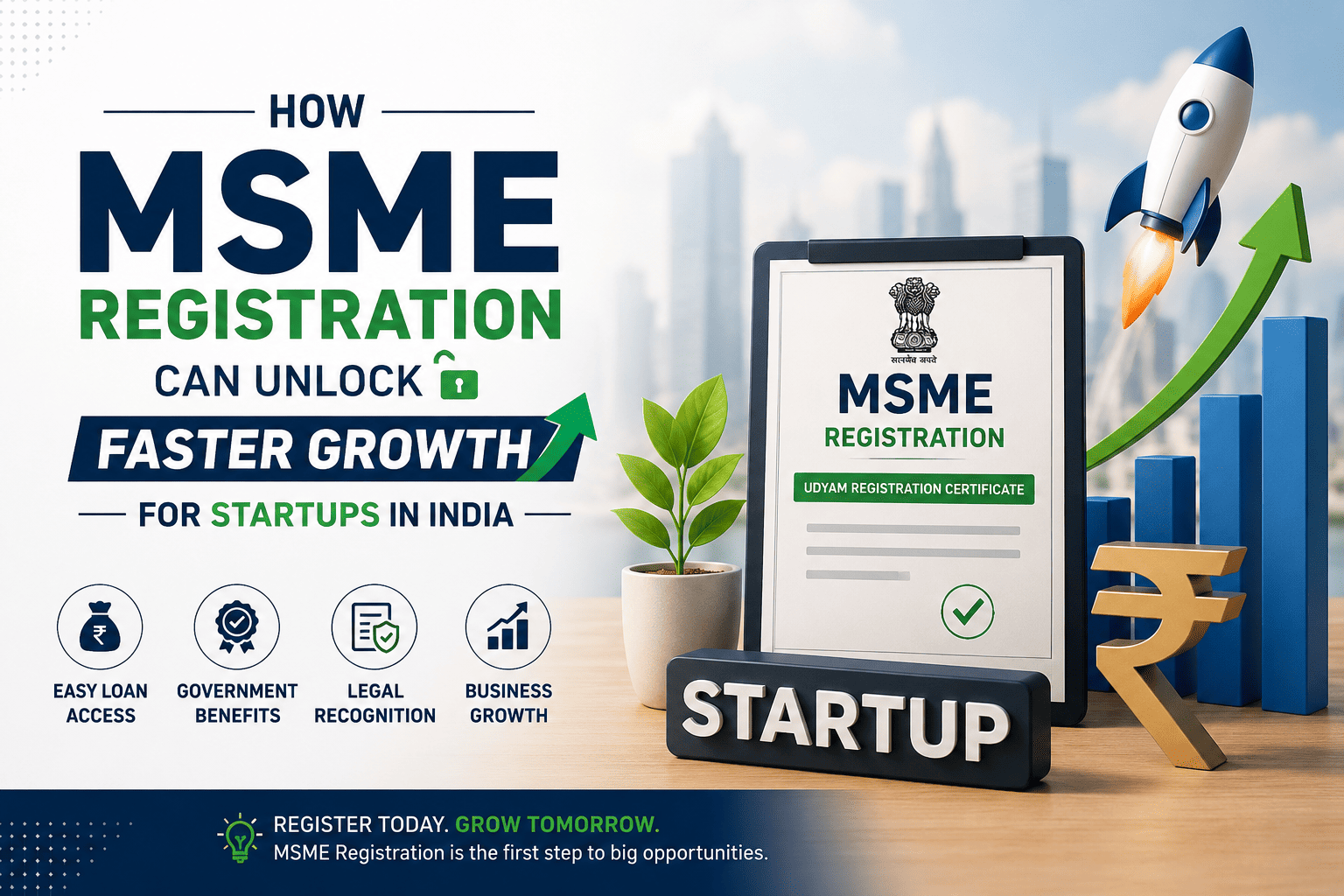
How MSME Registration Can Unlock Faster Growth for Startups in India
You make the best biryani in your locality. Your pickles sell out at every neighbourhood fair. Your cloud kitchen is quietly growing a loyal base. But somewhere between taking orders on WhatsApp and actually running a business, there's a gap, and that gap is formalisation.
Thousands of small food entrepreneurs in India operate in this grey zone: real businesses, real customers, real income, but no official recognition. That changes the moment you complete your Udyam Registration online. It is one of the most underused yet powerful steps a food business owner can take, and this guide breaks it all down in plain language.
What Is Udyam Registration, and Why Does It Matter for Food Businesses?
Udyam Registration is the Government of India's official mechanism for recognising Micro, Small, and Medium Enterprises (MSMEs). Launched in July 2020 by the Ministry of MSME to replace the older Udyog Aadhaar system, it gives your business a unique identity under the MSMED Act, 2006.
In practical terms, it tells banks, government bodies, and large buyers that your food business is real, verified, and eligible for support.
For food entrepreneurs specifically, whether you run a home bakery, a spice processing unit, a tiffin service, or a packaged snack brand, Udyam Registration is the formal entry point into India's MSME ecosystem. And that ecosystem comes loaded with financial, legal, and market benefits that most small operators simply don't know they're leaving on the table.
As of July 2024, over 4.77 crore MSMEs have registered on the platform. The food and food-processing sector represents one of the largest segments within this base, and there's still significant room for informal operators to join.
The 2025 Classification Update
One of the most important recent developments is the revised MSME classification criteria that came into effect on April 1, 2025, following a government notification issued on March 21, 2025.
Here's the updated breakdown:
|
Category |
Investment Limit |
Annual Turnover Limit |
|
Micro Enterprise |
Up to ₹2.5 crore |
Up to ₹10 crore |
|
Small Enterprise |
Up to ₹25 crore |
Up to ₹100 crore |
|
Medium Enterprise |
Up to ₹125 crore |
Up to ₹500 crore |
Previously, a micro enterprise was capped at ₹1 crore in investment and ₹5 crore in turnover. The revised thresholds, 2.5x the investment limit and 2x the turnover limit, mean that significantly more food businesses now qualify for MSME status without the fear of being reclassified the moment they start growing.
This is a critical change for food entrepreneurs on a growth path. Under the old framework, success could actually hurt you by pushing you out of MSME benefits. The new limits are designed to grow with your business.
5 Concrete Benefits of Having an MSME Registration Certificate
An MSME Registration Certificate (also called the Udyam Certificate) is more than a piece of paper. Here's what it unlocks:
1. Easier Access to Business Loans Banks and NBFCs treat registered MSMEs as priority sector borrowers. The credit guarantee cover for micro and small enterprises was increased from ₹5 crore to ₹10 crore in the Union Budget 2025, enabling an additional ₹1.5 lakh crore in credit over five years. For a food entrepreneur looking to buy industrial equipment, refrigeration units, or packaging machinery, this matters enormously.
2. A Customised Credit Card for Micro Enterprises A new MSME Credit Card scheme launched through the Union Budget 2025 provides ₹5 lakh in credit to micro enterprises registered on the Udyam portal, with 10 lakh cards planned in the first year. This is instant working capital for a registered food business.
3. Legal Protection Against Delayed Payments One of the most real and often overlooked benefits: registered MSMEs are protected under the MSMED Act against buyers who delay payments. If a hotel chain, supermarket, or distributor delays payment to your food business beyond the legally prescribed period, you have a formal channel for redressal, MSME Samadhaan, that unregistered businesses simply cannot access.
4. Priority in Government Procurement Government canteens, defence establishments, state-run hospitality units, and public procurement portals give preferential treatment to MSME-registered suppliers. If you produce packaged foods, condiments, or ready meals, this opens up a procurement channel that most competitors never even enter.
5. Subsidies and Scheme Eligibility From the PM Employment Generation Programme (PMEGP) to the Credit Linked Capital Subsidy Scheme (CLCSS) and state-level food processing grants, nearly every government subsidy for food businesses requires Udyam registration as a baseline eligibility criterion.
What Is a Udyam Registration Number?
When you complete your registration, the government assigns your business a permanent Udyam Registration Number (URN), a unique 16-digit alphanumeric identifier. This number is printed on your Udyam Registration Certificate alongside a QR code.
Your URN is your business's identity in the MSME ecosystem. It is:
-
Referenced in loan applications to claim priority sector benefits
-
Required when applying for government tenders or procurement listings
-
Used to verify your business status with buyers, suppliers, and financial institutions
-
Linked permanently to your PAN and Aadhaar for cross-verification
Unlike older registration systems that involved physical paperwork, the URN is generated instantly upon successful submission, no waiting, no manual processing.
How to Complete Udyam Registration Online
The entire process is free of cost, paperless, and self-declaration-based; no documents need to be uploaded. Here's exactly how to do it:
Step 1 — Visit the Official Portal. Go to udyamregistration.gov.in — this is the only official government portal. Avoid third-party agents who charge fees for a process that is entirely free.
Step 2 — Enter Your Aadhaar Details. For a proprietorship firm, the Aadhaar of the proprietor is required. For a partnership, the managing partner's Aadhaar is needed. For companies, LLPs, and trusts, the authorised signatory's Aadhaar, along with PAN and GSTIN, is required.
Step 3 — Fill In Business Details You'll be asked to provide your business name, type of organisation, PAN, GSTIN (if applicable), business address, date of commencement, bank account details, and the primary activity (manufacturing or service).
Step 4 — Select Your NIC Code: Choose the correct National Industrial Classification (NIC) code that best describes your food business activity. For example, food product manufacturing, bakeries, spice processing, and beverage production each have distinct NIC codes. Choosing the wrong code can affect subsidy eligibility, so look this up carefully.
Step 5 — Submit and Download Review all details, submit the application, and receive your Udyam Registration Number instantly. Download your digitally signed MSME Registration Certificate from the portal.
The entire process can be completed in under 30 minutes if you have your Aadhaar, PAN, and basic business information ready.
Common Mistakes Food Entrepreneurs Should Avoid
Using incorrect turnover figures: Always use your GST returns or audited financials as the basis for declaring turnover. Incorrect figures can lead to penalties under the MSMED Act.
Wrong Aadhaar linkage: The Aadhaar used must belong to the authorised signatory. Mismatched details will cause your application to be rejected.
Registering multiple times: One business entity can hold only one Udyam Registration. Duplicate entries are flagged by the system.
Skipping GSTIN integration: If your food business is GST-registered, link your GSTIN during registration. The system cross-checks turnover data automatically.
Paying an agent: The registration is free. Anyone asking you to pay for Udyam registration is charging for something the government provides at no cost.
From Home Kitchen to Scaling Brand
Here's what formalisation actually looks like in practice for a food entrepreneur:
A home baker in Lucknow selling customised cakes earns ₹8–12 lakh per year. She registers on Udyam as a micro enterprise (well within the ₹10 crore turnover limit). With her MSME Registration Certificate, she approaches a regional bank for a ₹5 lakh equipment loan under a credit guarantee scheme. She gets the loan at a subsidised rate, buys a commercial oven and packaging equipment, and starts supplying to a corporate gifting company. Within 18 months, her revenue crosses ₹25 lakh.
None of that second chapter happens without the first step: getting the Udyam certificate and entering the formal economy.
Frequently Asked Questions (FAQ'S)
1) What is the 12-digit Udyam Registration number?
The Udyam Registration Number (URN) is a unique permanent identifier assigned to your business upon successful MSME registration. It appears on your Udyam Certificate with a QR code and is used for loan applications, government tenders, and business verification.
2) How do I find my Udyam number?
Visit udyamregistration.gov.in, click "Print/Verify," and enter your registered mobile number or Aadhaar to retrieve your URN instantly.
3) Can we download an MSME certificate?
Yes. Log in to udyamregistration.gov.in, navigate to "Print/Verify Udyam Certificate," enter your URN and OTP, and download your digitally signed certificate for free.
4) How to get a UAM number?
UAM (Udyog Aadhaar Memorandum) is the older system, now replaced by Udyam Registration. New registrations are done exclusively at udyamregistration.gov.in. Existing UAM holders should migrate to Udyam to retain MSME benefits.
5) What is NIC code 71200?
NIC code 71200 falls under "Technical Testing and Analysis" covering laboratories that test food safety, materials, and product quality. Food businesses using certified testing labs often reference this code for compliance and quality assurance purposes.
Conclusion
Many small food business owners see registration as paperwork. In reality, it is the single most leveraged action available to you as an entrepreneur. Your Udyam Registration Number is not just a compliance checkbox; it is your access key to credit, protection, procurement, and subsidies that larger businesses have always enjoyed.
Catégories
Lire la suite
Polaris Market Research has introduced a new market research report entitled Crypto ATM Market Share, Size, Trends, Industry Analysis Report, By Type (One Way, Two Way); By Offering; By Type of Coin; By Region; Segment Forecast, 2023- 2032, which acts as a reliable resource for analyzing historic and forecast measures, development structure, and key dynamics and their impact. The report is...

Fashion is constantly evolving, but some wardrobe essentials remain timeless while adapting to modern trends. One standout piece that has become a favorite across Canada is the Essentials hoodie. Known for its premium comfort, minimalist design, and effortless versatility, the Essentials hoodie has transformed from a simple casual garment into a streetwear icon. Whether you're walking through...

fly88.com is revolutionizing online entertainment. Launched in 2025, this next-generation platform offers a modern and dynamic betting space that caters to all types of players. With hundreds of exciting games, advanced technology, and smooth performance across devices, FLY88 provides an unmatched gaming experience. Whether you are a fan of sports betting, eSports, fish shooting games, Sic...
How Does a Makeup Primer Factory Handle Large Wholesale Orders? The cosmetic industry continues to develop as beauty brands expand their product collections and reach customers in different markets. Handling large wholesale orders requires strong production ability, careful planning, and professional management. A reliable Makeup Primer Factory needs to coordinate materials, manufacturing...
The global solid control equipment market is witnessing sustained expansion driven by growing oil and gas exploration and production activity, tightening environmental regulations on drilling waste management, and accelerating adoption of advanced separation and fluid recovery technologies across onshore and offshore drilling operations. The Insight Partners projects the market to register a...