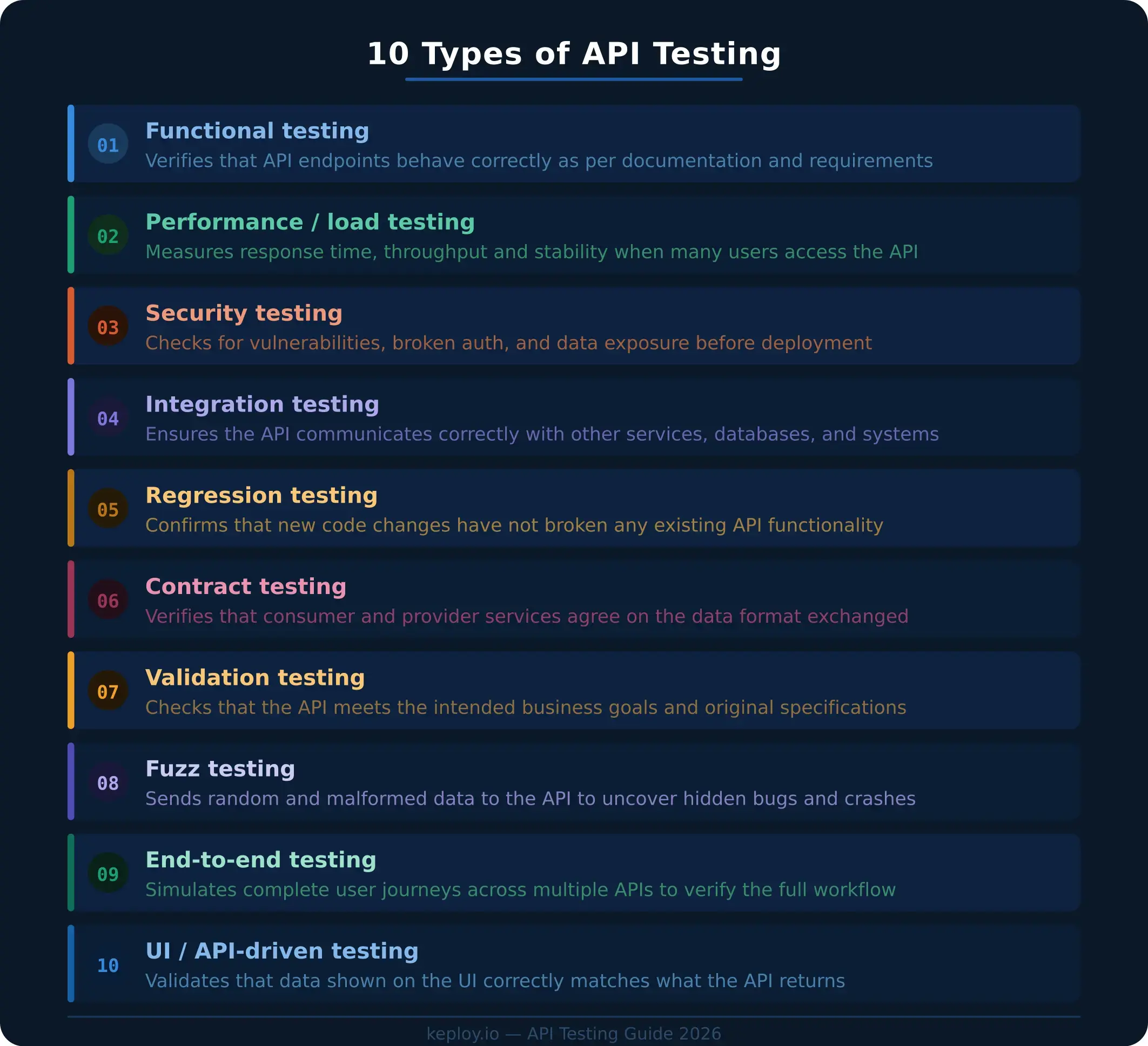
APIs have become the foundation of modern software development. From mobile apps and websites to cloud platforms and payment gateways, APIs enable different systems to communicate with each other seamlessly. As businesses increasingly rely on APIs, ensuring their performance, reliability, and security has become more important than ever. This is where different ">types of API testing play a crucial role.
API testing helps developers validate whether APIs function correctly, return accurate responses, handle traffic efficiently, and remain secure against vulnerabilities. Without proper testing, applications may experience crashes, slow performance, integration failures, or security breaches.
What is API Testing?
API testing is a software testing method that verifies the functionality, performance, reliability, and security of an Application Programming Interface (API). Instead of testing the graphical user interface, API testing focuses on the communication layer between systems.
It checks whether requests and responses work as expected, validates data formats, ensures proper authentication, and identifies issues before they reach production. API testing is widely used in modern development practices because APIs act as the bridge between frontend and backend systems.
Why API Testing is Important
API testing has become essential for modern applications due to the growing use of microservices, cloud computing, and third-party integrations. A small issue in an API can affect the entire application experience.
Some major benefits of API testing include:
- Faster detection of bugs and integration issues
- Improved software quality and reliability
- Better application security
- Enhanced performance under heavy traffic
- Reduced production failures and downtime
- Faster software releases through automation
Testing APIs early in the development cycle saves both time and development costs while ensuring stable application performance.
Major Types of API Testing
1. Functional Testing
Functional testing verifies whether the API performs according to business requirements. It checks if endpoints return the correct data and responses for different requests.
This type of testing validates:
- Request and response accuracy
- HTTP status codes
- Input and output handling
- Business logic implementation
For example, an e-commerce API should correctly return product details when users search for products.
2. Validation Testing
Validation testing ensures that the API behaves correctly and meets expected standards. It verifies whether the API is stable, reliable, and production-ready.
This testing focuses on:
- Correct data structure
- Proper response formatting
- Error handling mechanisms
- API behavior under different conditions
Validation testing helps identify inconsistencies before deployment.
3. Load Testing
Load testing measures how an API performs under expected user traffic. It checks whether the system can handle multiple requests simultaneously without performance degradation.
Key goals include:
- Measuring response time
- Monitoring server behavior
- Identifying performance bottlenecks
- Evaluating scalability
Load testing is important for applications expecting high user activity, such as e-commerce platforms during sales events.
4. Stress Testing
Stress testing pushes the API beyond normal traffic limits to determine its breaking point. It helps teams understand how the system behaves during extreme conditions.
This testing identifies:
- System recovery capability
- Failure handling
- Maximum traffic capacity
- Stability under pressure
Stress testing ensures that applications remain resilient during unexpected traffic spikes.
5. Security Testing
Security testing identifies vulnerabilities and ensures that APIs protect sensitive user data. Since APIs often handle authentication and financial transactions, security testing is critical.
This testing checks for:
- Authentication flaws
- Authorization issues
- Data encryption
- SQL injection vulnerabilities
- Token security
Strong API security prevents unauthorized access and cyberattacks.
6. Integration Testing
Integration testing verifies whether different services and systems communicate properly through APIs. Modern applications often depend on multiple APIs working together.
This testing ensures:
- Smooth data exchange
- Proper third-party integrations
- Service compatibility
- Workflow consistency
Integration testing is especially important in microservices architecture.
7. Performance Testing
Performance testing evaluates API speed, responsiveness, and stability under different conditions. Slow APIs can negatively impact user experience and business operations.
It helps measure:
- Response time
- Throughput
- Resource usage
- Server efficiency
Performance testing ensures that applications deliver a smooth experience even during peak usage.
8. Regression Testing
Regression testing ensures that newly added updates or code changes do not break existing API functionality. It helps maintain software stability during continuous development.
This testing is useful when:
- New features are added
- Bugs are fixed
- APIs are updated
- System configurations change
Automated regression testing helps development teams release updates with confidence.
Best Practices for API Testing
To achieve effective API testing, teams should follow some important best practices:
- Automate repetitive test cases whenever possible
- Validate both positive and negative scenarios
- Test APIs with real-world data conditions
- Monitor response times regularly
- Include security testing in every release cycle
- Maintain clear API documentation
- Use continuous testing in CI/CD pipelines
Following these practices improves software reliability and reduces testing effort.
Conclusion
API testing is a critical part of modern software development because APIs power communication between applications and services. Different types of API testing help ensure functionality, performance, scalability, and security across systems.
From functional and integration testing to security and load testing, each testing type plays a unique role in delivering reliable applications. As businesses continue adopting cloud-based and API-driven architectures, investing in proper API testing strategies becomes essential for maintaining high-quality software and seamless user experiences.