The Ultimate Buying Guide to Iced-Out Cartier Watches: Moissanite vs. Natural Diamonds
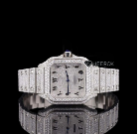
The "bust-down" watch market has evolved. While an iced-out timepiece remains the ultimate symbol of success, high fashion, and street culture, the way we achieve that iconic look has completely transformed.
For decades, natural factory or aftermarket diamonds were the only path to a flooded wrist. Today, advanced lab gemology has introduced a fierce competitor. If you are looking to invest in a striking custom piece, the decision inevitably comes down to two paths: a traditional natural diamond setup or a premium Heerok Moissanite Cartier Watch.
With over 15 years of expertise in creating bespoke jewelry and custom timepieces, Heerok has engineered a way to bring you absolute luxury without compromise. This comprehensive buying guide breaks down the physics, aesthetics, costs, and durability of both options to help you choose the perfect stone for your next custom timepiece.
1. What Are Diamond Studded Watches?
When we talk about high-end diamond studded watches, we are referring to timepieces where the original metal surface—the bezel, case, lugs, and bracelet—is meticulously drilled and set with hundreds of micro-pave gemstones.
Whether our master craftsmen at Heerok use a classic Cartier Santos, a refined Tank, or a bold Ballon Bleu as the base canvas, the goal is total light reflection. The quality of a custom iced-out watch relies on two core pillars:
● The Setting Integrity: How tightly and securely the stones are handset into the metal base by experienced jewelers.
● The Stone Selection: The optical properties of the gemstone chosen to deliver the "ice."
2. The Contenders: Moissanite vs. Natural Diamond
To the naked eye, a top-tier moissanite diamond watch from Heerok and a natural diamond watch are almost indistinguishable. However, under the surface, they are entirely different minerals with distinct physical behaviors.
Optical Performance: Fire & Brilliance
Natural diamonds possess a Refractive Index (RI) of 2.42. They reflect light in a classic, deep balance of white light (brilliance) and sharp colored flashes (scintillation).
Moissanite, on the other hand, has a higher Refractive Index at 2.65, paired with a massive dispersion rate (fire). In plain terms, moissanite bends light much more aggressively than a diamond. This gives a Moissanite Cartier Watch an intense "rainbow sparkle" effect, especially under direct sunlight or intense club lighting, making it a standout favorite for statement streetwear.
Hardness & Daily Wear Resistance
A luxury watch takes a beating through daily movement, friction against clothing, and accidental bumps.
Natural diamonds score a perfect 10 on the Mohs hardness scale. They are the hardest known material on earth and are virtually scratch-proof. Moissanite is a very close rival, scoring an exceptional 9.25 on the Mohs scale. It is harder than sapphires, rubies, and emeralds, meaning a Heerok custom creation will easily withstand everyday wrist wear without scratching, clouding, or dulling over time.
3. The Tech Factor: Do They Pass the Diamond Tester?
One of the biggest concerns for buyers entering the custom watch market is whether their timepiece will clear a standard jewelers' test pen.
The Thermal Reality: Standard diamond tester pens measure thermal conductivity (how heat moves through a stone). Because the premium-grade moissanite sourced by Heerok transfers heat at a rate incredibly close to a natural diamond, it will pass a basic thermal diamond tester.
If someone presses a standard tester to your moissanite diamond watch, the machine will light up and beep "Diamond." To reliably differentiate the two, a jeweler must use a dual-probe multi-tester that checks both thermal and electrical conductivity, or view the stone under a 10x magnification loupe to spot moissanite's signature double-refraction lines.
4. The Financial Verdict: Smart Luxury vs. Heritage Value
The defining factor for most collectors comes down to budget allocation.
Flooding a Cartier watch with aftermarket natural diamonds is incredibly expensive, often costing anywhere from $25,000 to over $60,000. Furthermore, modifying a factory watch with aftermarket diamonds generally voids the manufacturer's warranty and lowers the baseline resale value of the raw watch body.
Choosing a premium Moissanite Cartier Watch allows you to capture the exact weight, heavy wrist presence, and blinding aesthetic of a VVS diamond custom piece at a fraction of the cost—typically ranging between $1,500 and $4,500.
At Heerok, we believe luxury should be accessible. By choosing our lab-grown moissanite options, you are deploying capital intelligently into other assets while enjoying a flawlessly executed, head-turning piece of jewelry that is 100% ethically sourced and conflict-free. To make it even more seamless, our global service includes flexible EMI options, allowing you to fund your dream watch on your own terms.
Which One Should You Buy?
● Choose Natural Diamonds if: You are a purist collector, want to adhere strictly to heritage luxury traditions, and have an open-ended five-to-six-figure budget dedicated to fine jewelry.
● Choose Heerok Moissanite if: You love bold streetwear aesthetics, want maximum blinding flash under the lights, want a piece that passes basic tester checks, and prefer a smart financial move backed by our 15 years of bespoke craftsmanship and global shipping.
الأقسام
إقرأ المزيد
The Vigor Boost is an advanced natural supplement formulated to enhance energy levels, improve stamina, and support overall male performance. Powered by a premium blend of natural ingredients, it helps boost circulation, reduce fatigue, and promote long-lasting endurance so you can stay active, confident, and perform at your peak every day. Key Benefits of Vigor Boost ✅ Boosts natural...

Introduction: Unlocking the "Sugar Code"In the intricate world of biopharmaceuticals, a protein's destiny is often written in a subtle language of sugars. The glycans attached to therapeutic proteins are far more than mere decoration; they are fundamental molecular switches that directly command a drug's efficacy (e.g., antibody-dependent cellular cytotoxicity), safety (e.g., immunogenic...
"Executive Summary Pulse Oximeters Market Research: Share and Size Intelligence Data Bridge Market Research analyses that the pulse oximeters market, valued at USD 2.8 billion in 2022, will reach USD 4.74 billion by 2030, growing at a CAGR of 6.8% during the forecast period of 2023 to 2030The all-inclusive Pulse Oximeters Market report is the best to know the trends and opportunities...

"Deutsches Institut fur Normung Rail Power Supply Market Summary: According to the latest report published by Data Bridge Market Research, the Deutsches Institut fur Normung Rail Power Supply Market The global deutsches institut fur normung rail power supply market size was valued at USD 987.49 million in 2024 and is expected to reach USD 1310.43 million by...

Cricket is one of the most followed sports in the world, and for betting enthusiasts, it offers a wide range of opportunities across different formats like T20, ODI, and Test matches. Introduction Cricket is one of the most followed sports in the world, and for betting enthusiasts, it offers a wide range of opportunities across different formats like T20, ODI, and Test matches. Each format has...