


SaaS Meets Sustainability: How Companies Are Tackling ESG in the Digital Age
Introduction
In recent years, Environmental, Social, and Governance (ESG) considerations have moved from the sidelines to the center of business strategy. While ESG has traditionally been associated with manufacturing or energy-heavy industries, the software-as-a-service (SaaS) sector is increasingly recognizing its responsibility and opportunity in this space.
.png?table=block&id=3767be47-12eb-8086-a451-c130cdb39707&spaceId=e987be47-12eb-81cd-b1e2-0003b3c706a5&width=1410&userId=&cache=v2&imgBuildSrc=requestProxiedImageUrl)
SaaS companies operate largely in digital ecosystems, which may appear environmentally neutral at first glance. However, they are deeply connected to data centers, cloud infrastructure, and digital operations that consume significant energy. At the same time, SaaS is uniquely positioned to help organizations improve sustainability across industries.
Sustainability in SaaS is no longer just a moral choice—it is becoming a competitive advantage.
Why ESG Matters for SaaS Companies
SaaS businesses rely heavily on cloud computing, data centers, and digital tools. These systems require constant energy consumption to operate at scale. While SaaS reduces dependency on physical production and transportation, it still contributes to environmental impact through electricity usage, electronic waste, and office-related operations.
ESG in SaaS extends beyond environmental concerns. It includes:
- Environmental responsibility: Energy usage, carbon footprint, and resource efficiency
- Social responsibility: Employee well-being, diversity, inclusion, and community engagement
- Governance: Ethical decision-making, transparency, and compliance
Investors and customers are increasingly prioritizing ESG performance. Research indicates that companies with strong ESG practices often benefit from:
- Higher market valuations
- Improved customer loyalty
- Better employee engagement
For SaaS companies, ESG is also a way to differentiate in a highly competitive digital market and build long-term trust.
SaaS Innovations Driving Sustainability
SaaS companies are actively leveraging technology to improve sustainability outcomes. Several key innovations are driving ESG progress:
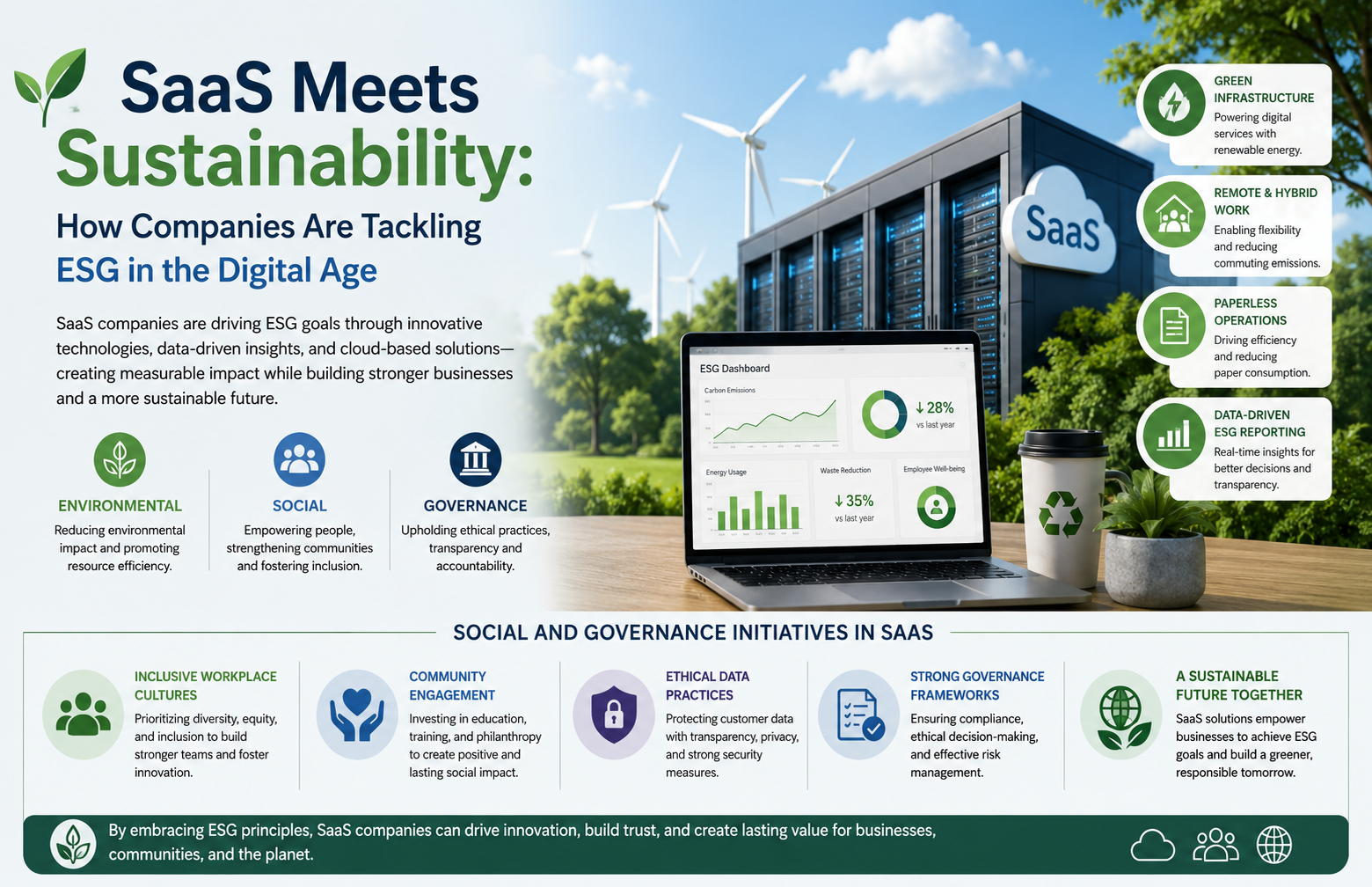
1. Energy-Efficient Infrastructure
Modern SaaS platforms increasingly rely on cloud providers that prioritize green data centers powered by renewable energy sources. In addition, companies are optimizing their software systems to reduce energy consumption.
Key practices include:
- Efficient coding techniques
- Server virtualization
- Intelligent workload management
- Optimized cloud usage
These improvements help reduce the overall carbon footprint of digital services.
2. Remote and Hybrid Work Models
SaaS companies are at the forefront of enabling remote and hybrid work environments. This shift significantly reduces commuting-related emissions and decreases reliance on physical office infrastructure.
The sustainability benefits include:
- Reduced transportation emissions
- Lower energy consumption in office spaces
- Fewer in-person meetings and travel requirements
- Reduced dependency on physical documentation
Remote work has become both a productivity and sustainability enabler.
3. Paperless Digital Processes
One of the most impactful ESG contributions of SaaS is the elimination of paper-based workflows. Cloud platforms enable fully digital operations through:
- E-signatures
- Online forms
- Automated approval systems
- Cloud document storage
These tools significantly reduce paper consumption and waste, making traditional manual processes nearly obsolete.
4. Data-Driven ESG Reporting
A unique advantage of SaaS lies in its ability to collect and analyze data at scale. This capability is now being used to support ESG tracking and reporting.
Companies can monitor:
- Energy consumption
- Waste reduction
- Employee well-being metrics
- Governance compliance
Real-time dashboards allow organizations to make informed sustainability decisions and improve transparency with stakeholders.
Social and Governance Practices in SaaS
ESG is not limited to environmental sustainability. SaaS companies are also focusing on social and governance improvements to build stronger, more responsible organizations.
Inclusive Work Culture
Many SaaS firms are prioritizing:
- Diversity in hiring
- Equity in leadership opportunities
- Inclusive workplace environments
This fosters stronger collaboration and innovation.
Community Engagement
SaaS companies are increasingly contributing to society through:
- Educational initiatives
- Technology training programs
- Philanthropic efforts
These efforts strengthen their connection with communities and support long-term social development.
Ethical Data Practices
Since SaaS platforms often handle sensitive user data, ethical responsibility is critical. Companies are focusing on:
- Data privacy protection
- Transparent data usage policies
- Strong cybersecurity measures
These practices help build trust with customers and stakeholders.
Strong Governance Policies
Governance plays a key role in ensuring accountability and long-term sustainability. SaaS companies are implementing:
- Internal control systems
- Ethical compliance frameworks
- Transparent decision-making structures
This improves organizational trust and operational stability.
Challenges and Opportunities in SaaS ESG Adoption
Despite progress, SaaS companies face several challenges in ESG implementation.
One major challenge is measurement complexity. Unlike manufacturing industries, SaaS operations are less physically visible, making it difficult to calculate exact environmental impact, especially in digital environments.
Other challenges include:
- Difficulty in tracking carbon savings accurately
- Lack of standardized ESG measurement frameworks
- Complexity in reporting digital sustainability metrics
However, these challenges also create significant opportunities.
By adopting ESG-focused strategies, SaaS companies can:
- Improve operational efficiency
- Reduce long-term costs
- Strengthen brand reputation
- Meet growing investor expectations
- Increase customer trust
Ultimately, ESG is becoming a business advantage rather than just a compliance requirement.
The Role of SaaS in Enabling Client Sustainability
Beyond improving their own ESG performance, SaaS companies also help their clients achieve sustainability goals.
Digital tools enable organizations to:
- Automate administrative processes
- Reduce paper usage
- Optimize office space utilization
- Improve operational efficiency
Every improvement in digital workflow contributes indirectly to reduced energy consumption and resource waste.
In this way, SaaS becomes a multiplier for sustainability—helping entire ecosystems operate more efficiently and responsibly.
Qudify’s Approach to ESG-Driven SaaS Solutions
Modern workplaces are increasingly looking for measurable sustainability outcomes, not just operational efficiency. SaaS platforms like Qudify address this need by integrating ESG visibility into everyday operations.
Qudify solutions such as:
- Visitor Management Systems
- Meeting Room Booking Tools
- Feedback and workplace management systems
help organizations track resource usage in real time.
These tools enable businesses to measure:
- Energy savings
- Paper reduction
- Operational efficiency improvements
By converting workplace activity into actionable insights, organizations can actively reduce waste and move toward a more sustainable future.
Conclusion
SaaS is no longer just a digital efficiency enabler—it is becoming a central force in global sustainability efforts. While the industry may not produce physical goods, its infrastructure, operations, and influence have a significant environmental and social footprint.
At the same time, SaaS companies are uniquely positioned to lead ESG innovation through cloud infrastructure, remote work models, digital workflows, and data-driven decision-making.
As ESG continues to shape global business priorities, SaaS companies that embrace sustainability will not only reduce their impact but also gain a clear competitive advantage in the digital economy.
Categorias
Leia Mais
Choosing the best water softener for rusty well water is an important step for homeowners who rely on private wells and want dependable, high-quality water throughout their homes. Rusty well water commonly contains naturally occurring minerals and iron that require a properly designed softening system to maintain consistent water quality. Many homeowners explore professional treatment solutions...

Airfreight Forwarding Market is influenced by changing customer expectations for faster and more transparent deliveries. Logistics providers are enhancing their services to meet evolving supply chain requirements. The airfreight forwarding market is projected to grow from US$ 35.22 Billion in 2025 to US$ 54.30 Billion by 2034, registering a CAGR of 4.5% during...

The SOCR Last Valor stands out as one of the top assault rifles in Once Human for everyday gameplay. Its remarkable adaptability allows it to excel across various activities and challenges. With the right configuration, this firearm transforms into a formidable force, especially in PvE scenarios. To obtain this powerful weapon, follow these steps and optimize your build for maximum...

Survival Instincts in PUBG Beyond its surface as a battle royale shooter, PUBG taps into a primal theater of survival. It crafts tense, unpredictable moments where every decision feels weighted with consequence. The game thrives on shared vulnerability, turning each match into a collective, nerve-wracking story. This creates a powerful bond between players and spectators alike, rooted in a raw,...
Custom Ball Valve Ball production requires careful consideration of material choices because different applications involve different working conditions. The selected material affects durability, compatibility, and overall application performance. Ballvalveballs provides customized solutions for customers who need components designed according to specific industrial requirements. In industrial...