Exploring the Role of Artificial Intelligence in Education and Learning
The role of Artificial Intelligence in education is no longer a distant concept from science fiction. It is happening right now, in classrooms, online learning platforms, and universities around the world. From AI tutors that give students instant feedback to tools that help teachers plan lessons in minutes, Artificial Intelligence is quietly becoming one of the most powerful forces reshaping how we teach and learn.
In 2026, students are using AI to get personalized study plans. Teachers are using it to identify which students need extra help before they fall behind. Schools are using it to make education more accessible for learners with disabilities. The transformation is real, and it is accelerating.
This article is your complete, beginner-friendly guide to understanding the role of Artificial Intelligence in modern education. Whether you are a student, educator, parent, or career switcher curious about EdTech, this guide will walk you through what AI actually does in learning environments, why it matters, and how you can build skills in this space.
What Is Artificial Intelligence?
Artificial Intelligence, or AI, is the ability of a computer or machine to perform tasks that normally require human thinking. These tasks include understanding language, recognizing patterns, making decisions, and learning from experience.
Think of AI as a very fast, tireless assistant that learns from massive amounts of data. For example, when Netflix recommends a show you might like, that is AI analyzing your past watching habits. When your email filters spam automatically, that is AI recognizing patterns in unwanted messages.
Two Types of AI You Should Know
Narrow AI: Designed to do one specific task very well. A chess-playing program or a voice assistant like Siri are examples of narrow AI. Most AI tools used in education today fall into this category.
Generative AI: A newer and more powerful type of AI that can create new content text, images, code, and more. ChatGPT is a well-known example. Generative AI has become a game-changer in education because it can write explanations, generate quiz questions, and even create personalized learning content on demand.
Understanding the difference helps you appreciate why AI is now capable of doing far more in education than simply grading multiple-choice tests.
Why the Role of Artificial Intelligence in Education Matters in 2026?
Education systems globally are under pressure. There is a shortage of teachers in many countries, learning gaps widened after the COVID-19 pandemic, and a growing demand for skills that traditional schools are not yet fully equipped to teach, especially digital and AI-related skills.
Artificial Intelligence addresses several of these problems at once. Here is why it matters right now:
-
There are over 1.5 billion school-aged children in the world. AI can help make quality education accessible even in remote or under-resourced areas.
-
Research consistently shows that personalized learning, where content is matched to a student's pace and level, leads to better outcomes. AI makes this possible at scale.
-
Educators spend a significant portion of their time on administrative tasks. AI tools can automate grading, attendance, and reporting, giving teachers more time for actual teaching.
-
The World Economic Forum projects that AI and automation will create millions of new jobs in the coming decade. Education must adapt to prepare students for these roles.
In short, AI is not just a tool that makes education more convenient. It has the potential to make education more equitable, more effective, and more future-ready.
The Role of Artificial Intelligence in Key Areas of Education
1) Personalized Learning
Personalized learning means every student gets a learning experience tailored to their strengths, weaknesses, and learning speed. AI makes this possible by analyzing how a student performs over time and adjusting what content is shown next.
Khan Academy's AI tutor, Khanmigo, is a clear example. It provides one-on-one tutoring conversations, hints when a student is stuck, and tracks progress to recommend what to work on next all without a human tutor needing to be present.
2) Intelligent Tutoring Systems
Intelligent tutoring systems are AI-powered programs that simulate the experience of working with a private teacher. They ask questions, evaluate answers, and explain concepts in different ways if a student does not understand.
Carnegie Learning's MATHia platform uses this approach for mathematics. Students receive immediate, specific feedback on every step of solving a problem, not just whether the final answer is right or wrong.
3) Automated Grading and Assessment
Grading is one of the most time-consuming parts of a teacher's job. AI can now grade multiple-choice and short-answer questions instantly. For longer written responses, natural language processing (NLP) tools programs that understand human language can evaluate structure, coherence, and even argument quality.
While AI is not replacing human judgment for complex essays, it dramatically reduces the time teachers spend on routine grading, freeing them for richer feedback and discussion.
4) Early Identification of Struggling Students
One of the most powerful applications of AI in education is predicting which students are at risk of falling behind before it is too late. By analyzing patterns in attendance, assignment completion, quiz scores, and engagement, AI systems can flag students who need support early.
This is particularly valuable in higher education, where students often struggle silently. Universities using AI-driven learning analytics have reported improvements in student retention rates.
5) Accessibility and Inclusive Learning
AI is making education more accessible for students with disabilities. Text-to-speech tools help visually impaired learners. Real-time captioning tools support deaf and hard-of-hearing students. Language translation tools powered by AI help non-native speakers access content in their preferred language.
Microsoft's Immersive Reader and tools powered by AI translation are now used in thousands of classrooms to level the playing field for diverse learners.
6) Content Creation for Educators
Teachers can now use generative AI tools to create lesson plans, quizzes, presentation slides, and even customized reading material within minutes. This dramatically reduces planning time and allows educators to focus on engagement and relationship-building with students.
Tools like Magic School AI and Eduaide.AI were built specifically for teachers to harness the power of generative AI in curriculum development.
Real-World Examples of AI in Education
-
Duolingo uses AI to personalize language learning paths and predict which words a user is likely to forget, scheduling targeted review sessions.
-
Coursera and edX use AI-driven recommendation engines to suggest courses based on a learner's career goals and past learning behavior.
-
Turnitin's AI detection tools help educators identify AI-generated submissions and plagiarism, maintaining academic integrity.
-
Georgia State University used AI-powered chatbots to answer student queries about enrollment and financial aid, contributing to improved enrollment rates among first-generation students.
-
Squirrel AI in China is one of the most advanced adaptive learning platforms, credited with significant improvements in student test scores compared to traditional classroom instruction.
Challenges and Ethical Concerns: The Role of Artificial Intelligence Must Be Responsible
While the benefits are significant, AI in education also raises important challenges that educators, institutions, and policymakers must address.
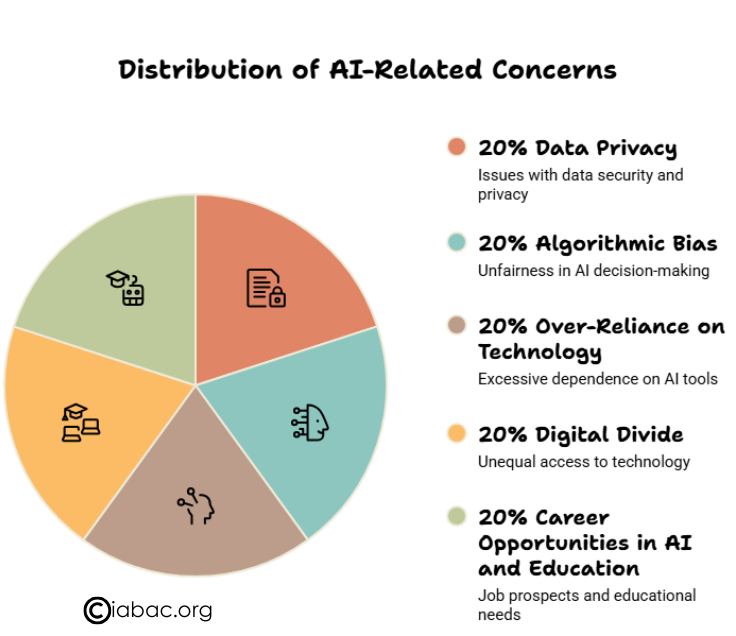
1) Data Privacy
AI systems in education collect large amounts of student data — learning behavior, performance records, and sometimes even emotional states. Protecting this data is critical. Regulations like the General Data Protection Regulation (GDPR) in Europe set strict rules on how data must be stored, used, and shared.
2) Algorithmic Bias
AI systems learn from data, and if that data reflects historical inequalities, the AI can reinforce those biases. For example, an AI grading tool trained predominantly on essays by one demographic group may evaluate writing from other backgrounds less fairly.
3) Over-Reliance on Technology
There is a genuine risk that excessive dependence on AI tools could weaken students' critical thinking and problem-solving skills. Education experts caution against using AI as a crutch rather than a scaffold — a support that helps learners grow, not a replacement for genuine learning effort.
4) Digital Divide
Not all students have equal access to devices and internet connectivity. If AI-powered learning tools are only available to well-resourced schools, they could actually widen existing educational inequalities rather than closing them.
Organizations like UNESCO and UNICEF have published guidelines on responsible AI use in education to address these concerns. Responsible implementation of AI must prioritize equity, transparency, and student wellbeing.
5) Career Opportunities in AI and Education
The intersection of AI and education is creating a range of exciting new career paths for people with different backgrounds and skill levels.
High-Demand Roles in AI and EdTech
-
AI Curriculum Designer: Develops learning programs that teach AI concepts to students from primary school through university level.
-
EdTech Product Manager: Oversees the development of AI-powered learning tools and platforms.
-
Learning Analytics Specialist: Uses data science and AI to understand student behavior and improve educational outcomes.
-
AI Ethics Advisor in Education: Helps schools and EdTech companies design AI systems that are fair, transparent, and responsible.
-
Instructional Technology Specialist: Supports teachers in integrating AI tools into classroom practice.
-
AI Engineer (Education Focus): Builds the underlying AI systems that power intelligent tutoring systems and adaptive learning platforms.
Is This Right for You? Who Should Learn About AI in Education?
This field is genuinely open to a wide range of people. You do not need to be a computer scientist to benefit from understanding AI's role in education. Here is a quick guide:
-
Students: Understanding how AI works will help you use AI tools more effectively and responsibly, and will prepare you for the future job market.
-
Educators and Teachers: Learning about AI tools can help you save time, improve your teaching, and better support your students.
-
School Administrators: Understanding AI can help you make smarter decisions about technology investments and policies.
-
Parents: Knowing how AI is being used in your child's learning environment helps you stay informed and engaged.
-
Career Switchers: If you are looking to transition into EdTech or AI, foundational AI knowledge combined with a certification is an excellent starting point.
-
Researchers and Policy Makers: Understanding both the technical and ethical dimensions of AI in education is essential for responsible governance.
Your Step-by-Step Roadmap: How to Build AI Skills for Education
Whether you are a complete beginner or already working in education, here is a practical roadmap to build your AI knowledge in the context of education and learning.
-
Start with the basics: Learn what AI is, how machine learning works, and what generative AI can do. Free resources like Google's 'AI for Everyone' and YouTube explainers are great starting points.
-
Experiment with AI tools: Use ChatGPT, Google Colab, or Hugging Face to get hands-on experience. Create a quiz, generate a lesson plan, or build a simple chatbot.
-
Explore EdTech platforms: Sign up for free trials of AI-powered tools like Khanmigo, Magic School AI, or Duolingo to experience AI learning from a student and educator's perspective.
-
Learn about AI ethics and data privacy: Read UNESCO's guidance on AI in education and familiarize yourself with GDPR principles, especially if you work with student data.
-
Study Python fundamentals: Python is the most widely used language for AI development. Even a basic understanding helps you understand how AI tools are built.
-
Choose a certification: Industry-recognized certifications validate your knowledge and open career doors. See the certifications section below.
-
Build a portfolio or project: Apply what you learn by creating something like an AI lesson plan generator, an adaptive quiz prototype, or a research paper on AI ethics in education.
-
Stay current: Follow EdTech publications, join LinkedIn communities on AI in education, and follow updates from UNESCO, IEEE, and leading EdTech companies.
Top AI Certifications for Educators and Learners (2026)
Earning an AI certification is one of the best ways to validate your knowledge, demonstrate expertise to employers, and stay current with rapidly evolving technology. Here is a side-by-side comparison of leading AI certifications relevant to education and learning:
|
Certification |
Level |
Format |
Key Focus Areas |
Industry Recognition |
|
IABAC Certified AI Professional |
Beginner–Advanced |
Online / Self-paced |
AI, ML, Ethics, EdTech |
Yes – Globally Recognized |
|
Google Cloud AI/ML Cert |
Intermediate–Advanced |
Online |
Cloud AI, ML Ops |
Yes – Google Badge |
|
Microsoft AI-900 / AI-102 |
Beginner–Intermediate |
Online |
Azure AI, Cognitive Services |
Yes – Microsoft Badge |
|
IBM AI Engineering / Gen AI |
Intermediate–Advanced |
Online (Coursera) |
Deep Learning, Gen AI |
Yes – IBM Badge |
Why IABAC Stands Out for Education Professionals?
The International Association of Business Analytics Certifications (IABAC) offers a structured AI certification pathway that is specifically designed to be accessible and practical. Unlike purely technical certifications, IABAC programs cover AI applications, AI ethics, generative AI, and business use cases making them particularly relevant for educators, administrators, and EdTech professionals who want to work with AI without needing a computer science degree.
-
Globally recognized certification with practical, real-world modules.
-
Covers foundational AI through advanced applications including generative AI.
-
Includes modules on responsible AI, making it ideal for education sector professionals.
-
Flexible online format suitable for working educators and career switchers.
-
Valued by employers in EdTech, corporate training, and AI-driven industries.
The Future of the Role of Artificial Intelligence in Education
The next decade will bring even more profound changes to how we learn and teach. Here are some developments already in progress that will shape the future of AI in education:
1) AI-Powered Immersive Learning
The combination of AI with augmented reality (AR) and virtual reality (VR) will create immersive learning experiences where students can explore historical events, conduct virtual science experiments, or practice surgical skills in fully simulated environments.
2) Lifelong Learning Companions
AI systems will increasingly serve as lifelong learning companions, adapting to a learner across their entire education journey from primary school through professional development building a deep, personalized understanding of each individual's strengths and goals.
3) AI in Workforce Training
As automation reshapes industries, AI-driven training platforms will become essential for reskilling and upskilling workers. The line between education and professional development will blur, and AI will be the infrastructure that connects them.
4) Emotional AI in Education
Emerging research explores AI systems that can detect student frustration, confusion, or disengagement through facial expressions or typing patterns. When used ethically and transparently, these systems could allow for highly adaptive interventions that support student wellbeing.
The importance of Artificial Intelligence in education will only grow. Those who understand it now students, educators, and policymakers alike will be better equipped to harness its potential and guard against its risks.
Conclusion: The Role of Artificial Intelligence Is Transforming Education
Artificial Intelligence is not a future trend in education. It is a present reality. From personalized learning platforms to automated grading, intelligent tutoring systems to accessible learning tools, AI Certification in modern education is already delivering measurable impact for students and educators worldwide.
The key is not to fear or resist this change, but to understand it, engage with it thoughtfully, and equip yourself with the knowledge and skills to use it responsibly and effectively.
Whether you are a student looking to stay ahead, a teacher seeking better tools, or a professional looking to transition into EdTech or AI, now is the right time to build your AI expertise.
Reference Links:
-
Hugging Face Transformers: Huggingface.co | Enables AI-driven language learning and educational assistants
-
IEEE AI Ethics: ieee.org | Standards for trustworthy and ethical AI development
-
International Association of Business Analytics Certifications (IABAC): iabac.org | AI and emerging technology certification programs

Nach Verein filtern
Read More
The Artificial Intelligence (AI) in Insurance Market is transforming the global insurance ecosystem by enabling automation, predictive analytics, intelligent underwriting, fraud detection, and personalized customer experiences. As insurers confront rising operational costs, complex regulatory frameworks, and evolving customer expectations, AI-driven technologies are rapidly becoming...

The online betting industry is growing faster than ever, and platforms offering more than just sports betting are becoming increasingly popular. One such name attracting attention in 2026 is Skyexchange Biz. From live sports betting to affiliate earning opportunities, the platform is designed for users who want entertainment as well as business potential in one place. In this detailed...

Introduction to Legacy Eric Carter Black Leather Jacket The Legacy Eric Carter Black Leather Jacket is more than just a piece of clothing; it represents confidence, bold personality, and timeless fashion appeal. Designed for individuals who appreciate strong style statements, this jacket has become a modern favorite in casual and semi-formal fashion. The legacy Eric Carter Black Leather...

Creating a workout schedule is one of the most effective ways to stay consistent and achieve your fitness goals at home. Whether your objective is weight loss, muscle building, improved endurance, or overall wellness, a structured training plan helps you exercise with purpose instead of relying on random workouts. A well-planned home gym routine keeps you organized, improves accountability, and...

Weight management is one of the most common health goals worldwide. Many adults struggle with stubborn fat, slow metabolism, frequent cravings, and low energy levels. Modern lifestyles often include long working hours, processed foods, irregular sleep, and stress—all of which can make it harder to maintain a healthy body weight. In response to these challenges, many people are now turning...