


Lead Generation Forms: Why Real-Time Validation Beats Post-Submission Cleanup
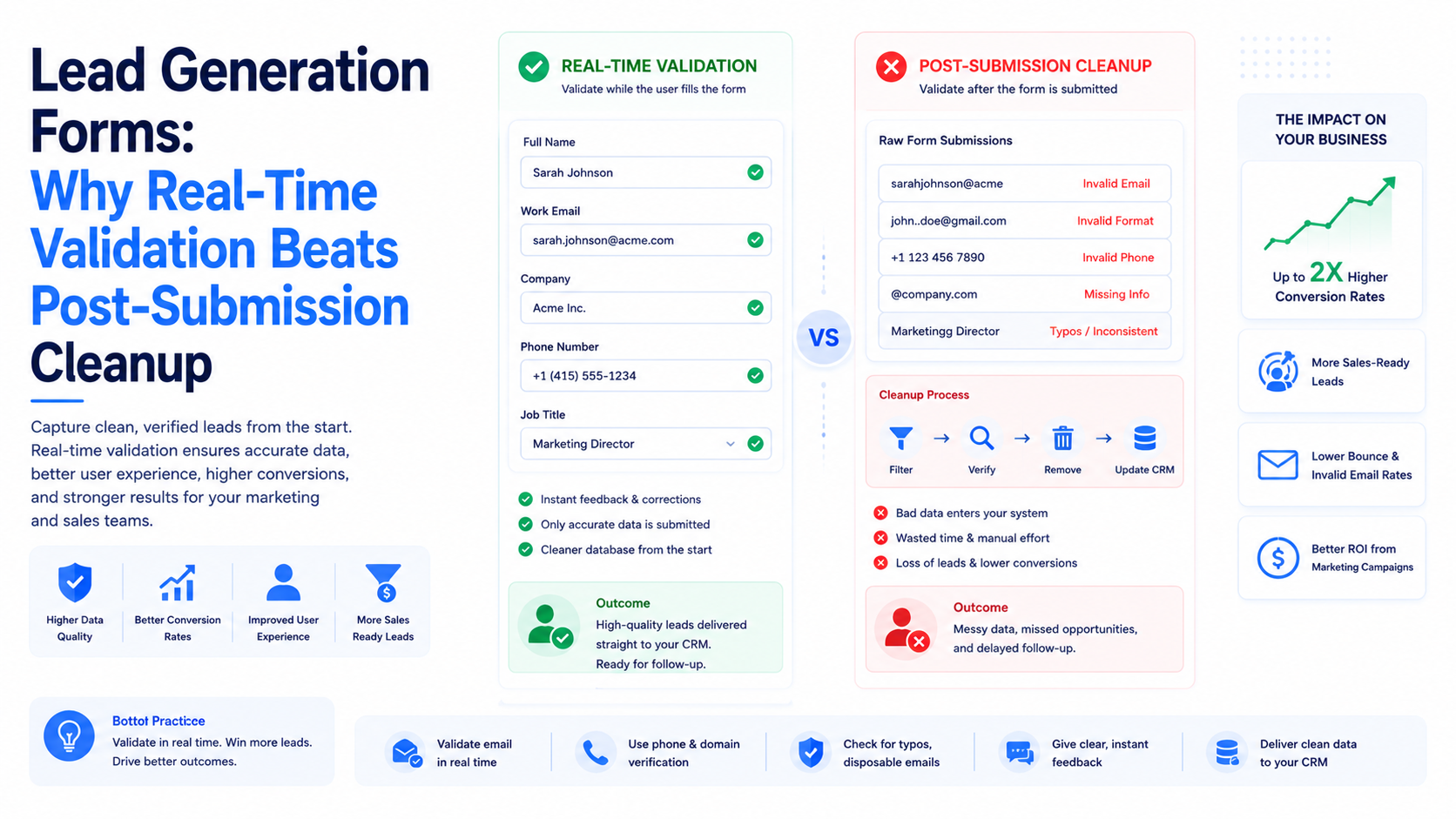
There are two approaches to dealing with invalid email addresses in your marketing database. The first is to let them in and clean them up later. The second is to stop them at the door.
Both approaches use an Email Verification Tool. But they use it at very different points in the process, and the timing difference has major implications for your data quality, your reporting accuracy, and your team's workload.
The Problem With Post-Submission Cleanup
Cleaning your list after the fact, running a Bulk Email Verification Tool on your existing database quarterly or annually is better than never cleaning at all. But it comes with real costs:
Time lag
Bad addresses sit in your database for weeks or months before being removed. During that time, they inflate your contact count, distort your engagement metrics, and potentially receive campaign emails that damage your deliverability.
Reactive rather than preventive
Every bad address that gets through represents a gap in your data quality for whatever period it was present. Cleaning it up later does not undo the campaign sent to that address or the bounces they caused.
Ongoing labor
List cleaning is not a one-time fix. It has to be repeated regularly because new bad addresses keep entering through your forms. Each cleanup cycle is a recurring operational cost.
Inaccurate reporting between cleans
If you report on email list size or engagement rates between cleanup cycles, the numbers are inflated by invalid addresses. Decision-making based on this data is less reliable.
How Real-Time Validation Works
Real-time email validation uses an API, provided by your Email Verifier tool that connects to your signup form. When someone enters an email address and submits the form, the API checks the address instantly, usually within one to two seconds, and returns a result.
If the address is valid, the form submission proceeds normally. If the address is invalid a hard bounce, disposable email, obviously fake address, or known spam trap, the form shows an error message asking the user to provide a correct address.
The user experience impact is minimal. The data quality impact is significant.
What Real-Time Validation Catches at the Form Level
A real-time Email Verification Tool integrated with your forms can catch syntax errors (typos and formatting mistakes), invalid or non-existent domains, known disposable email providers, and some categories of role-based addresses.
It cannot catch everything that a full verification process catches, catch-all domain ambiguity, for instance, is harder to resolve in real time. But it stops the most common categories of bad data at the earliest possible point.
Combining Both Approaches
The ideal setup is not either/or it is both:
Real-time validation at the form level to prevent the most common bad addresses from ever entering the system. Periodic Bulk Email Verification Tool runs to catch decay addresses that were valid at signup but have since become inactive or invalid.
Together, these two layers keep your list continuously cleaner than either approach alone.
Top 5 Email Verification Tools With Real-Time API Support
myEmailVerifier
Offers a well-documented real-time API that integrates with most major form builders, landing page platforms, and CRMs. Fast response times make it practical for high-traffic forms where submission speed matters. The combination of real-time API and bulk processing makes it effective for both layers of the approach described above.
ZeroBounce
Strong real-time API with good documentation. The additional data it returns alongside validation (email type, domain info) is useful for more advanced form logic.
NeverBounce
Clean, reliable real-time API with wide platform integration support. Good choice for teams already using NeverBounce for bulk cleaning who want to extend it to form validation.
Hunter.io
Real-time verification via API, particularly useful for B2B gated content forms where the leads are more valuable and individual validation is justified.
Bouncer
GDPR-compliant real-time API with strong privacy handling, important for European forms collecting user data under strict consent requirements.
The ROI of Prevention
When you prevent bad addresses from entering your system, you do not just save on cleanup costs. You get cleaner reports from day one, better deliverability from the first campaign sent to any new contact, more accurate attribution and ROI reporting, and lower ESP costs because you are not paying to store and email invalid addresses.
Final Thought
Real-time validation is one of those investments that pays for itself quietly and continuously. It does not make a splash in a quarterly review, but the cumulative effect on data quality, deliverability, and reporting accuracy is substantial. The tools that make it easiest to implement, with clean APIs, fast response times, and broad integration support are the ones that teams embed permanently in their infrastructure and never look back.
Kategoriler
Read More
In today’s digital world, smooth and secure login access is the key to enjoying uninterrupted experiences on any platform. For users of Reddybook, login is the first gateway to exploring everything the platform has to offer. But what happens when you face login issues? It can feel frustrating, especially if you’re in a hurry. Don’t worry—most Reddybook login...

Medication Dispensing And Packaging Systems Market: Size, Share and Growth Report (2025–2034) Market Overview The medication dispensing and packaging systems market is experiencing steady expansion as healthcare providers increasingly adopt automated technologies to improve medication management, patient safety, and operational efficiency. These systems play a critical role in minimizing...

Walk through almost any manufacturing facility and you'll notice that no two production lines are exactly the same. Products vary, assembly methods differ and every business has its own way of working. Because of this, standard adhesive tape rolls are not always the most efficient option. Increasingly, manufacturers are turning to custom cut tape to improve productivity and consistency. Rather...

QKS Group's SPARK Matrix™: eCommerce Fraud Prevention Solutions, Q4 2025 provides comprehensive market intelligence to help organizations identify the best fraud prevention technologies and leading solution providers. This in-depth research report delivers a comprehensive analysis of the global eCommerce Fraud Prevention Solutions market, exploring emerging technology trends, evolving...

According to a new report from Intel Market Research, the global Data Annotation Platform Market was valued at USD 1.67 billion in 2025 and is projected to reach USD 2.44 billion by 2034, growing at a steady CAGR of 5.6% during the forecast period. Growth is driven by increasing adoption of artificial intelligence and machine learning across industries, with the global AI market projected to...