


SOC Security Services Checklist: Choose the Right Partner in India Confidently
Why Choosing SOC Security Services Deserves a Structured Approach
Retail and e-commerce businesses in India move fast — new product launches, seasonal sales spikes, and constant platform updates leave little room for slow decision-making. But choosing SOC security services is one decision that shouldn't be rushed, because the right partner directly affects how quickly a payment fraud attempt, account takeover, or data leak gets caught and contained. A structured checklist helps IT managers and security leaders compare providers on substance rather than getting swayed by whichever pitch sounds most confident.
Why This Decision Matters More for Retail and E-Commerce
Online retail businesses handle a constant stream of customer payment data, order histories, and account credentials. Attackers know this, which is why retail platforms are frequently targeted with credential stuffing, checkout fraud, and bot-driven scraping attacks. Traffic spikes during sales events also make it harder to distinguish genuine customer activity from malicious behavior. Without continuous, expert-led monitoring, a security team can easily miss a slow-building attack hidden inside a flood of legitimate transactions.
Why an Unstructured Evaluation Process Falls Short
Many retail and e-commerce companies choose a security vendor based mainly on price or a demo that looked impressive, without digging into how the provider actually operates day to day. This often leads to mismatched expectations — a business assumes it's getting full 24/7 analyst coverage, only to discover later that alerts are largely automated with minimal human review. Others sign contracts without confirming how the provider handles incidents during high-traffic periods like festive sales, when monitoring needs are actually at their peak.
The SOC Security Services Checklist
Use the following checklist when evaluating potential partners, and ask each provider to answer these points directly rather than relying on general marketing claims:
- Monitoring depth: Is monitoring handled by real analysts around the clock, or primarily by automated alerts with limited human review
- Detection method: Does the provider use behavioral analytics and threat intelligence, or only signature-based detection that misses newer attack patterns
- Response commitments: Are incident response timelines clearly defined in the contract, not left as vague promises
- E-commerce relevance: Has the provider handled retail-specific threats such as payment fraud, bot traffic, or account takeover attempts
- Scalability during peak events: Can monitoring capacity adjust during high-traffic periods like festive sales without additional lengthy setup
- Compliance alignment: Does the provider support frameworks relevant to payment data protection, such as PCI-DSS
- Reporting clarity: Are dashboards and reports understandable to business stakeholders, not just technical teams
- Onboarding timeline: How quickly can monitoring actually go live once a contract is signed
How SOC Security Services Should Work in Practice
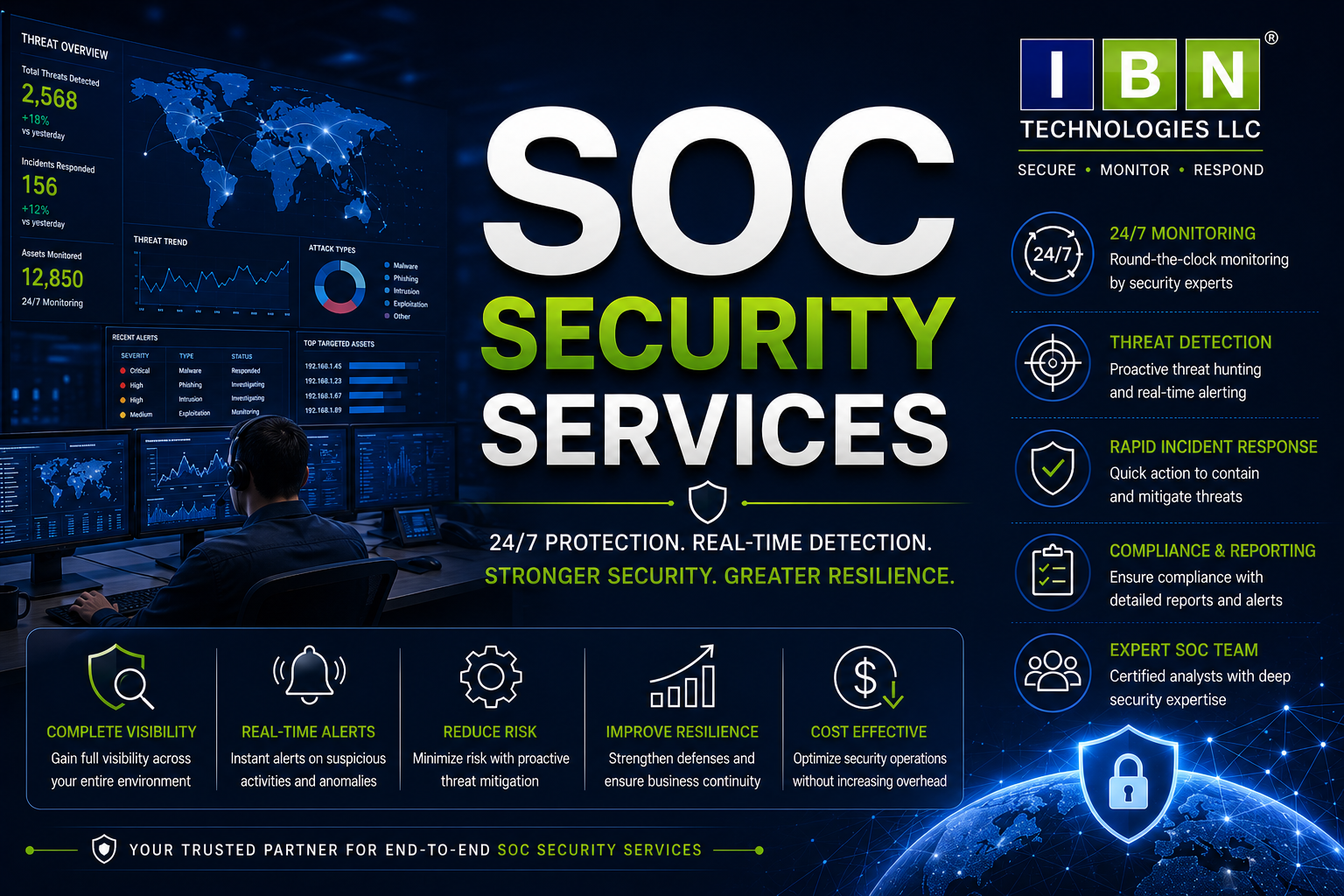
Once selected, a provider should centralize log and event data from your website, payment gateway, order management system, and cloud infrastructure into a single monitoring layer. IBN Technologies structures this through its Managed SIEM and SOC services, combining continuous analyst-led monitoring with AI-assisted detection to identify anomalies such as unusual login patterns or abnormal transaction volumes, and to respond quickly before damage spreads across customer accounts or payment systems.
Comparison: Weak Evaluation vs. Checklist-Based Evaluation
|
Evaluation Approach |
Risk of Weak Evaluation |
Benefit of Checklist-Based Evaluation |
|
Coverage confirmation |
Assumed 24/7, later found automated-only |
Verified analyst coverage upfront |
|
Peak traffic handling |
Discovered gaps during sales events |
Scalability confirmed before signing |
|
Compliance fit |
Found mismatched after an audit |
Verified against PCI-DSS needs early |
|
Reporting usability |
Reports too technical for business teams |
Clear, stakeholder-friendly dashboards |
Benefits of a Well-Chosen SOC Security Services Partner
A carefully selected provider reduces fraud losses by catching suspicious transaction patterns earlier, protects customer trust by minimizing the risk of exposed payment or account data, and gives IT managers confidence that security scales automatically during high-traffic periods instead of requiring last-minute scrambling.
Industry Use Case: Handling a Festive Sale Traffic Surge
An e-commerce retailer preparing for a major seasonal sale needed assurance that security monitoring could keep pace with a sharp increase in site traffic and transaction volume. By working with a provider that had already confirmed scalable monitoring capacity, the retailer maintained consistent visibility into checkout activity throughout the event, without needing to add internal security staff temporarily.
Best Practices When Applying the Checklist
Request the checklist responses in writing as part of the proposal, not just verbally during a sales call. Ask for a walkthrough of how an actual incident would be detected and escalated. Involve both IT and business stakeholders in the evaluation, since reporting usability matters to both groups differently. Revisit the checklist periodically even after onboarding, since coverage needs evolve as the business grows.
Compliance Context for Retail and E-Commerce
Retail and e-commerce businesses handling online payments are expected to maintain security practices aligned with PCI-DSS requirements. A provider that supports this alignment through structured monitoring and reporting makes it considerably easier to pass payment processor audits and maintain uninterrupted payment gateway access.
Using a clear checklist when selecting soc security services turns a high-stakes decision into a structured, comparable process. Retail and e-commerce leaders who evaluate providers this way are far less likely to discover coverage gaps only after an incident has already occurred.
الأقسام
إقرأ المزيد
A bright white smile can boost your confidence, improve your appearance, and leave a lasting impression. Professional teeth whitening in Coventry has become one of the most popular cosmetic dental treatments in the UK because it offers fast, safe, and long-lasting results. Whether your teeth are stained by coffee, tea, smoking, wine, or aging, modern whitening treatments can significantly...

The global Prismatic Battery Structure Components Market was valued at approximately USD 3.68 billion in 2023 and is projected to reach USD 21.89 billion by 2030, expanding at an impressive CAGR of 29.00% during the forecast period. Market growth is being driven by the rapid adoption of electric vehicles (EVs), increasing deployment of renewable energy storage systems, advancements in...

According to a new report from Intel Market Research, the global Polyether Block Amide (PEBA) market was valued at USD 507 million in 2024 and is projected to reach USD 470 million by 2032, exhibiting a Compound Annual Growth Rate (CAGR) of -1.1% during the forecast period (2025–2032). This contraction occurs despite increasing demand in...
GPS Farming Equipment: Precision Agriculture Powered by Smart Navigation GPS farming equipment refers to advanced agricultural tools that use Global Positioning System (GPS) technology to improve farming accuracy, efficiency, and productivity. These systems help farmers guide tractors, plan field operations, reduce overlaps, and optimize input usage such as seeds, fertilizers, and...
The Global Blood Culture Tests Market Report presents an in-depth analysis, merging qualitative and quantitative insights to provide a holistic understanding of the market's dynamics. The report evaluates growth drivers, challenges, and constraints while forecasting revenue trends across key segments. It offers both historical and projected data, giving stakeholders a clear view of market...