The Definitive Guide to Comme des Garçons: History, Iconic Sub-Labels, and Cultural Impact
When Rei Kawakubo debuted Comme des Garcons in Paris in 1981, critics were stunned. Instead of the era's sleek, body-conscious silhouettes and bright glamor, Kawakubo presented oversized, asymmetrical, distressed garments in muted shades of black, grey, and navy. The fashion press famously dubbed it "Hiroshima Chic," but it signaled a global paradigm shift.
Today, Comme des Garçons—frequently abbreviated as CDG—stands as one of fashion's most influential avant-garde powerhouses. It operates at the intersection of high-art couture, radical architecture, and global streetwear, proving that a brand can defy industry norms while building a thriving fashion empire.
The Visionary Origins: Rei Kawakubo & Anti-Fashion
Founded in Tokyo in 1969 and officially incorporated in 1973, Comme des Garçons translates from French to "like boys." Inspired by the lyrics of the 1962 French pop song Tous les garçons et les filles by Françoise Hardy, the name reflected Kawakubo's desire for independence and strength, detached from conventional feminine expectations.
Kawakubo studied fine arts and literature at Keio University rather than traditional fashion design. This lack of formal dressmaking constraints allowed her to treat garments not as mere utilitarian clothing, but as three-dimensional sculpture. By questioning the fundamental architecture of garments—slashing seams, shifting armholes, and exposing raw thread—she pioneered deconstructivism alongside fellow Japanese visionaries Yohji Yamamoto and Issey Miyake.
"I never intended to start a revolution. I only came out with what felt natural to me—trying to create something that didn't exist before." — Rei Kawakubo
Decoding the CDG Ecosystem: A Map of Sub-Labels
Rather than keeping the brand confined to high-concept Paris runways, Kawakubo created an expansive universe of sub-labels. Each diffusion line caters to a specific aesthetic, price point, and audience while maintaining the core CDG identity.
| Sub-Label | Established | Aesthetic Focus | Price Point |
| Comme des Garçons (Main Line) | 1969 | Pure avant-garde, runway sculpture, conceptual art | High-End Luxury |
| Comme des Garçons HOMME PLUS | 1984 | Radical menswear, anti-establishment tailoring | Luxury |
| Comme des Garçons PLAY | 2002 | Streetwear basics featuring the iconic heart logo | Mid-Range / Entry-Level |
| CDG SHIRT | 1988 | Reconstructed classic shirting, bold graphics, color-blocking | Mid-to-High |
| BLACK Comme des Garçons | 2008 | Monochromatic staples offering main-line shapes at lower costs | Mid-Range |
| Junya Watanabe Comme des Garçons | 1992 | Technical outerwear, workwear fusion, innovative textiles | High-End |
The Cultural Phenomenon of CDG PLAY
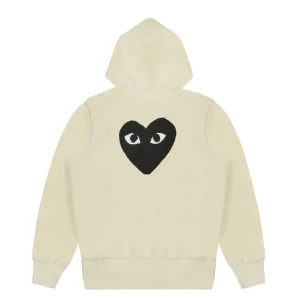
While the main runway collections push boundary-breaking concepts, Comme des Garcons PLAY remains the brand's most recognizable and commercially successful line. Launched in 2002, PLAY abandoned complex, structural tailoring in favor of everyday wardrobe essentials: everyday t-shirts, striped long-sleeves, cardigans, hoodies, and polo shirts.
The bug-eyed red heart logo, designed by Polish graphic artist Filip Pagowski, became an instant pop-culture icon. It proved that a high-fashion house could create an accessible gateway product without diluting its artistic prestige.
Retail Revolution: Dover Street Market & Collaborations
CDG's impact extends far beyond its own garments. Kawakubo and her husband, CDG CEO Adrian Joffe, revolutionized retail in 2004 with the opening of Dover Street Market (DSM) in London.
Inspired by London's historic Kensington Market, DSM functions as an experiential multi-brand department store where high luxury, emerging designers, and raw streetwear sit side-by-side. There are no traditional brand boundaries; each designer is given creative freedom to construct their own installation space, making shopping feel like exploring a contemporary art museum.
CDG has also mastered the art of strategic, culture-defining partnerships:
-
Converse x CDG PLAY: The heart-stamped Chuck Taylor All-Star 70 is one of the longest-running, highest-selling sneaker collaborations in history, serving as an entry point into luxury fashion for millions of young consumers worldwide.
-
Nike: From deconstructed Air Force 1s to elevated Air Max iterations and molded Foamposites, CDG regularly reinterprets Nike's athletic heritage through a high-fashion lens.
-
Supreme & Moncler: High-profile capsule collections that bridged the gap between skate culture, luxury outerwear, and Japanese avant-garde design.
Sizing, Quality, and Buying Advice
Navigating Comme des Garçons items can be tricky for first-time buyers due to regional sizing variations and distinct manufacturing processes:
-
Japanese Sizing Runs Slim: Because CDG products are designed around Japanese sizing standards, garments—especially in the PLAY and SHIRT lines—run noticeably smaller than standard Western sizing. It is standard practice to size up at least one full size (e.g., if you wear a US Medium, purchase a CDG Large).
-
Craftsmanship & Fabric: Main line pieces, HOMME PLUS, and Junya Watanabe collections are crafted in Japan with custom-milled textiles, raw selvage edges, and hand-finished details that justify high-end price tags.
-
Authentication Tips: Due to the widespread popularity of CDG PLAY, counterfeit items are common online. Pay close attention to the embroidered heart patch—authentic patches have slightly asymmetrical shapes with sharp, clear pupil stitching, rather than perfectly round or flat felt hearts.
Frequently Asked Questions
What does "Comme des Garçons" actually mean?
Comme des Garçons is a French phrase that translates to "like boys." Designer Rei Kawakubo selected the name in 1969 after hearing it in Françoise Hardy's song Tous les garçons et les filles. She chose it for its phonetic sound and the independent, energetic attitude it conveyed.
Is Comme des Garçons a luxury brand?
Yes, Comme des Garçons is a premier luxury fashion house. Its main runway collections and specialized sub-labels like HOMME PLUS command high-end designer pricing due to conceptual design work, limited production runs, and Japanese manufacturing. However, diffusion lines like CDG PLAY offer accessible entry-level options.
Why does CDG PLAY sizing run so small?
CDG PLAY garments are manufactured in Japan using regional sizing patterns, which feature narrower shoulders and slimmer cuts than traditional US or European garments. Sizing up by one size is recommended for a standard fit, or two sizes for a relaxed look.
Who owns Comme des Garçons today?
Comme des Garçons remains privately owned and independent—a rarity in modern luxury fashion. Founding designer Rei Kawakubo and her husband, CEO Adrian Joffe, retain majority ownership and total creative control over the business and its retail network.
Categories
Read More
Introduction In today’s competitive digital world, businesses need a strong online presence to attract customers, increase visibility, and achieve sustainable growth. Simply having a website is not enough; your business needs to appear in front of the right audience at the right time. Search Engine Optimization (SEO) helps businesses improve their search engine...

According to the latest report published by Data Bridge Market Research, the Asia-Pacific Silicon Carbide Wafers Market Asia-Pacific silicon carbide wafers market is expected to gain market growth in the forecast period of 2022 to 2029. Data Bridge Market Research analyses that the market is growing with the CAGR of 23.4% in the forecast period of 2022 to 2029 and expected to reach...

Regional Overview of Executive Summary Manga Market by Size and Share CAGR Value The global manga market size was valued at USD 14.84 billion in 2024 and is expected to reach USD 22.26 billion by 2032, at a CAGR of 5.2% during the forecast period With the superior Manga Market report, get knowledge about the industry which explains what market definition, classifications,...
There are hundreds of link building agencies out there. Most are average. Some are genuinely terrible. A small number are excellent. The difference between excellent and average is not always obvious from a website or a sales call. But it shows up clearly in the quality of their work, the depth of their thinking, and the transparency of their communication. Here is what to look for. ...
Cillian Murphy has recently addressed speculation surrounding the future of the "28 Years Later" franchise, clarifying his stance on ongoing projects. He confirmed his return as Jim in the upcoming sequel, "28 Years Later: The Bone Temple," expressing enthusiasm and readiness for the film’s production. When asked about the possibility of a follow-up, Murphy responded positively, saying,...