


Why Your Service Pages Don't Rank Even Though Your Blogs Do
One afternoon during our routine SEO audit we opened Google Search Console expecting to review keyword performance.
Instead we noticed something that completely changed the direction of our audit.
Two content types on the same website. Same domain authority. Same technical setup. Same internal team writing both.
But wildly different results in the eyes of Google.
That single observation turned a routine check into a full investigation one we're documenting here not as a polished success story but as a real audit trail.
What We Found Inside Google Search Console
We pulled up the Pages report inside Search Console filtered for the last 3 months and sorted by impressions.
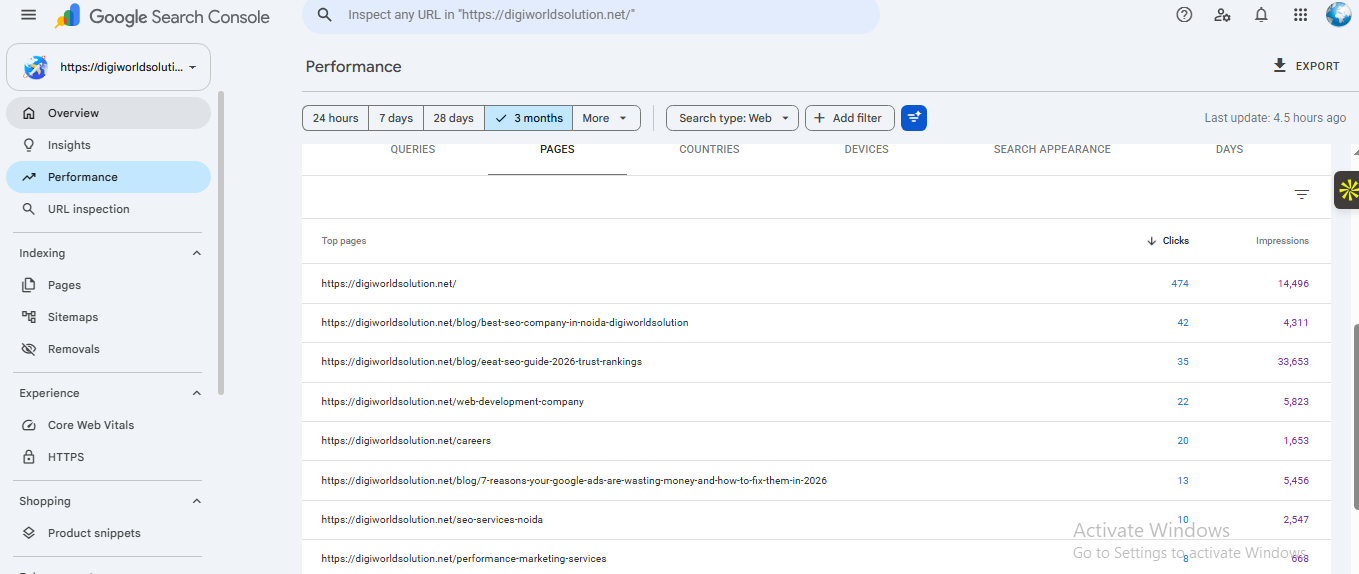
The top of the list wasn't what we expected.
Our EEAT SEO Guide a purely educational blog post had crossed 33K+ impressions in the period. Another blog, "Best SEO Company in Noida," had pulled in over 4K+ impressions on its own. A third educational post was also showing strong, consistent visibility.
Scroll further down the same report and our commercial pages told a different story. The SEO Services page and the Performance Marketing Services page built specifically to generate enquiries were sitting with noticeably lower impressions. A few other service pages followed the same pattern.
Nothing was broken. Nothing had de indexed. The pages were live, crawlable and technically sound.
So the question wasn't "why isn't this working." The question was "why is Google choosing to show one type of page far more often than the other."
Two Pages, One Goal, Very Different Results
To understand the gap we picked one blog and one service page targeting a related theme and placed them side by side.
| Factor | Blog (EEAT SEO Guide) | Service Page (SEO Services) |
|---|---|---|
| Primary goal | Educate the reader | Convert the reader |
| Impressions (3 months) | 33K+ | Comparatively low |
| Word count | Long-form, in-depth | Shorter, sales-focused |
| Internal links pointing to it | Multiple, from related blogs | Fewer, mostly from navigation |
| Content refreshed recently | Yes | Rarely |
| Answers a specific question | Yes, directly | Partially |
| Written for | People researching a topic | People ready to hire |
The two pages were never competing for the exact same query. But Google was clearly finding far more reasons to surface the blog than the service page and that difference was worth digging into rather than dismissing.
We want to be upfront here: this is a pattern we observed on our own website during this specific period. It isn't a universal rule, and it may look different on another domain, in another industry, or at another time. We're not claiming blogs always outrank service pages. We're explaining what we found and why, on our own data.
We Started Asking Better Questions
Instead of jumping straight into "fixing" the service pages, we paused and asked questions a search engine would effectively be asking on the user's behalf.
Why is Google rewarding this blog page with more visibility?
What search intent does this specific page actually satisfy?
If we were a stranger landing on our own service page would we click it or scroll past it?
Does this page absolutely help someone circulate closer to a buying decision or does it just describe what we provide?
Does it look and examine like a web page built by people who have without a doubt achieved this working or like a template packed with conventional guarantees?
These weren't rhetorical questions for the article. We answered each one page by page using our own service pages as the test subjects.
What Google's Behaviour Told Us
It would be easy and lazy to say "Google likes blogs more than service pages." That's not what the data was showing us.
What it was actually showing is that Google tries to match a page to the intent behind a search, and our blog content was doing that job more precisely than some of our service pages.
Search intent generally falls into three buckets, and it's worth separating them clearly:
Informational intent — someone wants to learn something. "What is EEAT in SEO" or "how does Google rank websites" are questions with informational intent. Our EEAT guide was built almost entirely around this.
Commercial intent — someone is comparing options before deciding. "Best SEO company in Noida" sits here. The searcher isn't ready to buy yet, but they're close and they want evidence before they commit.
Transactional intent — someone is ready to act. "Hire SEO agency for ecommerce site" or "SEO services pricing" fall here. This is where our service pages are supposed to win.
Our audit showed that our informational content was matching its intent bucket almost perfectly. Our commercial and transactional pages on the other hand were often trying to serve all three intents at once a little education, a little comparison, a little pitch without fully satisfying any of them.
Breaking Down Our Service Pages
We went through our service pages individually the same way we'd audit a client's site.
Content. Several pages described what we do, but not how we do it, what the process looks like or what results have historically looked like for similar work. Description without depth.
Structure. Headings were often promotional ("Why Choose Us") rather than answering a real question a prospect would have in their head.
FAQs. Some pages had none. Where FAQs existed, they were generic and didn't address pricing, timelines or process the things people actually hesitate over before enquiring.
Internal links. Our blogs frequently linked to each other. Our service pages were comparatively isolated, receiving fewer contextual links from relevant blog content that could have passed both relevance and authority.
Trust signals. Case studies, specific numbers and named outcomes appeared inconsistently across pages even though we have this proof available internally.
Calls to action. Present but often repeated verbatim across multiple pages which weakened their relevance to the specific service being discussed.
Commercial intent alignment. Some pages read more like a brochure than an answer to "why should I choose this agency for this exact service."
Original experience. This was the clearest gap. Our blogs shared perspective and firsthand insight. Several service pages read more like a description of a service category than an account of our own delivery of it.
None of this meant the pages were low quality in absolute terms. It meant they weren't fully doing the specific job Google expects a commercial page to do.
The Competitor Exercise
Once we understood our own gaps we looked outward at service pages already ranking well for the terms we cared about.
We didn't just check backlinks which is where this kind of exercise usually stops. We looked at the full picture.
Structure — how information was ordered and whether it followed the logic of a buyer's decision rather than a company's internal org chart.
Content depth — whether the page answered follow up questions before the reader had to ask them including scope, process and what happens after signing up.
EEAT signals — visible experience, author or team credibility and evidence that the content came from people who'd actually done the work being described.
User experience — how quickly someone could find pricing information a clear next step or proof of past results.
Intent alignment — whether the page felt built for someone ready to enquire not someone still researching.
Freshness — whether the page had been updated to reflect current services or left untouched since it was first published.
The pattern was consistent. The service pages performing well weren't necessarily longer or more heavily linked they were more complete answers to a buyer's real questions.
The Framework We Now Follow
Out of this audit we built a repeatable process the one we now use before publishing or revising any service page.
Step 1 Define the exact intent. Is this page meant for someone comparing options or someone ready to hire? Write for that stage only.
Step 2 Map the buyer's real questions. Not generic FAQs the actual hesitations someone has before enquiring cost, timeline, process, proof.
Step 3 Build content around evidence, not description. Replace "we offer SEO services" with specifics of how the work is actually delivered.
Step 4 Strengthen internal linking deliberately. Connect relevant blog content to the service page it supports and vice versa instead of leaving them as separate silos.
Step 5 Add visible trust signals. Case studies, outcomes and named experience placed where a skeptical reader would look for them.
Step 6 Benchmark against pages already ranking. Not to copy them but to see what intent level completeness looks like in practice.
Step 7 Review on a schedule, not just at launch. Revisit service pages the way blogs are usually revisited refreshed, not left static.
This is now part of our internal process at Digiworld Solution applied before any service page goes live or gets updated.
Before You Publish Any Service Page
Instead of a generic checklist here are the ten questions we now ask ourselves before a service page is considered finished.
- Would this page convince me to enquire if I were the reader?
- Does it answer pricing questions even indirectly?
- Would I trust the team behind this page based on what's written here?
- Is there proof a result, a case study, a number anywhere on this page?
- Does it explain the process not just the outcome?
- Is there enough detail to remove doubt without turning into a wall of text?
- Does it link to and from relevant supporting content?
- Does it read like it was written by people who've done this work?
- Is the call to action precise to this service now not copy pasted?
- Would this web page nevertheless make feel to a reader six months from now or does it want updating already?
If a page cannot expectantly answer most of those it is not ready to compete for business visibility yet.
Frequently Asked Questions
Why do blog pages sometimes get more impressions than service pages?
In our audit it came down to intent match not content type. Our blogs were built tightly around informational search intent, while some service pages were trying to serve informational, commercial and transactional intent all at once which diluted how precisely they matched any single search.
Does this mean blogs always rank better than service pages?
No. This was a pattern we observed on our own website over a specific three month period. Results can differ by industry, competition and how a site's service pages are structured. We're sharing what we found not a universal rule.
Should we stop investing in service pages and focus only on blogs?
No. the two serve different purposes. Blogs deliver people in during research provider pages are supposed to transform people who are closer to a decision. The aim is ensuring each web page is absolutely built for the intent it's speculated to capture now not deciding on one content type over the opposite.
How do we know if a service page is matching the wrong search intent?
Look at what it's actually offering the reader. If it reads like a definition or explanation rather than a reason to enquire missing pricing context, process detail or proof it's likely under serving commercial or transactional intent.
What's the fastest way to start improving an underperforming service page?
Begin with the ten questions we outlined above. Answering them honestly usually reveals the two or three biggest gaps often missing proof, unclear process detail or weak internal linking before anything else needs to change.
How often should service pages be reviewed?
We now review ours on a set schedule rather than leaving them untouched after launch the same way we'd revisit a blog post. Services, pricing context and proof points change over time and the page should reflect that.
One More Thing We Noticed
While going through this audit we kept running into a related question sites with genuinely solid on page SEO were still losing visibility to competitors. That's a separate rabbit hole and one we have written about in detail here Your SEO Is Fine But Competitors Keep Outranking You. Here's Why If your service pages are technically sound but still not moving that piece walks through the other side of this problem.
Final Thoughts
We didn't start this audit looking for a lesson about content types. We started it looking at numbers in a report.
But the gap between our blog performance and our service page performance forced us to look closer ask harder question, and be honest about where our commercial pages were falling short of user intent.
This isn't a claim that blogs will always outperform service pages or that every website will see this exact pattern. It's what we found on our own site in our own data, during this specific period.
Our audit reminded us that ranking isn't always just about keywords. It's approximately giving Google the most powerful possible reason to believe that your page is the best solution for a person ready up to take action.
Κατηγορίες
Διαβάζω περισσότερα
Netflix is expanding its original programming lineup with a highly anticipated new drama series, currently in production in Toronto. Titled "Tiny Pretty Things," this series is based on the popular book by Sona Charaipotra and Dhonielle Clayton. It explores the intense and competitive world of an elite ballet academy, where young dancers from diverse backgrounds strive for greatness amidst...

Businesses require solutions that not only deliver detailed designs but also ensure long-lasting performance across different materials. Traditional engraving methods often struggle to produce consistent deep relief results while maintaining efficiency. With the advancement of laser technology, modern engraving systems now offer superior depth control and precision. At martlaser, advanced...

Tiger Mist: Complete Guide to Dresses, Women's Fashion & New Arrivals [2026] Introduction I've had a Tiger Mist order sitting in my cart more times than I can count, usually right before a birthday dinner or a long weekend away. The brand has a way of showing up in your Instagram explore page with exactly the dress you didn't know you needed. That's not an accident — Tiger Mist has...

In today's hyper-competitive digital marketplace, businesses cannot afford slow, outdated, or ineffective websites. Every second of delay, every poor user experience, and every missed conversion opportunity can translate into lost revenue. This is where an Australian web developer becomes a game-changing asset. Businesses across industries are rapidly investing in advanced website solutions to...

The digital radiography market is experiencing sustained growth as healthcare providers increasingly adopt advanced imaging technologies to improve diagnostic accuracy, workflow efficiency, and patient care. Digital radiography has become an essential imaging modality across hospitals, diagnostic centers, orthopedic clinics, and emergency departments due to its ability to deliver high-quality...