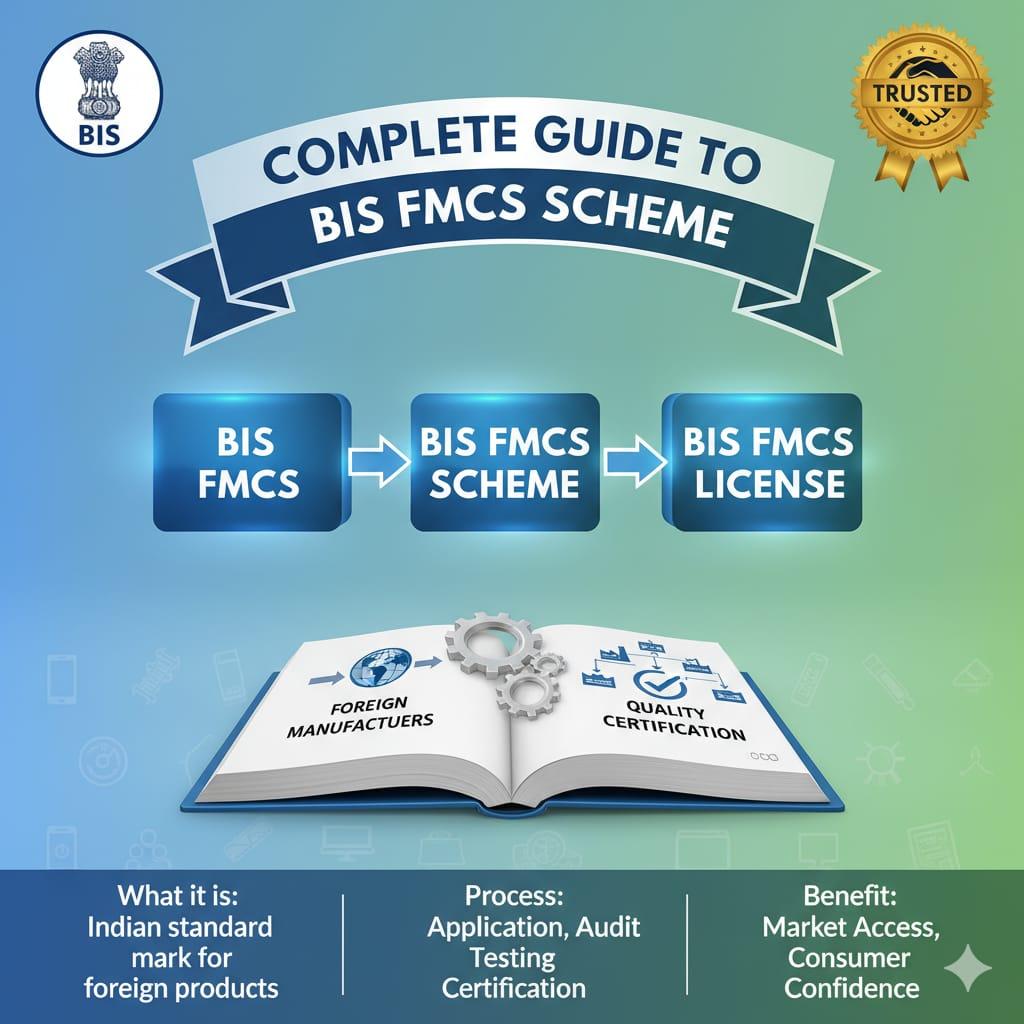
Complete Guide to BIS FMCS, BIS FMCS Certification & BIS Registration for Foreign Manufacturer
Introduction
Expanding into the Indian market is a massive opportunity for global manufacturers, but compliance with Indian standards is absolutely essential. One of the most vital compliance frameworks for overseas manufacturers is the BIS FMCS scheme. India’s Bureau of Indian Standards ensures that international products entering the Indian market meet strict safety, quality, and performance benchmarks.
In this detailed guide, we’ll dive deep into BIS FMCS, how BIS FMCS Certification works, and the complete procedure of BIS Registration for Foreign Manufacturer. If you’re a manufacturer looking to export products to India, this article will walk you through each step clearly and confidently.
What Is BIS FMCS?
The Foreign Manufacturers Certification Scheme (FMCS) is operated by the Bureau of Indian Standards specifically for overseas manufacturers. It ensures that foreign-made products comply with the same Indian Standards as domestically made goods.
Under BIS FMCS, foreign manufacturers can obtain a BIS license to use the ISI mark on their products, giving them legal approval to sell within India.
Products regulated under BIS FMCS Certification usually include:
-
Cement
-
Electrical appliances
-
Steel products
-
Automotive parts
-
Food-related products
-
Household equipment
Manufacturers must comply with the specific Indian Standard (IS) applicable to their product category.
Why BIS FMCS Certification Is Important
Pursuing BIS FMCS Certification is not just about compliance — it also provides major commercial advantages:
-
Legal Approval
India mandates several product categories to be certified before they can be sold.
-
Brand Trust & Reliability
The ISI mark boosts customer confidence and assures high product quality.
-
Wider Market Access
Certified products gain easier acceptance among distributors and retailers.
-
Reduced Risk of Rejections
Indian authorities may seize or reject non-certified products at ports.
-
Competitive Advantage
Certification helps a brand stand out in India’s competitive market.
BIS Registration for Foreign Manufacturer
BIS Registration for Foreign Manufacturer is a mandatory requirement for overseas factories producing goods that fall under the ISI mandatory certification list.
Under this system:
-
Only the manufacturer (not an importer or trader) can apply.
-
The application can be filed through an authorized Indian representative.
-
BIS officers will inspect the foreign manufacturing site.
-
Only after successful evaluation will the license be issued.
Foreign manufacturers often find the process complex due to cross-border logistics and documentation requirements — which is why proper guidance is essential.
Step-by-Step Process for BIS FMCS Certification
Now let’s explore the complete certification path for BIS FMCS Certification in detail:
Step 1: Identifying the Correct Indian Standard (IS Code)
Each product category has a unique IS code. Choosing the correct code is crucial because the entire certification depends on it.
Step 2: Appoint an Authorized Indian Representative (AIR)
For BIS Registration for Foreign Manufacturer, a local representative in India is mandatory. They act as the communication link between BIS and the overseas manufacturer.
Step 3: Prepare All Required Documentation
Documents usually include:
-
Factory license
-
Manufacturing details
-
Quality control procedures
-
Test equipment list
-
ISO certificate
-
Authorization letter for AIR
-
Product details
-
Factory layout diagrams
Any missing or incorrect documentation can delay the certification process.
Step 4: Product Testing in BIS-Approved Laboratory
Testing is one of the most important parts of the BIS process. Products must be tested only in:
-
BIS-recognized laboratories
-
According to the relevant Indian Standard
The lab results form the backbone of the application.
Step 5: Submit the BIS FMCS Application
The manufacturer must submit the application along with the test report, documents, and prescribed fees.
BIS scrutinizes:
-
Technical details
-
Manufacturing practices
-
Quality control capabilities
-
Factory infrastructure
Step 6: Factory Audit by BIS Officers
A BIS officer will physically visit the foreign manufacturing unit. During this inspection, BIS evaluates:
-
Production process
-
Machinery and testing equipment
-
Raw material standards
-
Quality assurance procedures
-
Factory hygiene and safety
This audit ensures the manufacturer can consistently produce goods meeting Indian Standards.
Step 7: Grant of BIS FMCS Certification
If everything is satisfactory, BIS issues the license, authorizing the manufacturer to use the ISI mark on their products.
The certificate is:
-
Valid for 1 or 2 years
-
Renewable upon compliance
-
Applicable only for the specific product and manufacturing location
Timeline for BIS FMCS Certification
On average:
-
Application & document preparation: 1–2 weeks
-
Product testing: 2–4 weeks
-
Factory inspection arrangement: 2–3 weeks
-
License approval: 2–4 weeks
Total timeframe: 8 to 12 weeks (may vary by product)
Cost of BIS FMCS Certification
The cost includes:
-
Application fee
-
Audit charges
-
Product testing fee
-
License fee
-
AIR appointment cost
-
BIS officer travel fees (for foreign inspection)
Costs vary based on country, product type, and testing complexity.
Tips to Smoothly Complete BIS FMCS Certification
-
Prepare all documents carefully
-
Use BIS-approved laboratories
-
Ensure your factory is inspection-ready
-
Maintain clear QC procedures
-
Work with a compliance expert for smooth processing
Conclusion
Entering the Indian market as a foreign manufacturer requires strict adherence to Indian quality and safety standards. BIS FMCS, BIS FMCS Certification, and BIS Registration for Foreign Manufacturer ensure your products meet these standards and gain official approval to be sold in India.
With proper documentation, testing, and expert guidance, the certification process becomes a streamlined and rewarding experience — opening doors to one of the world’s largest consumer markets.
For professional support with BIS FMCS and certification services, visit sunconsultants.co.in.
Categorias
Leia mais
According to the latest report published by Data Bridge Market Research, the Cardiovascular Information Systems Market The global cardiovascular information systems market size was valued at USD 1.31 billion in 2025 and is expected to reach USD 2.49 billion by 2033, at a CAGR of 8.4% during the forecast period The market growth is largely fueled by the...
The Automotive Cross Car Beam Market is gaining significant traction as automakers focus on improving vehicle structural integrity, safety, and lightweight design. Cross car beams are critical structural components located behind the dashboard, supporting various systems such as steering columns, HVAC units, and infotainment modules while enhancing crash safety. The increasing shift toward...
If you're considering buying Black Myth: Wukong, you'll want to know whether your PC can handle it. The good news is that the game doesn't demand a top-tier rig, but you will need to clear a substantial 130 GB of storage. Here's a concise breakdown of the minimum and recommended specifications to help you decide. System Requirements at a Glance Operating System: Windows 10 (both minimum and...

Gina Rodriguez lends her voice to the iconic character, bringing Carmen Sandiego to life in a new animated form. The series delves deep into her mysterious origins, revealing the story behind the legendary super thief. With Finn Wolfhard voicing her trusted ally, Player, the duo is set for global adventures across twenty episodes. Produced by Houghton Mifflin Harcourt for Netflix, this fresh...

Upcoming Netflix Releases As a new month begins, the platform unveils fresh cinematic journeys. Prepare for three captivating Netflix originals arriving in March 2026. These selections promise to transform your viewing experience with compelling narratives. First, immerse yourself in an original story of high stakes and deep emotion. Next, a gripping drama unfolds, challenging perceptions and...