Industrial Fume Extraction Systems in India: Everything Plant Managers Need to Know
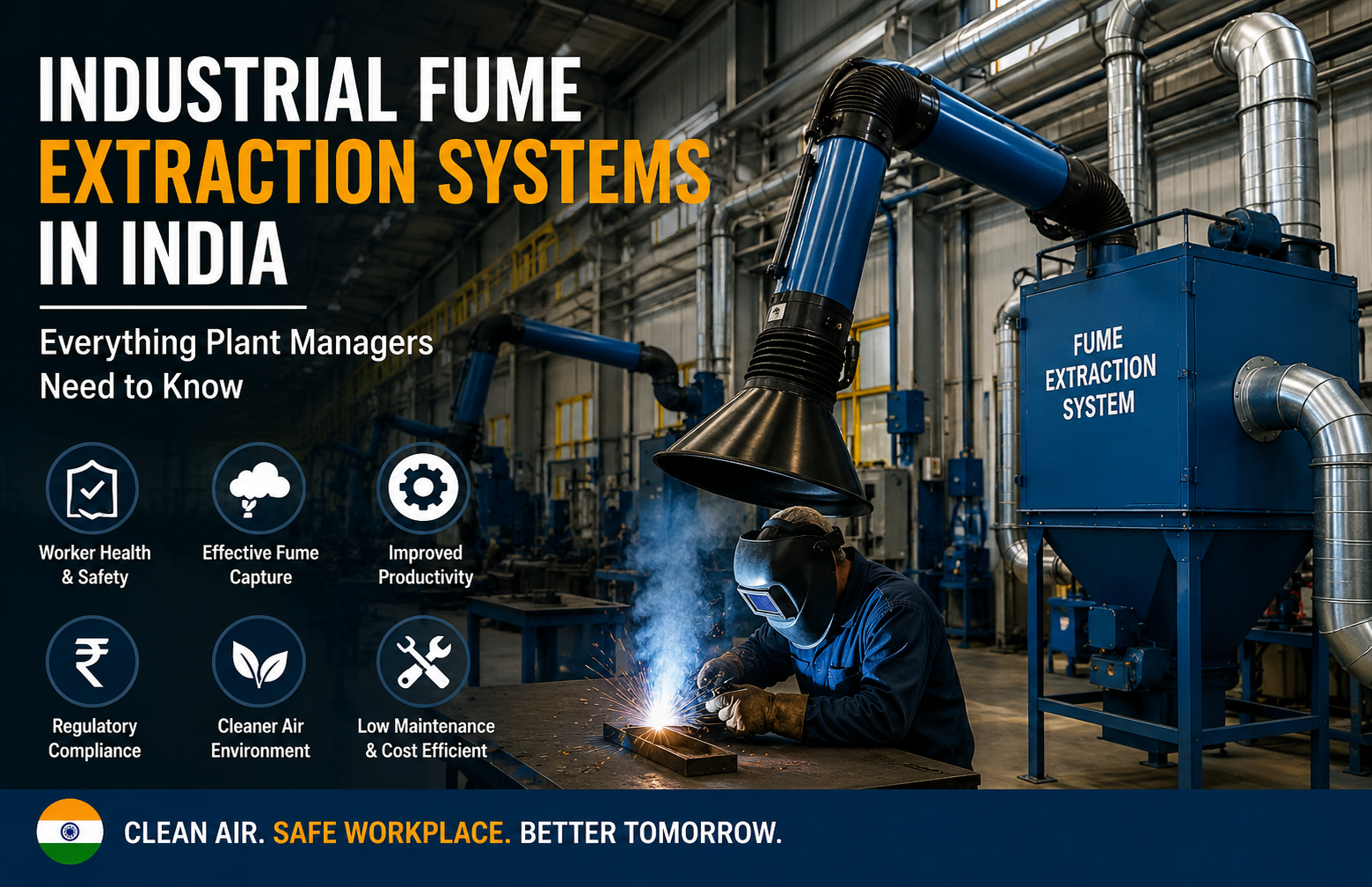
Any facility that welds, melts, cuts, or grinds metal produces airborne fume — and that fume is a bigger threat to workers, equipment, and compliance status than most plants realise. An Industrial Fume Extraction System (FES) is the piece of equipment built specifically to deal with it: it captures fume at the point it's generated, filters it out of the airstream, and releases clean air back into the workplace or atmosphere. Here's a practical overview of how these systems work, why they matter, and how to choose one.
What Exactly Is an FES?
Fume is not the same thing as dust. It forms when metal is vaporised at high temperature and then condenses into extremely fine solid particles — often under one micron in size. Because they're so small, these particles penetrate deep into the lungs and stay suspended in the air far longer than ordinary dust, which is why general housekeeping or open ventilation isn't enough. A dedicated FES is needed.
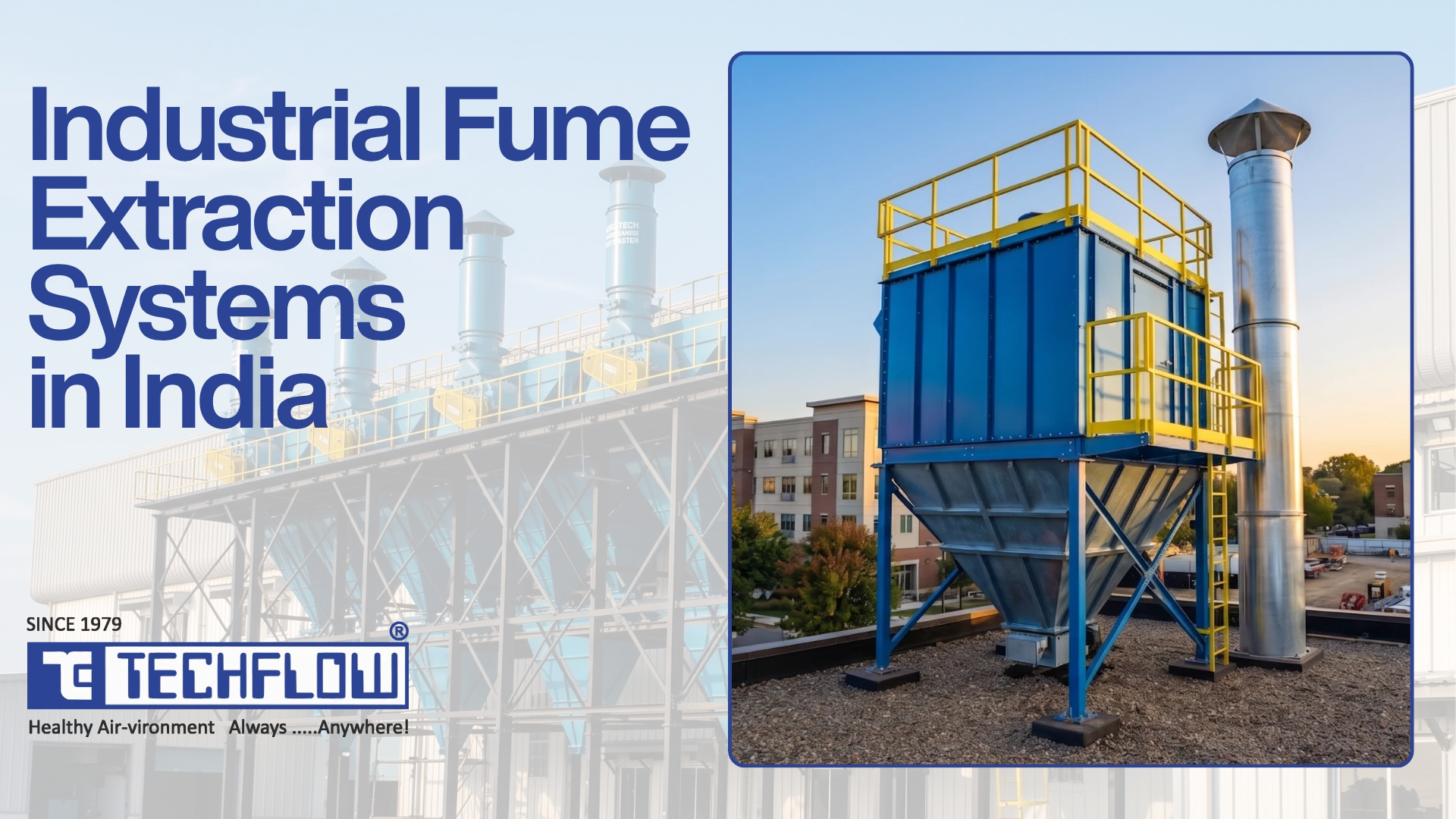
A complete system is built from five stages that all have to work together:
- Capture device (hood) — positioned at the fume source to draw in contaminated air.
- Ducting — sized to keep the air moving fast enough that particulate stays airborne instead of settling.
- Air-cleaning device (filter) — a cyclone, bag filter, cartridge filter, or precipitator that separates the pollutant from the air.
- Fan (ID fan/centrifugal blower) — generates the suction that drives the whole system.
- Discharge and collection — the stack or clean-air outlet, along with a hopper and rotary airlock or screw conveyor to remove collected material.
If any one stage is undersized or poorly matched to the others, the whole system underperforms — a strong fan behind a weak hood, or a great filter fed by leaky ducting, will still fail to protect workers.
Why Fume Is a Serious Health Hazard
The case for extraction isn't just regulatory box-ticking — it's backed by hard medical evidence. In 2017, the International Agency for Research on Cancer (IARC) reclassified welding fume as a Group 1 carcinogen, meaning it's carcinogenic to humans, based on sufficient evidence linking it to lung cancer (with a possible link to kidney cancer too). UV radiation from welding was classified the same way in the same review.
Specific fume components carry their own risks:
- Manganese (common in steel welding fume) is a neurotoxin linked to manganism, a Parkinson's-like condition.
- Zinc oxide (from welding or cutting galvanised steel) is the leading cause of metal fume fever, a flu-like illness.
- Hexavalent chromium and nickel compounds (from stainless steel work) are recognised carcinogens.
- Iron oxide (the bulk of mild-steel fume) can accumulate in the lungs over years and cause siderosis.
Beyond health, uncontrolled fume has a real productivity cost: it's uncomfortable to work in, it fouls machinery, contaminates product, and shortens the lifespan of electrical equipment.
How Extraction Actually Works
An FES operates in four steps: capture, conveyance, cleaning, and discharge. Of these, capture is the most important and most often underestimated. The single most effective principle in industrial ventilation is controlling the contaminant right at the source — before it disperses into the room — which is why Indian law requires exhaust hoods to be positioned "as near as possible" to where the fume originates.
This matters because capture velocity — the speed of air pulled into a hood — falls off very rapidly with distance. A hood that works well at 150 mm might be nearly useless at 450 mm. For typical manual welding, industry guidance (ACGIH) recommends capture velocities of around 0.5 m/s at the source, rising to 0.6–0.75 m/s for more toxic fume. Hot furnace applications need an additional cooling stage before the air reaches the filter, since fabric and cartridge media can't tolerate raw flue-gas temperatures.
Choosing the Right Type of System
There's no universal "best" FES — the right choice depends on how many sources there are, how mobile the work is, and how hot the fume is:
- Portable extractors with a flexible arm suit small workshops or jobbing work where the source moves around.
- Centralised systems connect multiple capture points to one large filtration unit — ideal for plants with many fixed workstations or continuous high-fume processes.
- Primary furnace FES captures fume directly at the furnace via water-cooled or swivelling hoods.
- Secondary furnace FES captures fugitive fume released during charging, tapping, and pouring, typically using canopy or side-draft hoods — common in steel melting shops.
On filtration, cyclones are cheap and effective for coarse dust but lose efficiency on fine fume, so they're usually used only as a pre-cleaner. Bag filters (baghouses) are the workhorse of the industry, commonly achieving up to 99.9% efficiency and capturing particles down to about 0.3 micron — making them the standard for furnace and high-volume applications. Cartridge filters offer similar fine-particle performance in a more compact footprint, well suited to welding smoke, laser-cutting fume, and grinding dust. Electrostatic precipitators handle very large gas volumes efficiently but come at a higher capital cost.
The Regulatory Picture in India
Two legal frameworks govern fume extraction. The Factories Act, 1948 protects workers: Section 14 requires effective measures to prevent inhalation of injurious fume and mandates exhaust appliances be placed as close as possible to the source. Its Second Schedule sets an eight-hour exposure limit of 5 mg/m³ for welding fume, with tighter limits for specific substances like manganese (1 mg/m³) and chromic acid (0.05 mg/m³).
The Air (Prevention and Control of Pollution) Act, 1981, enforced through CPCB and State Pollution Control Boards, governs what a plant may emit into the atmosphere. For metal-melting operations, particulate matter limits at the stack range from 150 mg/Nm³ for arc furnaces to 450 mg/Nm³ for smaller cupolas, and arc/induction furnaces are specifically required to collect fume before it reaches the stack.
A Simple Framework for Selection
Choosing an FES should be an engineering decision, not a catalogue purchase:
- Identify the fume type and its source metal/process.
- Quantify the required airflow (CMH/CFM) based on sources and capture velocity needed.
- Map out whether sources are fixed, mobile, or furnace-based.
- Match the filtration technology to the fume characteristics and applicable emission standard.
- Add a cooling stage if dealing with hot furnace gas.
- Plan for fan energy use and filter maintenance costs.
- Confirm the design meets both Factories Act exposure limits and CPCB emission standards.
Keeping It Working
Good performance doesn't stop at installation. Keep hoods as close to the source as the process allows, size ducting for adequate transport velocity, avoid leaks and sharp bends, clean filters on a regular schedule, monitor pressure drop as an early warning sign, and periodically verify performance with workplace air monitoring.
The Bottom Line
Clean air on the shop floor isn't optional anymore — not with welding fume classified as a known carcinogen and a dual legal framework covering both worker exposure and environmental emissions. The right system is never generic; it's engineered around your specific fume type, temperature, airflow, and layout, with every component from hood to stack designed to work as one system.
Categorias
Leia mais
Introduction Across the UAE, schools are under increasing pressure to deliver measurable outcomes in creativity, critical thinking, and real-world skills. STEAM education in the UAE has become the primary pathway to achieve this, but scaling it consistently across Dubai, Abu Dhabi, Sharjah, and the northern emirates remains a challenge. Regulatory expectations differ across KHDA, ADEK, and...

Pre Launch Projects in Chandigarh Pre Launch Projects in Chandigarh are attracting homebuyers and investors looking for premium apartments, luxury villas, and residential plots in one of North India's most desirable real estate markets. With rapid urban development across Chandigarh, New Chandigarh, Mohali, Zirakpur, and Panchkula, buyers now have access to world-class residential...

According to the latest report published by Data Bridge Market Research, the Asia-Pacific Loyalty Management Market CAGR Value This Asia-Pacific Loyalty Management Market research report is prepared with detailed statistics and market research insights that results in sharp growth and thriving sustainability in the market for the businesses. This market research report...

Smart Agriculture Market Expands Rapid as AI, IoT, and Precision Farming Technologies Transform Modern Agriculture Overview The Global Smart Agriculture Market is witnessing strong growth as farmers, agribusiness companies, and governments increasingly adopt advanced digital farming technologies to improve agricultural productivity, resource efficiency, and food security. Smart agriculture...

The UK vaping market is evolving rapidly, and one device that has captured significant attention is the Hayati Pro Ultra Plus 25K. Designed for vapers who want exceptional longevity, premium flavours, and advanced pod technology, this innovative vape has quickly become one of the most talked-about devices of 2026. Whether you're a regular vaper looking for a long-lasting alternative to...