Barcode Packaging Solutions: Improving Scanning, Tracking and Inventory Management
Modern businesses rely on accurate product identification and efficient inventory control to keep operations running smoothly. From manufacturing and warehousing to retail and logistics, barcodes provide a simple and reliable way to identify products, packaging and shipments. When combined with professionally designed labels and digital tracking systems, barcode technology can improve operational accuracy, reduce manual errors and support faster workflows.
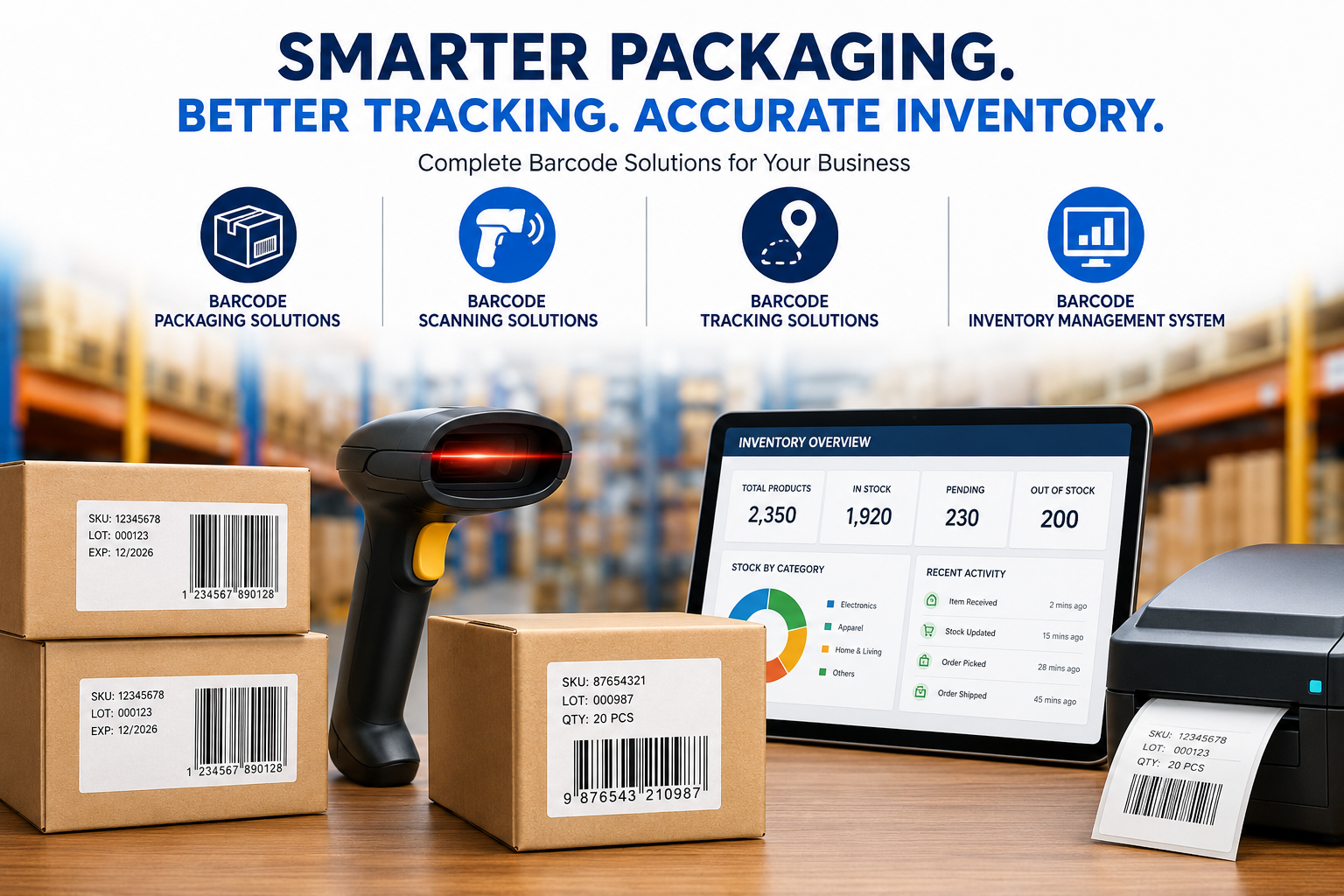
For businesses looking to modernise their packaging processes, integrating barcode packaging solutions, barcode scanning solutions, barcode tracking solutions and a barcode inventory management system can create a more connected approach to product identification and inventory control.
What Are Barcode Packaging Solutions?
Barcode packaging solutions involve incorporating machine-readable barcodes into product labels, cartons, packages, pallets or other packaging materials. These barcodes can contain information such as product identification numbers, batch details, serial numbers or other data required for tracking.
A well-designed barcode label needs to be clear, durable and compatible with the scanners used throughout the supply chain. Factors such as barcode size, print quality, material, adhesive strength and environmental conditions can all affect scanning performance.
For example, packaging used in cold storage may require labels that withstand moisture and low temperatures, while industrial packaging may need durable labels that resist abrasion, chemicals or handling. Selecting the right barcode label solution therefore involves considering both the application and the environment in which the package will be used.
How Barcode Scanning Solutions Improve Operations
Barcode scanning is an important part of modern inventory and logistics workflows. Barcode scanning solutions allow businesses to capture product information quickly without relying on manual data entry.
Employees can scan a barcode during receiving, picking, packing, dispatch or stock checking. The information can then be transferred to the relevant inventory or business management system, helping teams maintain more accurate records.
Barcode scanning can provide several operational benefits:
-
Faster product identification
-
Reduced manual data-entry errors
-
More efficient warehouse processes
-
Easier stock verification
-
Faster order fulfilment
-
Improved visibility across operations
Instead of manually entering product codes, employees can scan labels and retrieve the relevant information within seconds. This can be particularly valuable for businesses handling large product volumes or frequent stock movements.
The Role of Barcode Tracking Solutions
Knowing where products are and how they move through the supply chain is essential for efficient operations. Barcode tracking solutions help businesses monitor products from manufacturing and storage through distribution and delivery.
Each barcode can act as a unique identifier that connects a physical product or package with digital information. When the barcode is scanned at different stages, businesses can record important events and update their systems.
For example, a product may be scanned when it enters a warehouse, moves to a picking location, is packed for dispatch and leaves the facility. These scanning events create a digital record of the product's movement.
Barcode tracking can be especially useful for:
-
Manufacturing operations
-
Warehouses and distribution centres
-
Retail supply chains
-
Logistics companies
-
Pharmaceutical and healthcare businesses
-
Food and beverage operations
-
E-commerce fulfilment
Better tracking can also help businesses identify process bottlenecks and investigate discrepancies between expected and actual inventory movements.
Barcode Inventory Management System for Better Stock Control
Inventory accuracy directly affects purchasing, fulfilment, customer service and operational costs. A barcode inventory management system can help businesses maintain more reliable stock records by connecting barcode identification with inventory data.
When stock arrives, employees can scan the barcode to record the item. During internal movement, picking or dispatch, another scan can update its status or location. This creates a more structured inventory workflow and reduces dependence on spreadsheets or manual records.
A barcode-based system can support functions such as:
-
Stock receiving and put-away
-
Inventory counting
-
Product location tracking
-
Order picking
-
Packing and dispatch
-
Stock replenishment
-
Returns management
-
Batch and serial number tracking
Businesses can also use the data generated through scanning to understand stock movement and identify products that require replenishment or closer monitoring.
Choosing the Right Barcode Packaging Approach
Not every business has the same packaging requirements. Before implementing barcode solutions, organisations should consider the type of products being labelled, the packaging material, scanning distance, storage environment and expected volume of operations.
The barcode itself should also be selected according to the required data capacity and scanning requirements. Common barcode formats include linear barcodes and two-dimensional codes such as QR codes.
Print quality is equally important. A poorly printed or damaged barcode may cause scanning failures and interrupt workflows. Using suitable label materials, printers and verification processes can help maintain consistent readability.
Businesses should also consider how barcode labels will integrate with existing warehouse, inventory, ERP or point-of-sale systems. A solution that works effectively across the entire workflow can provide greater long-term value than a barcode label designed only for a single operational stage.
Building a More Connected Supply Chain
Barcode technology becomes more powerful when packaging, scanning and inventory systems work together. Instead of treating labels as simple identification tools, businesses can use them as a connection between physical products and digital information.
A package can carry its barcode, the scanner can capture the identification data, and the inventory system can use that information to update stock records. This creates a streamlined flow of information across different operational stages.
For growing businesses, this approach can also provide a foundation for improving automation and supply chain visibility. As product volumes increase, automated identification and tracking can help organisations manage operations without relying entirely on manual processes.
Conclusion
Effective product identification is essential for businesses that want accurate inventory records and efficient supply chain operations. Barcode packaging solutions provide the physical foundation for reliable product identification, while barcode scanning solutions enable fast data capture. Barcode tracking solutions help businesses monitor product movement, and a barcode inventory management system can connect these activities with stock control processes.
By choosing suitable barcode labels, printing technologies and scanning systems, businesses can build a more accurate and efficient approach to packaging and inventory management. The right solution can help reduce manual work, improve operational visibility and support smoother movement of products from warehouse to customer.
Categorii
Citeste mai mult
International Montessori Teacher Training Institute Chennai – Your Gateway to a Global Teaching Career (2026) Are you looking for an International Montessori Teacher Training Institute in Chennai? As Montessori education continues to gain recognition across the world, professionally trained Montessori teachers are in demand in preschools, Montessori schools, international...

Bravest Studios: A Bold Vision in Modern Streetwear In the fast-paced and highly competitive world of streetwear, only a few brands manage to stand out with originality, creativity, and confidence. Bravest Studios is one such brand that has carved its own identity by blending bold design with a fearless attitude. Known for its unique approach to fashion, the brand has gained popularity among...

In today’s fast-moving lifestyle, weight management has become a major concern for millions of people worldwide. Slow metabolism, low energy levels, frequent cravings, and stubborn fat often make it difficult to achieve fitness goals even with diet and exercise. As a result, many individuals are searching for natural metabolism boosters, coffee weight loss supplements, and fat-burning...

The latest business intelligence report released by Polaris Market Research on Home Healthcare Market Share, Size, Trends & Industry Analysis Report By Component (Equipment, Service); By Region; Segment Forecast, 2025 - 2034. It covers the in-depth knowledge of the Home Healthcare Market Share that includes opportunities, growth factors, and challenges. The research analysts prepared the...

Varicocele is one of the most common disorders affecting the male reproductive system. It is characterized by the enlargement and twisting of veins inside the scrotum, specifically within the pampiniform plexus, a network of veins responsible for draining blood from the testicles. The condition is often compared to varicose veins in the legs because both involve abnormal swelling of...