


Critical-Mineral Concerns Boost Demand for Sulfur-Based Batteries Worldwide
Global Lithium-Sulfur Battery Market Poised for Rapid Expansion as High-Energy-Density Storage Gains Momentum
Global Lithium-Sulfur Battery Market Overview
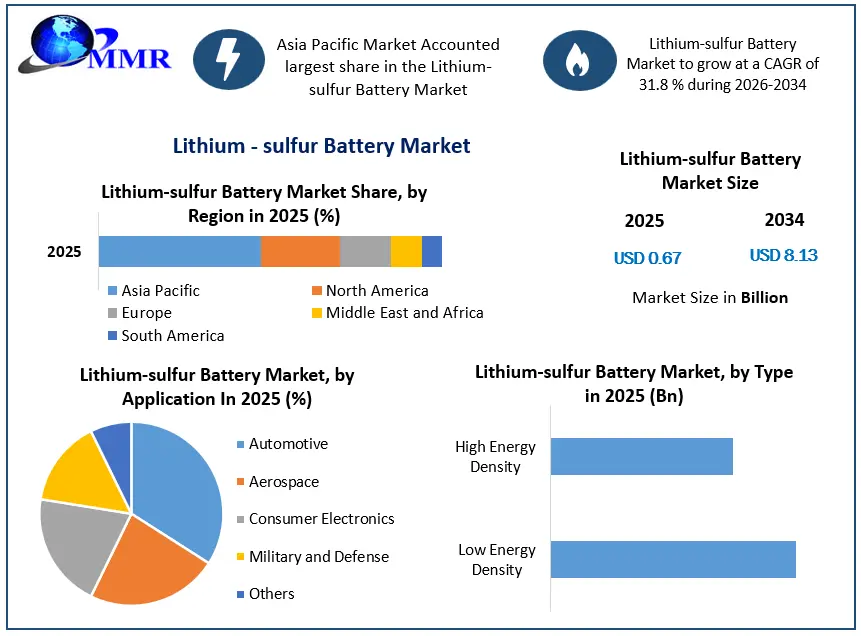
The Global Lithium-Sulfur Battery Market is entering a high-growth phase as manufacturers and research organizations pursue battery chemistries capable of delivering higher energy density, lower material costs, reduced weight, and improved supply-chain resilience. According to Maximize Market Research, the market was valued at USD 0.67 billion in 2025 and is expected to grow at a CAGR of 31.8% from 2026 to 2034, reaching nearly USD 8.13 billion by 2034.
Lithium-sulfur batteries are attractive because sulfur is widely available and significantly reduces dependence on materials such as cobalt, nickel, manganese, and graphite used in conventional battery chemistries. Their lightweight characteristics and high theoretical energy density create opportunities across electric vehicles, aerospace, drones, satellites, military systems, consumer electronics, and stationary energy storage. The market is also benefiting from global decarbonization programs, rising EV adoption, renewable-energy integration, and increasing demand for high-performance energy-storage systems.
A major opportunity lies in applications where weight and energy density are critical, particularly aerospace and defense. Li-S batteries can potentially deliver longer operating durations without proportionally increasing battery weight. Growing microgrid deployment and renewable-energy storage are also creating opportunities as countries seek flexible systems capable of balancing intermittent solar and wind generation.
However, commercialization continues to face technical challenges, particularly polysulfide shuttle effects, lithium-metal instability, degradation, and cycle-life limitations. Research into advanced electrolytes, sulfur cathodes, solid-state configurations, and protective materials is therefore becoming central to market development.
* Download the Full Market Report: https://www.maximizemarketresearch.com/request-sample/226050/
US Market Trends and Investment
The United States is emerging as an important growth center for lithium-sulfur technology because of its focus on domestic battery manufacturing, defense applications, aerospace, drones, and supply-chain independence. In 2025, Lyten expanded its U.S. lithium-sulfur manufacturing strategy by securing domestically sourced sulfur for facilities in California and Nevada. The company also planned additional investment in its San Leandro manufacturing operation and was developing a larger Nevada gigafactory. In July 2025, Lyten announced more than $200 million in additional equity investment, taking total investment in the company above $625 million. The company also advanced lithium-sulfur applications for drones and U.S. national-security requirements during 2025, highlighting the importance of lightweight, high-energy batteries for aerospace and defense.
Market Segmentation
According to the supplied Maximize Market Research report, the Lithium-Sulfur Battery Market is segmented by Type, Battery Capacity, Application, and Region. Type is divided into Low Energy Density and High Energy Density; battery capacity includes Below 500 mAh, 500–1000 mAh, and Above 1000 mAh; while applications include Automotive, Aerospace, Consumer Electronics, Military and Defense, and Others.
The High Energy Density segment is expected to experience significant growth during the forecast period. Its ability to provide longer operating durations from comparatively smaller and lighter battery systems makes it particularly attractive for EVs, aerospace, drones, and other demanding applications.
By region, Asia Pacific held the dominant position in the global market and is expected to maintain its leadership. China, Japan, and South Korea are important contributors to regional battery development, while government initiatives and investments in advanced battery technologies are supporting the ecosystem.
Lithium-sulfur Battery Key Players:
1. Bettergy Corp. (Peekskill, New York.)
2. TRU Group Inc. (Tucson, Arizona, United States)
3. Zeta Energy LLC (Houston, Texas )
4. CIC energiGUNE (Vitoria, Álava.)
5. Giner Inc. (Newton, Massachusetts, US.)
6. Gelion Technologies Pty Ltd. (Australasia)
7. Theion (Germany)
8. Ilika PLC (UK )
9. Poly Plus Battery Co. (Berkeley, CA,)
10. Iolitec Ionic Liquids Technologies GmbH (Germany)
11. Lyten Inc. (San Jose, California)
12. Merck KGaA (Darmstadt, Germany.)
13. LG Chem Ltd. (Seoul, South Korea.)
14. Rechargion Energy Pvt. Ltd. (Pune, Maharashtra.)
15. Shenzhen Uscender Industrial Co. Ltd. (China)
16. Sion Power Corp. (United States)
17. Solid State PLC (Redditch, UK)
18. VTC Power Co. Ltd. (shenzhen)
19. Guang Dong Fullriver Industry Co. Ltd. (Guangdong)
20. NexTech Batteries (Carson City, Nevada)
21. Li-S Energy Ltd.
Competitive Analysis
The supplied report identifies Bettergy Corp., TRU Group Inc., Zeta Energy LLC, CIC energiGUNE, Giner Inc., Gelion Technologies, Theion, Ilika PLC, PolyPlus Battery Co., Iolitec Ionic Liquids Technologies, Lyten Inc., Merck KGaA, LG Chem, Sion Power, Li-S Energy, and other companies as key participants. Because the report does not provide individual percentage shares for the five largest companies, the companies below are presented as prominent market participants rather than an unsupported ranking by exact market share.
Zeta Energy is developing lithium-sulfur batteries using proprietary sulfurized-carbon technology designed to address the polysulfide shuttle problem while avoiding cobalt, nickel, manganese, and graphite. Its technology is aimed at improving energy density and reducing supply-chain complexity.
Gelion Technologies made substantial progress in 2025, including a multi-year collaboration with TDK, a £10.5 million oversubscribed capital raise, and development of its Nano-Encapsulated Sulfur cathode technology. The company also secured £533,000 of UK government DRIVE35 funding to support scale-up and validation with QinetiQ for defense, aerospace, and automotive applications.
Theion is developing sulfur-based batteries aimed at mobile and automotive applications, with the company pursuing commercialization of its high-energy-density chemistry. Theion is specifically identified among the key players in the MMR report.
Li-S Energy is developing semi-solid-state lithium-sulfur cells using proprietary nanomaterials including boron nitride nanotubes and Li-nanomesh technology to improve strength, cycle life, and performance.
Lyten is advancing a 3D-Graphene-enabled lithium-sulfur platform and expanding U.S. production. Its 2025 activities included domestic sulfur sourcing, manufacturing expansion, additional investment, and development of battery applications for drones, aerospace, energy storage, and transportation.
Regional Analysis
United States: North America is identified as a rapidly growing regional market, supported by energy-storage demand, military investment, renewable-energy integration, EV development, and domestic battery manufacturing initiatives.
United Kingdom: The UK is supporting Li-S development through government-backed programs. In 2025, Gelion's UK subsidiary received DRIVE35 funding for pouch-cell scale-up and validation, demonstrating institutional support for advanced battery commercialization.
Germany: Germany benefits from its strong automotive manufacturing base and growing investment in next-generation battery technologies. The presence of Theion also strengthens the country's role in European Li-S innovation.
France: France's automotive ecosystem and broader European transition toward lower-carbon mobility provide opportunities for advanced battery chemistries with higher energy density and reduced dependence on critical minerals.
Japan: Japan is an important battery-technology market, supported by its advanced electronics and automotive industries. Government efforts to encourage EV adoption are expected to contribute to lithium-sulfur battery demand.
China: China remains a major battery manufacturing and technology center within Asia Pacific. Its extensive EV, electronics, and energy-storage industries create substantial opportunities for next-generation battery technologies.
Conclusion
The Global Lithium-Sulfur Battery Market, valued at USD 0.67 billion in 2025, is projected to reach nearly USD 8.13 billion by 2034, advancing at a 31.8% CAGR.
In my view, the most significant growth opportunity will come from solving the industry's remaining cycle-life, polysulfide-shuttle, lithium-metal stability, and manufacturing-scale challenges. Success in these areas could allow Li-S batteries to move from specialized aerospace, defense, and drone applications into broader EV and stationary-storage markets.
The combination of high energy density, lightweight construction, sulfur availability, lower reliance on critical minerals, and domestic manufacturing potential gives lithium-sulfur technology a compelling long-term position. Continued investment in advanced sulfur cathodes, solid-state electrolytes, nanomaterials, and scalable manufacturing will be the key factor determining how quickly the technology progresses toward mainstream commercial adoption.
About Maximize Market Research
Maximize Market Research Pvt. Ltd. (MMR) is a global market research and consulting firm known for delivering accurate, actionable, and data-driven insights. Our expertise spans diverse industries — including medical devices, pharmaceuticals, technology, automotive, electronics, chemicals, personal care, and consumer goods. We provide services such as market-validated forecasts, competitive intelligence, strategic consulting, and industry impact analysis, helping businesses navigate market complexities and achieve sustainable growth.
Contact Maximize Market Research
MAXIMIZE MARKET RESEARCH PVT. LTD.
2nd Floor, Naval IT Park Phase 3,
Pune-Bangalore Highway, Narhe,
Pune, Maharashtra 411041, India.
📞 +91 9607365656
📧 sales@maximizemarketresearch.com
Categorías
Read More
The global Truffles Market is witnessing strong growth, fueled by increasing consumer demand for premium and gourmet food products, expanding culinary innovation, and growing popularity of luxury dining experiences. Truffles, known for their distinctive aroma and flavor, are increasingly being incorporated into a wide range of food applications, from fine dining to packaged gourmet...

The Indian escort KL Service: A Way to De-Stress De-stressing is achieved by hiring an Indian escort KL girl through a local agency in Malaysia. She will provide ultimate pleasure and relaxation for you. Take a break from your worry and enjoy every activity with your Indian escort KL girl in Malaysia, while fully relaxing without remorse for attempting something you cannot do with a normal...

Jake Paul Faces Top Rival After years of expressing his desire to challenge a top-tier puncher, Jake Paul finally faced his ultimate test in the ring. His goal was to take on one of boxing's most feared finishers, a fighter renowned for their knockout power and reputation for avoiding certain opponents. On December 19th, that challenge materialized in a spectacular showdown broadcast live on...

Die Anwendung der Fitralin Kapseln lässt sich denkbar einfach in den persönlichen Tagesablauf integrieren. Die empfohlene Dosis liegt bei zwei Kapseln täglich, die bevorzugt morgens oder mittags vor einer Hauptmahlzeit mit ausreichend Wasser egenommen werden. Aufgrund des enthaltenen Guarana-Koffeins empfiehlt es sich lediglich, die Kapseln nicht am späten Abend einzunehmen,...

Medical endoscopes are flexible or rigid tubular instruments equipped with a camera and light source used to visualize internal organs and body cavities. They are widely used for diagnostic and therapeutic procedures in gastroenterology, urology, gynecology, pulmonology, and orthopedics, offering reduced recovery time, lower risk of infection, and minimal scarring compared to traditional open...
