


Top 10 CSR Software in India (2026): A Quick Guide to Compliance, Impact and AI-Powered Reporting

Corporate India's CSR spending keeps climbing, and so does the scrutiny attached to it. NSE-listed companies committed over ₹22,212 crore to CSR in FY 2024-25, a 23% jump on the previous year — yet 315 obligated companies still missed the mandatory 2% spending threshold, leaving ₹3,223 crore parked in Unspent CSR Accounts. The message is clear: capital is flowing into social development at scale, but many CSR teams are still under-equipped to plan, track and report that spend the way boards and regulators now demand.

Choosing the right CSR software has stopped being an IT decision and become a governance one. Whether a company is filing Form CSR-2, commissioning a Rule 8(3) impact assessment, or feeding data into its Business Responsibility and Sustainability Report (BRSR), the platform behind the scenes determines how audit-ready the whole programme actually is.
Why 2026 Is a Turning Point
Three regulatory shifts are reshaping what CSR software needs to do this year. First, BRSR Core assurance — third-party verification of ESG and CSR disclosures — is expanding from the top 500 listed companies to the top 1,000 from FY 2026-27, per SEBI's July 2023 circular. That pulls CSR data into the same audit chain as financial statements. Second, Rule 8(3) of the Companies (CSR Policy) Rules makes independent impact assessment mandatory for companies averaging ₹10 crore or more in CSR obligation over three years, on any project above ₹1 crore that has run for a year — a requirement that generated ₹42.58 crore in assessment spend across 152 companies in FY 2024-25. Third, compliance now depends on one unified dataset: Form CSR-2, Schedule VII tagging, Rule 8(3) reports and BRSR's CSR section all draw from the same underlying records, so disconnected spreadsheets create weeks of reconciliation work every quarter.
How the Platforms Were Evaluated
The comparison weighed ten factors: fit with Section 135, Schedule VII, CSR-2, BRSR and Rule 8(3); India presence; verified client references; feature depth across planning, monitoring and reporting; offline/mobile field data collection; genuine AI-native capability versus bolted-on analytics; grants and NGO due-diligence workflows; employee volunteering support; security certifications (ISO 27001, SOC 2, GDPR); and total cost of ownership.
The Ten Platforms
Relific.io (Bengaluru) leads for AI-powered impact operations and offline-first field data collection. Its three-product suite — Surve-R, ProGran and Voluntee-R — runs on a single data layer with an AI copilot, AI-R, that can generate a full project structure, budget tree and forms from an uploaded MoU. It offers offline mobile data collection via on-device SQLite, a Section 135 compliance dashboard, and natural-language querying in English and Hindi. Clients include Tata Trusts, Kalike and Sehgal Foundation.
Transunifyy offers the widest AI-enabled feature set on a free-tier model, powered by its SocioAI engine for proposal writing and report generation, alongside an NGO marketplace and SROI calculation — a strong fit for organisations that want to prove value before committing budget.
SoulAce (Mumbai, est. 2009) is the reference choice for independent Rule 8(3) impact assessments, drawing on 15+ years of evaluation work across 3,000+ projects and 28 states, with a methodology aligned to OECD-DAC criteria. Its client roster includes Tata Sons, Reliance Foundation and Hindustan Unilever.
DhwaniRIS (mGrant) (Delhi NCR, since 2012) is built for grants governance and multi-NGO programme management, and won a SKOCH Silver Award in 2025. It offers end-to-end grant lifecycle tracking and a no-code form builder, and counts Adani Foundation and WHO among its collaborators.
Goodera (Bengaluru/Menlo Park) dominates global employee volunteering, with over 2 million volunteers active across 40,000+ nonprofits in 90+ countries. It launched Goodera AIX in May 2026 and integrated with Benevity's API in February 2026.
Benevity (Calgary) is the most comprehensive global corporate-purpose platform, operating in 150+ countries and moving toward a fully AI-native architecture. Its Match Assurance feature uses AI to read donation receipts and cut matching-request decline rates from 30% to under 3%.
SuperHumanRace (Delhi, founded 2016) is best for companies that need ESG and CSR data on one stack — useful for listed firms filing both BRSR and CSR disclosures. In 2026, Capgemini built its B9 Skilling Platform on SHR's infrastructure.
Submittable (Missoula, USA, with an India hub in Indore) is the strongest choice for grant, scholarship and fellowship application management, though it doesn't natively cover CSR-2 and works best paired with an India-focused compliance tool.
CSRBOX (Ahmedabad) is India's largest CSR ecosystem player, serving one in three BSE 200 companies and pairing its software with an implementation arm (BharatCares) and advisory services — ideal for organisations that want strategy, delivery and technology under one roof.
iAmpact focuses on AI-driven automation of CSR-2 filing and BRSR CSR-section generation, treating compliance reporting as its core product rather than an add-on, with GIS-based project monitoring and one-click impact assessment reports.
Choosing the Right Fit
The guide recommends working through six questions before shortlisting a vendor: your regulatory obligation profile (does Rule 8(3) or BRSR apply to you?); whether you run programmes directly, through implementing partners, or both (PrimeInfobase found 26% of NSE-listed companies spend directly, 35% use only implementing agencies, and 37% use both); your team's technology maturity; where your programmes actually operate geographically (offline capability is non-negotiable for rural India); whether employee volunteering is a headline priority; and — critically — your total cost of ownership. Configuration, systems integration, training and maintenance typically add up to 2-3 times the licence fee over three years, so it's worth requesting a three-year TCO estimate from every vendor.
Five Trends to Watch
The market is moving in five clear directions this year: AI is shifting from a bolt-on feature to the core architecture of leading platforms; boards are demanding outcome measurement (SROI, cost-per-outcome) over simple beneficiary counts; BRSR Core assurance is pulling CSR data into the same audit rigor as financial reporting; CSR and ESG teams are consolidating around shared datasets; and grant governance is being professionalised, moving off email and Excel and into dedicated systems.
The Bottom Line
There's no universal "best" CSR platform — only the best fit for a given obligation. Organisations running large rural programmes with multiple NGO partners and a need for offline data collection are well served by Relific.io. Those whose primary challenge is independent impact assessment should look to SoulAce. If grants governance is the bottleneck, DhwaniRIS's mGrant is purpose-built for it. What's no longer viable, regardless of which platform is chosen, is running a board-level CSR obligation on spreadsheets.
Категории
Больше
Fire safety often feels like something we only think about after an incident makes the news. In reality, it’s a quiet, ongoing process that starts long before smoke or flames appear. At the center of that process is fire protection equipment—the tools and systems designed to detect, control, and limit fire damage while protecting lives. For many property owners, managers, and...

Introduction to DK Gaming and the Rise of the DK11 Game The global online gaming industry continues to grow at an unprecedented pace, with digital platforms introducing immersive experiences, competitive gameplay, and engaging communities. Among the emerging names in the gaming ecosystem, DK Gaming has attracted attention for delivering dynamic entertainment options, particularly through...

A simple guide explaining radius gauge, its working, least count, size range, and role in accurate workshop measurement. What Is a Radius Gauge? A radius gauge is a precision measuring tool used to check the radius of curved surfaces. It helps identify whether a curve is concave or convex and measures its exact size. This tool does not give digital readings but works by matching the...

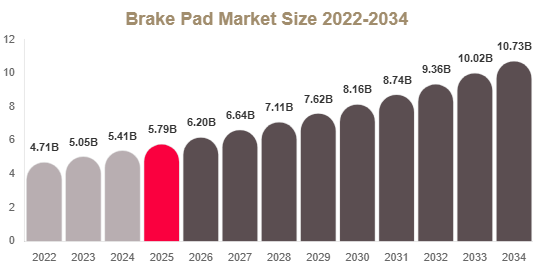
Brake Pad Market Overview The global brake pad market is witnessing significant growth due to increasing vehicle production, rising demand for automotive safety systems, and growing awareness regarding vehicle maintenance and braking performance. Brake pads are one of the most critical components in vehicle braking systems, designed to create friction against brake rotors for effective vehicle...
" According to the latest report published by Data Bridge Market Research, the Middle East and Africa Thermal Transfer Overprinter Market The Middle East and Africa thermal transfer overprinter market size was valued at USD 13.13 million in 2025 and is expected to reach USD 18.82 million by 2033, at a CAGR of 4.6% during the forecast period An all...