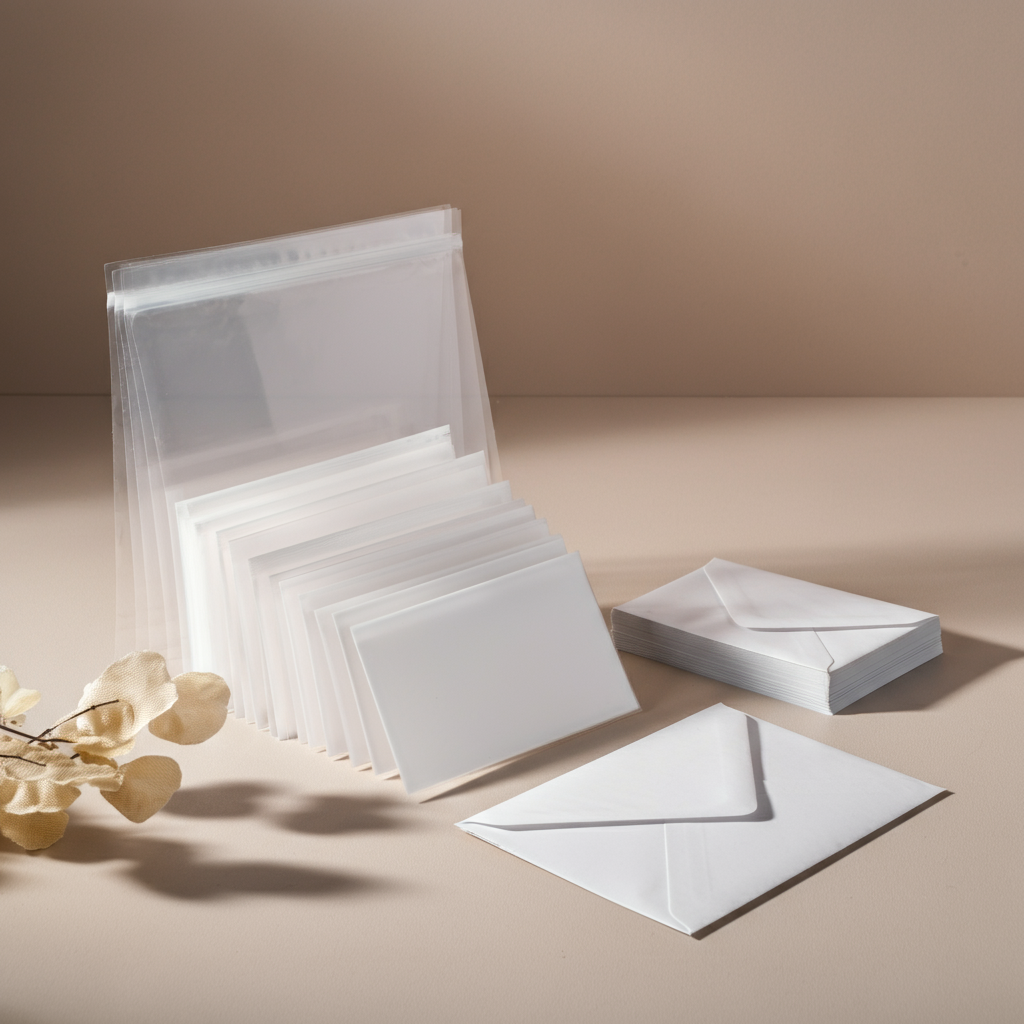
How to Choose the Right Size Cello Bag for Your Cards & Envelopes
Presenting your greeting cards, handmade creations, or important invitations in a professional manner is just as important as the item itself. A crisp, clear cello bag not only protects your work from dust, moisture, and fingerprints but also elevates its perceived value. However, choosing the wrong size can lead to a sloppy, unprofessional look or even damage the contents. This guide will walk you through everything you need to know to select the perfect cello bag size for your cards and envelopes every time.
We will cover how to measure your items correctly, understand bag dimensions, and explore different material options to ensure your products look their best.
Understanding the Basics of Cello Bag Sizing
Selecting the right cello bag isn’t as simple as matching the dimensions of your card. To achieve a snug, professional fit, you need to account for the thickness of your items and allow for a small amount of wiggle room. A bag that is too tight can be difficult to use and may bend your card, while one that is too loose will look untidy.
The key is to find a bag that is slightly larger than the item it will hold. As a general rule, adding a few millimetres to both the width and height of your card or envelope will give you the ideal bag dimensions.
How to Measure Your Cards and Envelopes
Accurate measurements are the foundation of a perfect fit. Before you start browsing for bags, take the time to measure your items correctly.
- Measure the Dimensions: Use a ruler or tape measure to find the exact width and height of your card or envelope. If you are packaging a card and its corresponding envelope together, always measure the largest item, which is typically the envelope.
- Account for Thickness: This is a crucial step that is often overlooked. If you are packaging a single flat card, the thickness may be negligible. However, for items with embellishments like bows, gems, or multiple layers of cardstock, you must consider the depth. Lay your item flat and measure its thickness.
- Calculate Your Ideal Bag Size: Once you have your measurements, add a small allowance. A good starting point is to add 2-4mm to the width and height of your item. For thicker items, you may need a slightly larger allowance. For example, if your envelope measures 130mm x 180mm, you should look for a cello bag that is approximately 133mm x 184mm.
Navigating Standard Card and Envelope Sizes
The stationery industry uses standard sizing conventions, which can make finding the right cello bag much simpler. Many cello bags are manufactured specifically to fit these common envelope sizes. Familiarising yourself with these can save you a lot of time.
Here are some of the most common sizes and the cello bags designed to fit them:
- C6 Envelopes (114mm x 162mm): These are designed for A6 cards (an A5 sheet folded in half). Look for cello bags specifically labelled to fit C6 envelopes. These bags will have slightly larger dimensions to provide a perfect fit.
- C5 Envelopes (162mm x 229mm): Used for A5 cards (an A4 sheet folded in half), C5 is a popular size for larger greeting cards and official correspondence. Cello bags for C5 envelopes will accommodate these dimensions with ease.
- Square Envelopes: Square cards offer a modern, stylish look and come in various dimensions, such as 130mm x 130mm or 155mm x 155mm. You can find cello bags made to fit these specific square sizes. Always measure your square envelope and add a few millimetres to find the corresponding bag.
- Other Common Sizes: You will also find envelopes and cards in sizes like 125mm x 175mm and 133mm x 184mm. Specialised cello bags are available for these popular dimensions, taking the guesswork out of your selection.
By searching for a cello bag designed for your specific envelope size (e.g., “Cello bag for C5 envelope”), you can quickly find a product that is guaranteed to fit.
Choosing the Right Cello Bag Material
Beyond size, the material of the bag itself is an important consideration. The type of film affects the bag’s clarity, durability, and environmental impact.
Polypropylene Bags
Often referred to as ‘poly bags‘, these are the industry standard. Polypropylene is a type of plastic prized for its exceptional clarity, which allows the design and colours of your card to shine through without distortion. These bags are also strong, flexible, and resistant to tearing, providing excellent protection for your products during handling and display. Most polypropylene bags come with a peel-and-seal strip for quick and secure closure.
Compostable Bags
For those seeking an eco-friendly alternative, compostable cello bags are an excellent choice. Made from plant-based materials like Nativia® film, these bags are designed to break down under industrial composting conditions. They offer great transparency and product protection, similar to traditional polypropylene bags, but with the added benefit of being kinder to the planet. Many compostable bags feature printed messages to inform the end-user of their eco-friendly properties, adding value to your product.
Final Considerations for a Perfect Presentation
With the right size and material selected, you are well on your way to a professional finish. Keep these final tips in mind:
- Seal Type: Most cello bags come with a self-adhesive peel-and-seal strip. This is the most convenient option, creating a neat and secure closure. Ensure the adhesive strip is on the body of the bag, not the flap, for a cleaner look when sealed.
- Custom Sizes: If you create cards or products with unique dimensions, standard bag sizes may not work. Many suppliers offer custom-sized cello bags, allowing you to get the perfect fit for any item.
Choosing the right cello bag is a small detail that makes a big difference. By carefully measuring your items, understanding standard sizes, and selecting the appropriate material, you can ensure your cards and creations are presented beautifully and protected effectively.
Frequently Asked Questions (FAQ)
Q: What are cello bags made from?
A: The term “cello bag” originally referred to cellophane, but nowadays most are made from biaxially-oriented polypropylene (BOPP). This material provides excellent clarity and durability. Eco-friendly options are also available, typically made from plant-based, compostable films such as polylactic acid (PLA).
Q: How do I measure for a cello bag?
A: To measure for a cello bag, start by placing your card or envelope on a flat surface. Measure its width and height. Then, check its depth, particularly if it includes any embellishments. Add around 2-4mm to the width and height measurements to ensure the item slides in easily and fits snugly without being too tight.
Q: Are cello bags recyclable?
A: Polypropylene cello bags can technically be recycled, but you’ll need to check with your local recycling facility, as not all centres accept soft plastics. Compostable cello bags aren’t suitable for recycling and should be put into an industrial composting bin where available.
Q: What is the difference between a C5 and C6 envelope?
A: C5 and C6 are standard international paper sizes. A C6 envelope measures 114mm x 162mm and is designed to hold an A6 card. A C5 envelope is larger, measuring 162mm x 229mm, and is made to hold an A5 card.
Nach Verein filtern
Read More
According to a new report from Intel Market Research, Global Smart Airport Technologies market was valued at USD 10.4 billion in 2024 and is projected to reach USD 25.96 billion by 2032, growing at a robust CAGR of 13.8% during the forecast period (2025–2032). đ„ Download Sample Report: Smart Airport Technologies Market - View in Detailed Research Report This transformation is being...
The aerospace accumulator market is expected to witness market growth at a rate of 3.50% in the forecast period of 2021 to 2028 and is expected to reach USD 10.98 million by 2028. The global business landscape is undergoing a transformation, with industries increasingly leaning on deep research and actionable insights to make strategic decisions. One segment seeing tremendous traction is...
Creating a safe and efficient outdoor electrical system begins with choosing a Weatherproof db box that offers reliable protection against rain, dust, and environmental challenges. These boxes are essential for maintaining power continuity in residential, commercial, and industrial outdoor applications. Long-Term Protection from Environmental Damage Outdoor environments pose serious risks to...
Erleben Sie die Vielfalt der indischen Küche im besten Indischen Curry Restaurant in Zürich. Genießen Sie authentische Gewürze, aromatische Currys und frisch zubereitete Spezialitäten in gemütlicher Atmosphäre. In Zürich, einer Stadt, die für ihre kulturelle Vielfalt bekannt ist, hat sich die indische Küche als fester Bestandteil etabliert. Ein...
More families than ever depend on airlines to help children travel alone—whether for school breaks, family visits, custody arrangements, or international programs. To ensure every young traveler is protected, airlines offer specialized services for unaccompanied minors flying, providing round-the-clock supervision and secure handling from departure to arrival. This article explains...