Grooving Insert Buying Guide: Types, Sizes & CNC Selection Tips
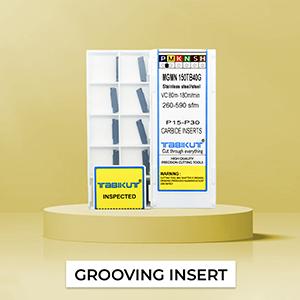
Explore our complete grooving insert buying guide covering grooving insert type, face grooving inserts, 1 mm grooving insert, and CNC grooving insert selection tips.
Grooving Insert Buying Guide: Everything You Need to Know
In CNC machining and precision turning, selecting the right cutting tool plays a critical role in productivity and surface finish. One such essential tool is the grooving insert, widely used for creating grooves, recesses, and narrow cuts in metal components. Whether you are working on automotive parts, aerospace components, or general engineering products, choosing the correct insert can directly impact tool life, machining accuracy, and cost efficiency.
What Is a Grooving Insert?
A grooving insert is a replaceable cutting tip mounted on a tool holder, mainly used in CNC lathes and turning centers to create internal or external grooves. Unlike traditional tools that require regrinding, inserts are indexable and easy to replace, which reduces downtime.
These inserts are typically made from carbide, cermet, ceramic, or coated materials to withstand high temperatures and cutting pressure. Their geometry is specially designed to ensure clean cuts and smooth chip evacuation.
Why Choosing the Right Insert Matters
Selecting the wrong insert can lead to:
-
Poor surface finish
-
Excessive vibration
-
Short tool life
-
Increased production costs
Tool breakage
On the other hand, the correct grooving insert improves accuracy, consistency, and machining speed while maintaining dimensional precision.
Types of Grooving Inserts
Understanding each grooving insert type helps you select the correct one based on your machining needs.
1. External Grooving Inserts
These are used for cutting grooves on the outer diameter of a workpiece. They are common in shaft manufacturing and threaded components.
2. Internal Grooving Inserts
Designed for cutting grooves inside a bore. They require precise alignment and strong chip control due to limited space.
3. Face Grooving Inserts
As the name suggests, face grooving inserts are used to machine grooves on the face of a component. These inserts are essential when working on parts that require front-side grooving operations, such as hydraulic fittings and bearing housings.
4. Narrow Width Inserts
A 1 mm grooving insert is ideal for fine and precision grooves where tight tolerances are required. These are commonly used in electronics, medical components, and miniature engineering applications.
Material and Coating Options
Material selection directly affects performance and tool life.
Carbide Inserts
Carbide is the most common material due to its strength, heat resistance, and wear resistance. It is suitable for steel, stainless steel, and cast iron.
Coated Inserts
Coatings such as TiN, TiAlN, or PVD coatings enhance hardness and reduce friction. A coated grooving insert performs better in high-speed CNC operations.
Cermet Inserts
Best suited for finishing operations, offering excellent surface finish.
Key Factors to Consider Before Buying
When purchasing a grooving insert, evaluate the following:
1. Workpiece Material
Different materials require different grades. For example:
-
Steel → Tough coated carbide
-
Stainless steel → Heat-resistant grade
-
Aluminium → Sharp edge with polished surface
2. Groove Width Requirement
The groove width determines insert size. For narrow grooves, a 1 mm grooving insert is appropriate. For wider grooves, choose accordingly.
3. Cutting Speed and Feed Rate
High-speed machining requires a durable insert with proper coating.
4. Machine Compatibility
Make sure the insert fits your tool holder and machine setup. A cnc grooving insert is specifically designed for CNC lathes, offering precision and repeatability.
5. Chip Control
Proper chip breakers are essential to prevent chip clogging, especially in deep grooves.
Insert Geometry and Design
The geometry of a grooving insert
affects performance significantly.
-
Rake angle influences cutting force.
-
Relief angle prevents rubbing.
-
Edge preparation improves durability.
-
Chip breaker design ensures efficient chip evacuation.
Choosing the right geometry ensures stable cutting and extended tool life.
Applications Across Industries
Grooving inserts are widely used in:
-
Automotive industry (piston rings, shafts)
-
Aerospace components
-
Oil and gas fittings
-
Hydraulic parts
-
General machining workshops
In CNC production environments, a high-quality grooving insert ensures consistent results and reduced tool replacement frequency.
Common Problems and Solutions
1. Insert Chipping
Cause: Incorrect speed or feed
Solution: Optimize cutting parameters and use the correct grade.
2. Poor Surface Finish
Cause: Worn insert or vibration
Solution: Replace insert and check machine stability.
3. Chip Clogging
Cause: Improper chip breaker
Solution: Select correct chip breaker design.
4. Excessive Tool Wear
Cause: Wrong material grade
Solution: Choose insert based on workpiece hardness.
Cost vs Performance: What to Prioritize?
While cheaper inserts may seem attractive, they often reduce efficiency. Investing in a premium-quality grooving insert may initially cost more but savemoney in the long run by:
-
Increasing productivity
-
Reducing downtime
-
Improving consistency
-
Lowering scrap rate
Maintenance and Handling Tips
To extend insert life:
-
Store inserts in the original packageing
-
Avoid dropping or mishandling
-
Use proper torque when clamping
-
Monitor wear regularly
-
Replace at the right time
Proper maintenance ensures maximum performance and safety.
Future Trends in Grooving Inserts
Modern machining demands higher speeds and tighter tolerances. Many manufacturers are developing advanced coatings, improved chip breakers, and specialised geometries to meet evolving industry needs. With automation increasing, selecting the correct grooving insert for CNC environments is more important than ever.
FAQs
1. What is the main purpose of a grooving insert?
It is used to create precise grooves in internal, external, or face machining operations in CNC lathes.
2. When should I use face grooving inserts?
They are ideal for machining grooves on the front face of a workpiece, especially in hydraulic and automotive components.
3. Is a 1 mm grooving insert suitable for heavy-duty cutting?
No, it is mainly designed for narrow, precision grooves and light-duty applications.
4. What makes a CNC grooving insert different?
It is optimized for CNC machines, offering better accuracy, repeatability, and compatibility with automated machining systems.
5. How do I choose the right grooving insert type?
Consider groove width, workpiece material, cutting speed, and machine compatibility before selecting.
Conclusion
Choosing the right insert requires understanding material compatibility, groove size, geometry, and machining conditions. By carefully evaluating your needs and selecting the proper insert, you can significantly improve machining efficiency, tool life, and overall productivity.
About Jaibros
Jaibros is a trusted supplier of high-quality CNC cutting tools and industrial solutions. With a strong focus on precision, durability, and performance, Jaibros provides reliable tooling products designed to meet modern manufacturing demands across various industries.
Categorie
Leggi tutto
Market Overview The carbon capture construction materials (CCCM) market is emerging as a transformative force in the global construction industry, offering innovative solutions to embed captured CO₂ into building materials. According to Polaris Market Research, the market was valued at USD 27.98 million in 2024 and is projected to grow from USD 39.74 million in 2025 to USD 961.68...

Healthcare expenses can become a major financial consideration as parents grow older. After the age of 70, the need for regular medical consultations, diagnostic tests, hospitalisation support, and specialised treatments may increase. Having suitable health coverage helps families manage these expenses while ensuring that senior family members can access quality healthcare when required. Buying...
Online poker has grown into one of the most popular forms of digital gaming, and Poker Online Poker88 is a platform that has gained recognition for its reliability, variety, and player-friendly interface. Whether you are a beginner or an experienced player, understanding how to approach the platform can make your poker experience both enjoyable and strategic. This guide explains how Poker...

U.S. Self-levelling Concrete Market According to the latest report published by Data Bridge Market Research, the U.S. Self-levelling Concrete Market The U.S. self-leveling concrete market size was valued at USD 1.02 billion in 2024 and is projected to reach USD 1.67 billion by 2032, growing at a CAGR of 6.3% during the forecast period. In this persuasive U.S. Self-levelling Concrete...
The global medical tourism market is witnessing strong expansion as international patients increasingly travel across borders to access cost-effective, high-quality healthcare services. Rising healthcare costs in developed economies, long waiting times for elective procedures, and improved access to advanced treatments in emerging countries are reshaping the competitive landscape. In this...