


Managed Cloud Services Market Landscape: Insights from SPARK Matrix™ Q4 2024
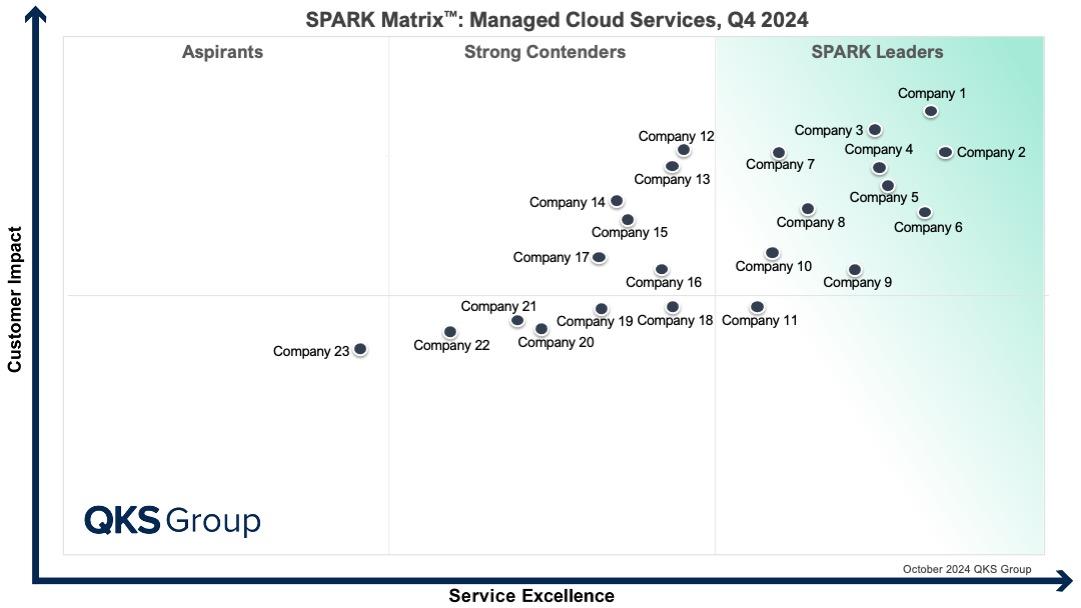
The SPARK Matrix™: Managed Cloud Services market is witnessing significant growth as organizations increasingly adopt cloud platforms to manage and optimize their IT infrastructure. As businesses continue their digital transformation journeys, the demand for specialized expertise to manage complex cloud environments has grown substantially. Managed Cloud Services refer to the outsourcing of cloud infrastructure and application management to third-party service providers who ensure that cloud systems operate efficiently, securely, and reliably. By leveraging these services, organizations can focus on their core business operations while relying on expert providers to manage their cloud environments effectively.
Managed Cloud Services play a crucial role in helping organizations simplify IT operations while maximizing the benefits of cloud computing. Managing cloud infrastructure internally can be complex, requiring skilled personnel, continuous monitoring, and regular updates to maintain optimal performance and security. Through managed services, organizations can reduce the operational burden of maintaining cloud systems while gaining access to specialized expertise, advanced tools, and proven best practices. This approach allows enterprises to improve operational efficiency, enhance system reliability, and accelerate the adoption of innovative technologies without making heavy investments in internal cloud management capabilities.
Another major advantage of Managed Cloud Services is the ability to support scalable and flexible IT environments. As organizations expand their operations and adopt new digital technologies, their IT infrastructure must be able to scale accordingly. Managed cloud providers offer flexible service models that enable businesses to scale resources up or down based on demand. This flexibility helps organizations maintain cost efficiency while ensuring that their IT infrastructure can support evolving business requirements. In addition, managed services providers help enterprises optimize their cloud usage by continuously monitoring workloads, improving resource allocation, and implementing cost management strategies.
Managed Cloud Services typically include a wide range of capabilities that support the entire cloud lifecycle. These services often begin with cloud migration, where providers assist organizations in moving their applications and workloads from on-premises environments to public, private, or hybrid cloud platforms. Migration services involve careful planning, risk assessment, and execution to ensure minimal disruption to business operations. Once migration is complete, managed service providers continue to support organizations through cloud-native development, infrastructure management, and performance optimization. By leveraging cloud-native technologies such as containers, microservices, and automation tools, organizations can modernize their applications and improve overall system efficiency.
Security is another critical component of SPARK Matrix™: Managed Cloud Services market. As cyber threats become more sophisticated, organizations must ensure that their cloud environments are protected from vulnerabilities and unauthorized access. Managed cloud providers implement advanced security measures including identity and access management, threat detection, encryption, compliance monitoring, and vulnerability management. These services are particularly important for industries that operate under strict regulatory requirements, such as banking, healthcare, and telecommunications. By partnering with managed cloud service providers, organizations can strengthen their security posture while ensuring compliance with industry regulations and data protection standards.
In addition to security, Managed Cloud Services focus on continuous monitoring and optimization of cloud environments. Providers use advanced monitoring tools and analytics to track system performance, identify potential issues, and implement proactive solutions. This continuous optimization ensures that cloud resources are used efficiently, minimizing downtime and maximizing application performance. Managed services also support business continuity and disaster recovery planning, enabling organizations to quickly recover from unexpected disruptions and maintain uninterrupted operations.
The adoption of Managed Cloud Services is growing rapidly across multiple industries. Sectors such as banking and financial services, healthcare, telecommunications, retail, and manufacturing are increasingly relying on cloud-based technologies to support digital operations and deliver innovative services to customers. These industries often require secure, reliable, and scalable IT infrastructures that can support high transaction volumes and complex workloads. Managed cloud providers help organizations meet these requirements by offering specialized solutions tailored to industry-specific needs.
QKS Group’s Managed Cloud Services market research provides a comprehensive analysis of the global market landscape and key service providers. The research examines the capabilities, service offerings, and strategic positioning of leading vendors operating in this market. It evaluates service features, technological capabilities, and competitive differentiators that enable organizations to select the most suitable service providers for their cloud management needs. The research also offers valuable insights into market trends, growth opportunities, and emerging technologies shaping the future of the Managed Cloud Services market.
In addition to market analysis, the research provides an in-depth evaluation of the competitive landscape through QKS Group’s proprietary SPARK Matrix framework. The SPARK Matrix is a powerful analytical tool that assesses vendors based on their technological excellence and customer impact. This evaluation framework enables organizations to understand how different vendors compare in terms of innovation, service capabilities, and market presence. The SPARK Matrix also provides a detailed ranking and positioning of vendors that have a significant global impact on the Managed Cloud Services market.
The study includes a comprehensive evaluation of several leading Managed Cloud Services providers that play a key role in shaping the global cloud services ecosystem. These vendors include Accenture, TCS, Tech Mahindra, IBM, Infosys, Wipro, Capgemini, Deloitte, Coforge, DXC Technology, UST, HCL Technologies, Cognizant, Virtusa, Atos, Fujitsu, GAVS Technologies, NTT Data, Rackspace, Ensono, Mphasis, YASH Technologies, and Happiest Minds. Each vendor is analyzed based on its service portfolio, technological innovation, strategic initiatives, and ability to support enterprises in their cloud transformation journeys.
According to Manish Chand Thakur, Senior Analyst at QKS Group, the growing adoption of hybrid and multi-cloud strategies is one of the primary drivers of the Managed Cloud Services market. Organizations are increasingly moving away from traditional on-premises IT infrastructures in favor of cloud-based environments that offer greater flexibility, scalability, and cost efficiency. Hybrid and multi-cloud models allow enterprises to distribute workloads across multiple platforms, enabling them to optimize performance, improve reliability, and reduce vendor dependency.
Furthermore, the increasing reliance on digital technologies and the need to modernize legacy systems are encouraging organizations to adopt cloud-based solutions. SPARK Matrix™: Managed Cloud Services market play a vital role in helping businesses transition from outdated infrastructure to modern, cloud-enabled environments. These services support improved business continuity, robust disaster recovery capabilities, and seamless remote working environments. As organizations continue to prioritize digital transformation, the demand for Managed Cloud Services is expected to grow steadily, creating significant opportunities for service providers and technology vendors worldwide.
Categorías
Read More
Finding reliable academic support can be challenging when statistics assignments involve complex calculations, data interpretation, and analytical techniques. Students often need guidance that not only helps them complete assignments but also improves their understanding of the subject. With numerous academic support platforms available, selecting the right service requires careful evaluation....

Searching for oriental rug cleaning near me usually happens for one reason—you need help quickly. Maybe there’s a fresh coffee spill, pet accident, or years of dullness that suddenly feels impossible to ignore. While professional cleaning is the safest long-term solution, knowing a few quick tips can protect your rug until experts step in. In many UK homes, especially in busy cities...

The Nano Silica Market has been experiencing steady growth due to its wide-ranging applications in construction, automotive, electronics, coatings, and chemical industries. Nano silica is valued for its exceptional mechanical strength, thermal stability, and chemical resistance, making it essential for high-performance concrete, polymers, adhesives, and rubber products. Growing...

Trong môi trường kỹ thuật số cạnh tranh mạnh mẽ và liên tục đổi mới, nhiều nền tảng lựa chọn cách phát triển nhanh, mở rộng quy mô ồ ạt và tập trung vào quảng bá ngắn hạn để thu hút sự chú ý. Tuy nhiên, https://open88-co.com/ lại xây dựng cho mình một hướng đi khác biệt,...
Gurgaon, the bustling financial hub of Haryana often referred to as the Millennium City, is more than just skyscrapers, corporate offices, and luxury malls. Beneath its fast-paced corporate veneer lies a vibrant world of exclusive adult entertainment. Gurgaon escorts services have emerged as one of the most sought-after companionship options for professionals, travelers, and high-net-worth...
