


Why Google Rankings Are Now Obsolete Due to ChatGPT
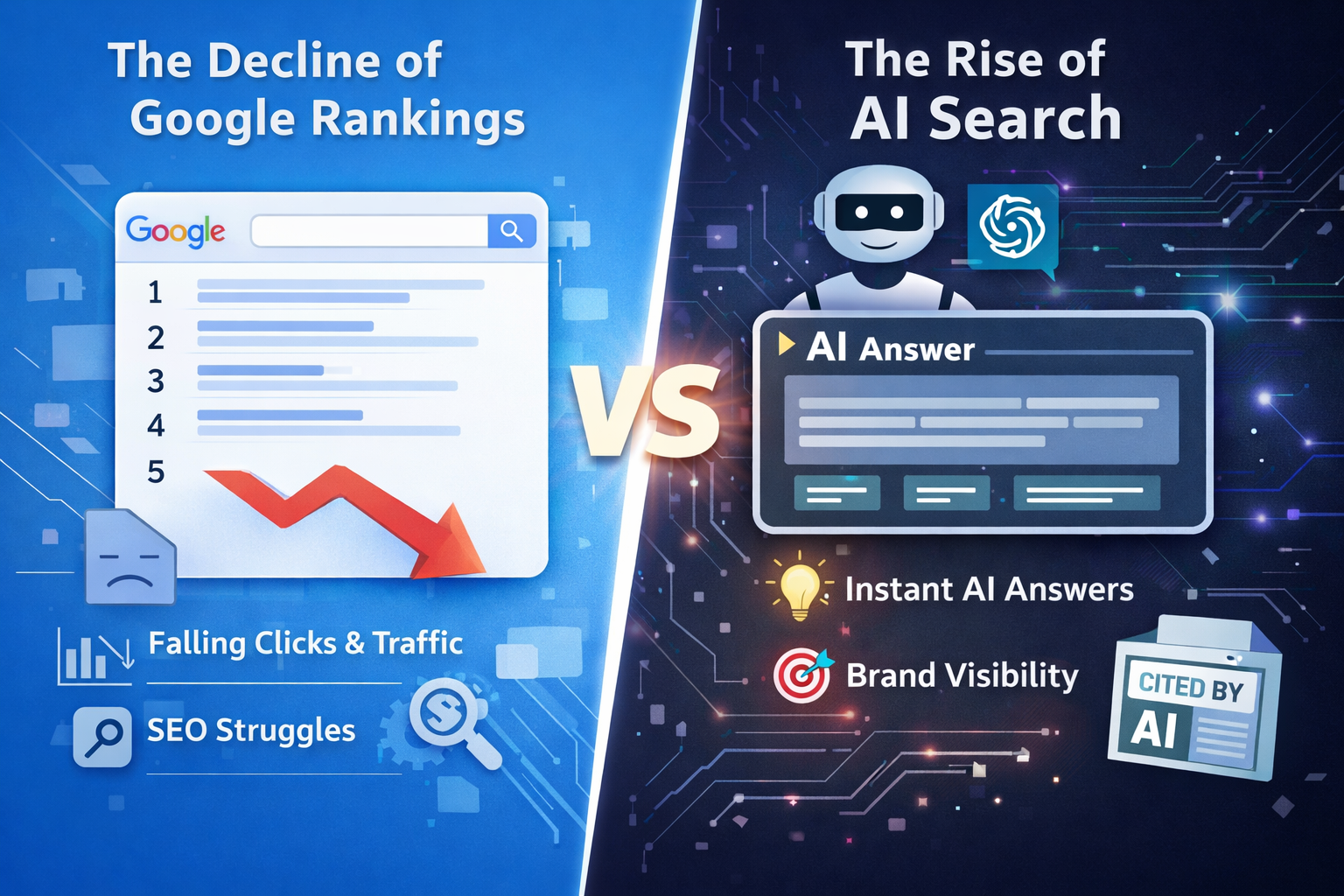
Why Google Rankings Are Becoming Obsolete in the Age of ChatGPT
For over two decades, digital marketing revolved around one central goal: ranking on Google. Businesses invested heavily in SEO strategies, backlinks, and keyword optimization to secure top positions on search engine results pages.
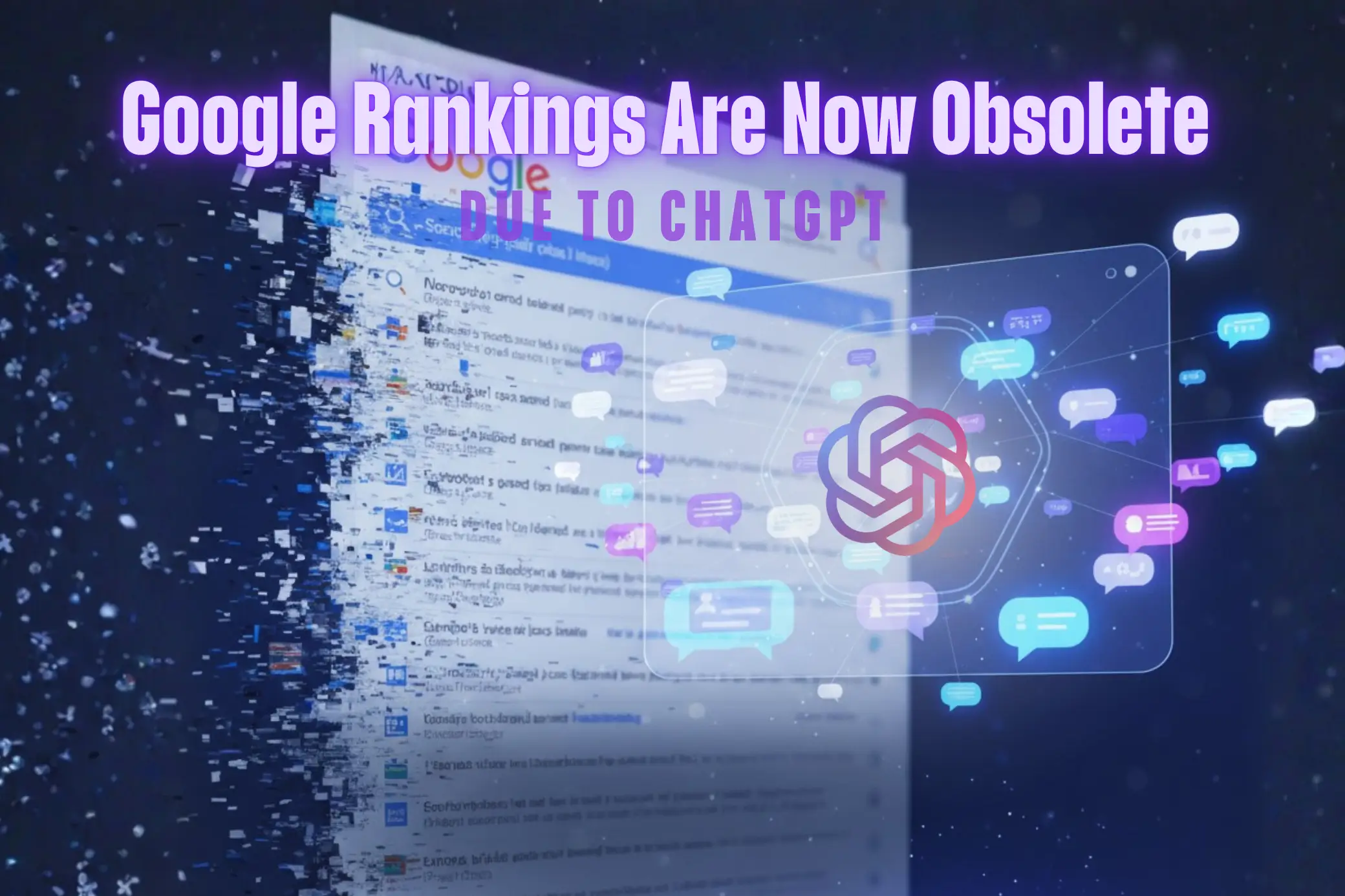
But that era is rapidly changing.
Today, a new paradigm is emerging—one where Google rankings alone no longer guarantee visibility, traffic, or business results. The rise of AI-driven search tools like ChatGPT and AI-powered search summaries is reshaping how users discover information online.
Welcome to the age of answer-first search.
The Rise of Zero-Click Search
One of the most significant shifts in digital behavior is the growth of zero-click searches. Studies indicate that over 60% of searches now end without a single click.
Users no longer browse through multiple links to find answers. Instead, they:
- Ask a question
- Get an instant answer
- Move on
Search has transformed from a process into a moment. What used to take minutes of exploration now takes seconds.
This change is not driven by impatience—it is driven by better interfaces. AI tools and search engines are now capable of delivering complete, structured answers instantly, eliminating the need for users to visit websites.
The Illusion of “Good Rankings”
Many businesses today face a confusing situation:
- Their rankings remain stable—or even improve
- Their content quality increases
- Yet, their website traffic declines
This creates a misleading assumption: “Something is wrong with SEO.”
In reality, nothing is broken. The system itself has changed.
Even if your content ranks #1, it may never be clicked if users already get their answers directly from AI-generated summaries. In fact, click-through rates can drop significantly when AI overviews appear, even for top-ranking pages.
Ranking is no longer the same as visibility.
From Search Engines to Answer Engines
Traditional search engines acted as gateways—they directed users to websites.
Modern AI systems act as interpreters of information. They:
- Collect data from multiple sources
- Synthesize it
- Deliver a single, unified answer
This shift fundamentally changes the rules of digital visibility.
Instead of asking, “How do I rank higher?” the better question now is:
👉 “How do I become the source of the answer?”
Introducing Generative Engine Optimization (GEO)
To adapt to this new reality, a new strategy has emerged: Generative Engine Optimization (GEO).
Unlike traditional SEO, which focuses on ranking links, GEO focuses on ensuring that your content is:
- Cited
- Summarized
- Referenced
by AI systems like ChatGPT and other generative platforms.
In simple terms:
- SEO fights for position
- GEO fights for inclusion in answers
This shift is subtle but powerful. The goal is no longer to attract clicks—it is to become the trusted source that AI relies on.
Why Visibility Matters More Than Traffic
In the traditional model, success was measured by:
- Click-through rates (CTR)
- Pageviews
- Bounce rates
But in a zero-click world, these metrics are losing relevance.
If users get answers without visiting your site, your traffic may decline—but your influence may actually increase.
When your content is consistently used in AI-generated responses, it builds:
- Familiarity
- Trust
- Brand recall
Users may not visit your site immediately, but they remember your brand when making decisions later.
This is what can be called “authority without visits.”
The New Rules of Content Creation
To succeed in this AI-driven environment, content must evolve.
AI systems do not “discover” content the way humans do. They select content that is:
- Easy to understand
- Clearly structured
- Logically organized
If your content cannot be easily extracted, it cannot be cited.
Winning content today has the following characteristics:
1. Clear Structure
Use headings, subheadings, and logical flow. AI prefers organized content over long narratives.
2. Standalone Value
Each section should make sense independently. If a paragraph can stand alone, it can be reused by AI.
3. Direct Answers
Focus on clarity rather than storytelling. Answer questions directly and precisely.
4. Consistency
Maintain consistent explanations and terminology to build trust with AI systems.
The Shift in User Behavior
User behavior has also evolved significantly.
| Then | Now |
|---|---|
| Explorer | Scanner |
| Browsing | Consuming |
| Minutes | Seconds |
| After clicking | Before clicking |
Users now scan AI-generated summaries instead of exploring multiple sources.
This means brands must adapt to capture attention within the answer itself, not just through search rankings.
New Metrics of Success
As the ecosystem changes, so do the metrics that define success.
Declining Metrics:
- Click-through rate (CTR)
- Pageviews
- Bounce rate
Emerging Metrics:
- AI citations – Are AI tools using your content?
- Impressions – Is your content being seen?
- Share of Model (SoM) – How often does your brand appear in AI responses?
- Brand search growth – Are users searching for you directly?
Success is no longer about where users go—it’s about what they remember.
The Risks of Ignoring This Shift
Businesses that fail to adapt face several risks:
- Strong rankings but weak business results
- Declining organic ROI
- Overdependence on paid advertising
- Poor brand recall
- Absence from AI-generated answers
In short, you may exist on Google—but be invisible everywhere else.
The Future: Optimize for Truth, Not Just Traffic
The digital landscape is entering a new phase.
The goal is no longer just to:
- Rank higher
- Drive clicks
- Increase traffic
The new goal is to:
- Provide accurate, structured answers
- Become a trusted source
- Be consistently cited by AI systems
This marks a shift from “optimizing for traffic” to “optimizing for truth.”
Final Thoughts
Google rankings are not entirely dead—but they are no longer enough.
In a world where AI tools deliver instant answers, the winners will not be those who rank highest, but those who are most trusted, most clear, and most usable by machines.
Categories
Read More
In today’s fast-moving digital world, businesses need more than just an online presence. They need visibility, targeted reach, and measurable results. This is where PPC Companies in Chandigarh play a crucial role in helping businesses grow through strategic paid advertising. Pay-Per-Click (PPC) advertising is one of the most effective ways to drive instant traffic and generate leads....
Wireless EV Chargers Market: Growth Outlook, Industry Trends, and Forecast Through 2034 Market Overview The Wireless EV Chargers Market is experiencing significant growth as the global transportation sector continues its transition toward electrification. Wireless electric vehicle charging, also known as inductive charging, enables energy transfer between a ground charging pad and a vehicle...

Choosing the Right Agent Mastering the right agent can define your success in Delta Force. While every launch operator brings value to the field, their impact varies greatly in solo and squad play. Strategic selection is key, as some specialists offer a clear competitive edge in both Operations and Warfare. We evaluate each based on team synergy, individual power, and their adaptability across...

Residential Construction Lee County: Building Custom Homes for Florida Coastal Living When it comes to Residential Construction Lee County, homeowners need a builder who understands both the opportunities and challenges of Florida’s coastal and inland properties. Rock Homes & Estates is a fourth-generation Florida custom home builder serving Lee County communities including Fort...

Polaris Market Research has announced the latest report, namely Batter & Breader Premixes Market Share, Size, Trends, Industry Analysis Report, By Product Type; By Application (Vegetables, Poultry, Seafood, Meat, Others); By Distribution Channel; By End-Use; By Region; Segment Forecast, 2023 - 2032, that examines the overall market condition both now and in the future. It provides...