


Flavor Modulator Market Forecast Highlights Growing Demand for Natural Taste Enhancers
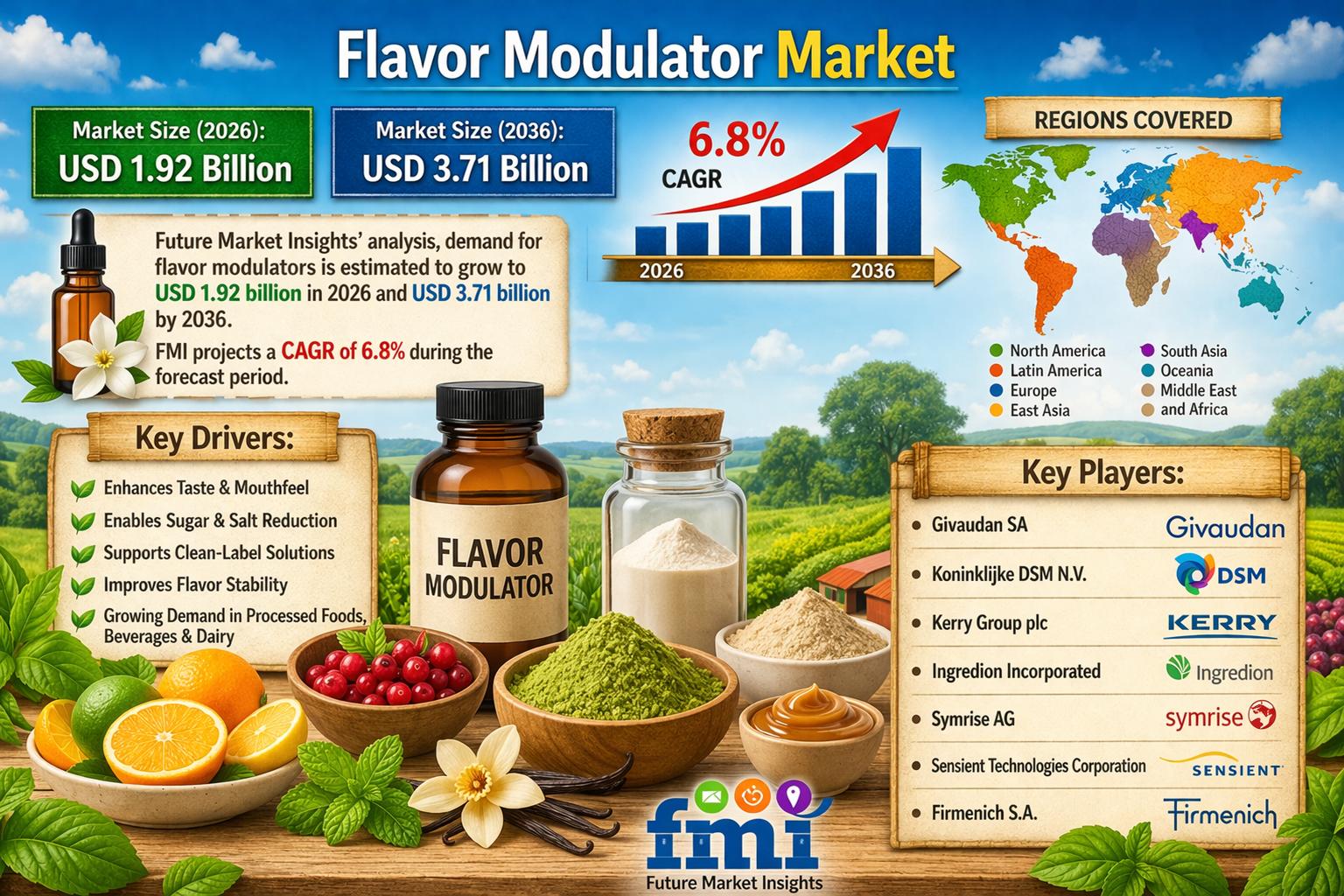
NEWARK, DE, United States – April 6, 2026 – The global flavor modulator market share is rapidly evolving into a critical enabling technology for food and beverage reformulation, supporting industry-wide efforts to reduce sugar, sodium, and fat without compromising taste. According to the latest strategic outlook by Future Market Insights (FMI), the flavor modulator market—valued at USD 1.80 billion in 2025—is projected to reach USD 1.92 billion in 2026 and further expand to USD 3.71 billion by 2036, registering a CAGR of 6.8% during the forecast period.
Absolute dollar growth of USD 1.83 billion reflects the accelerating adoption of flavor modulation technologies across multiple reformulation priorities, including sugar reduction, sodium reduction, fat reduction, and plant protein taste optimization. As global food manufacturers face increasing regulatory pressure and shifting consumer preferences toward healthier products, flavor modulators are becoming indispensable tools in maintaining product palatability while improving nutritional profiles.
The market is witnessing strong momentum driven by large-scale investments and innovation in flavor science. Strategic expansions in reformulation infrastructure and the introduction of advanced taste-masking technologies are enhancing the ability of manufacturers to deliver clean-label, reduced-sugar, and reduced-sodium products without compromising consumer experience. Flavor modulation is increasingly transitioning from a supporting function to a core formulation technology across the food and beverage value chain.
From a product segmentation perspective, sweet flavor modulators dominate the market, accounting for 41.7% of total share in 2026. This reflects the widespread industry focus on sugar reduction across beverages, confectionery, and dairy categories. These modulators enable calorie reduction while preserving sweetness perception, addressing consumer resistance to artificial sweeteners and maintaining product appeal.
In terms of end use, non-alcoholic beverages represent the leading segment, contributing 28.9% of total market value in 2026. Carbonated soft drinks, sports drinks, and ready-to-drink tea and coffee are key application areas where flavor modulators play a vital role in balancing reduced sugar content with desirable taste profiles. Additionally, the growing incorporation of plant proteins in functional beverages is driving demand for bitter-masking solutions.
By form, powder-based flavor modulators lead the market with a 52.4% share in 2026, aligned with the operational requirements of food and beverage manufacturers utilizing dry blending systems in large-scale production environments. However, liquid formats are gaining traction, particularly in ready-to-drink beverage and liquid nutrition applications.
Regionally, India is projected to lead market growth with a CAGR of 6.3% through 2036, driven by expanding processed food consumption and increasing adoption of healthier formulations in urban markets. China follows with a CAGR of 6.0%, supported by rising health awareness and demand for premium food products. The United States grows at 5.1%, influenced by regulatory initiatives targeting sodium and sugar reduction, while Japan and Germany record steady growth at 5.5% and 4.1%, respectively.
Technological innovation remains a key differentiator in the market, with advancements in taste receptor science, cross-modal sensory enhancement, and plant protein flavor masking driving new product development. Flavor modulators are increasingly being integrated into holistic ingredient systems, enabling manufacturers to address multiple formulation challenges simultaneously.
👉 Get Access to the Report Sample: https://www.futuremarketinsights.com/reports/sample/rep-gb-9635
Despite strong growth prospects, the market faces challenges such as regulatory complexity, the need for validated sensory performance data, and competition from alternative formulation strategies. However, increasing investments in R&D, strategic collaborations, and integrated solution offerings are expected to support long-term market expansion.
The competitive landscape is moderately consolidated, with major players focusing on innovation, capacity expansion, and strategic partnerships to strengthen their market positions. Key companies operating in the global flavor modulator market include Givaudan SA, Koninklijke DSM N.V., Kerry Group plc, Ingredion Incorporated, Symrise AG, Sensient Technologies Corporation, Firmenich S.A., International Flavors & Fragrances Inc., Carmi Flavor and Fragrance Co. Inc., and Guangdong Zhaoqing Flavor Factory Co., Ltd.
👉 Why FMI: https://www.futuremarketinsights.com/why-fmi
About Future Market Insights (FMI)
Future Market Insights (FMI) is a leading provider of market intelligence and consulting services, serving clients in over 150 countries. Headquartered in Delaware, USA, with a global delivery center in India and offices in the UK and UAE, FMI delivers actionable insights to businesses across industries including automotive, technology, consumer products, manufacturing, energy, and chemicals.
An ESOMAR-certified research organization, FMI provides custom and syndicated market reports and consulting services, supporting both Fortune 1,000 companies and SMEs. Its team of 300+ experienced analysts ensures credible, data-driven insights to help clients navigate global markets and identify growth opportunities.
Contact Us:
Future Market Insights Inc.
Christiana Corporate, 200 Continental Drive,
Suite 401, Newark, Delaware - 19713, USA
T: +1-347-918-3531
For Sales Enquiries: sales@futuremarketinsights.com
Categorías
Read More
The growing demand for dependable electrical infrastructure has increased the need for transmission products that deliver excellent conductivity, long-term durability, and consistent operational performance. Modern utility networks, industrial facilities, renewable energy projects, and municipal power systems all rely on high-quality conductor solutions to ensure stable electricity delivery....

Wuthering Waves 3.0 Update The latest update for Wuthering Waves, version 3.0, unveils an exciting new area known as Lahai-Roi. Fans can look forward to exploring the newly added Startorch Academy, the hub where characters such as Chisa, Lynae, and Mornye are based. Stay tuned for the official release date of WuWa 3.0 and be aware of the scheduled maintenance end time to ensure a smooth gaming...

Il settore del gioco digitale offre numerose piattaforme con caratteristiche differenti, rendendo importante una scelta consapevole. Prima della registrazione è consigliabile verificare autorizzazioni ufficiali, metodi di pagamento affidabili e strumenti dedicati alla sicurezza delle informazioni personali. I migliori casino online Italia garantiscono un ambiente semplice da utilizzare,...

"Executive Summary Canola Protein Market Size and Share Analysis Report The global canola protein market size was valued at USD 2.62 billion in 2025 and is expected to reach USD 3.64 billion by 2033, at a CAGR of 4.20% during the forecast period Canola Protein Market report objective analysis is employed to make decisions that will not only assist in...

The Global Energy Bar Market is set for robust growth, with a projected increase from USD 9.2 billion in 2025 to USD 22.2 billion by 2033, registering a CAGR of 11.9%. Rising health consciousness, busy lifestyles, and demand for convenient, nutrient-rich snacks are driving this expansion. Energy bars, particularly protein bars, have become a preferred choice...