


Google AI Overviews: What They Mean for the Future of Search and SEO
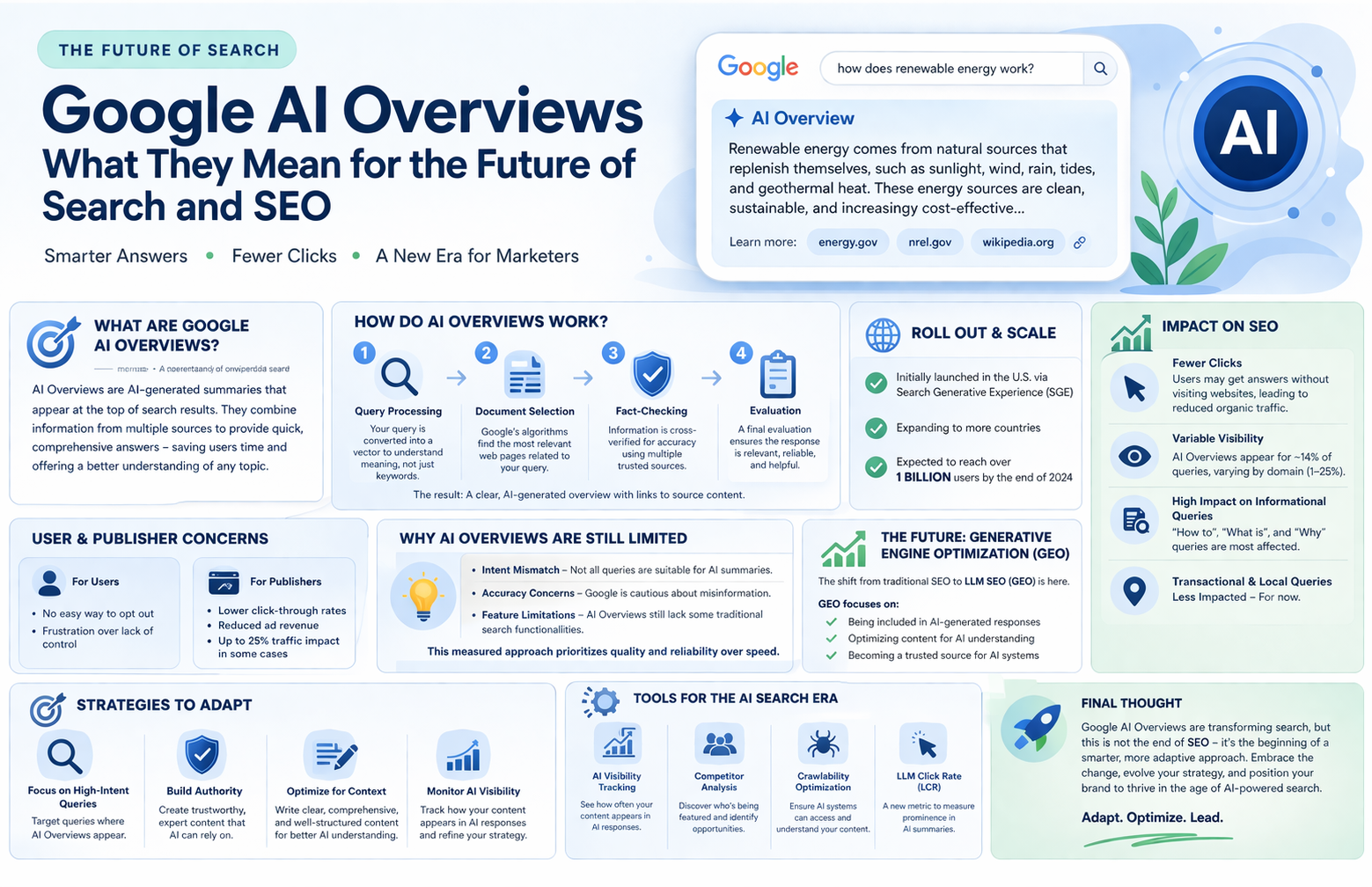
Search is undergoing one of its most transformative shifts since the invention of the search engine itself. With the introduction of Google AI Overviews, the way users discover information—and the way businesses optimize for visibility—is rapidly evolving. This change is not just a feature update; it represents a fundamental rethinking of how search engines deliver value.
In this blog, we’ll explore what Google AI Overviews are, how they work, their impact on SEO, and what businesses and marketers should do to stay ahead in this new landscape.
The Rise of AI in Search
At its annual I/O developer conference, Google introduced a suite of AI-powered features, signaling its strong commitment to artificial intelligence as the future of search. Among these innovations, AI Overviews stand out as a game-changing development.
Traditionally, search engines presented users with a list of links. Users had to click, compare, and synthesize information themselves. AI Overviews flip this model. Instead of providing links first, Google now delivers summarized answers directly within the search results page.
This marks what many experts call the “day zero” of a new era in search—where AI becomes the primary interface between users and information.
What Are Google AI Overviews?
Google AI Overviews are AI-generated summaries that appear at the top of search results. These summaries combine information from multiple sources to provide a quick, comprehensive answer to a user’s query.
Powered by Google’s Gemini model, AI Overviews aim to:
- Save time by reducing the need to click multiple links
- Provide context-aware answers
- Offer a structured understanding of complex topics
Unlike traditional featured snippets, AI Overviews are more dynamic, nuanced, and capable of synthesizing multiple perspectives into a single response.
How AI Overviews Work
Behind the scenes, AI Overviews rely on a multi-step process that blends search and generative AI technologies:
1. Query Processing
When a user enters a query, it is transformed into a vector representation, enabling the system to understand meaning rather than just keywords.
2. Document Selection
Google’s algorithms identify the most relevant web pages related to the query.
3. Fact-Checking
These selected documents act as reference points. The AI cross-verifies information to ensure accuracy and consistency.
4. Evaluation
Before presenting the final output, an additional evaluation layer ensures relevance and reliability.
The result is a synthesized answer that includes both AI-generated insights and links to source material, giving users the best of both worlds.
Rollout and Adoption
Google began rolling out AI Overviews to U.S.-based users as part of its Search Generative Experience (SGE). Initially, users had to opt in, but the feature is now becoming more widely available.
By the end of 2024, AI Overviews are expected to reach over a billion users globally. This масштаб signals Google’s confidence in AI-driven search as the default experience moving forward.
The Impact on SEO
One of the biggest questions surrounding AI Overviews is their impact on SEO—and the answer is nuanced.
Reduced Reliance on Links
Since AI Overviews provide direct answers, users may no longer need to click through to websites. This could lead to reduced organic traffic for many publishers.
Changing Visibility Patterns
At one point, AI summaries appeared for up to 85% of queries. However, this has since dropped to around 14%, suggesting Google is refining where and when AI Overviews appear.
Domain Variability
The likelihood of AI Overviews appearing varies widely depending on the type of query, ranging between 1% and 25% across domains.
User and Publisher Concerns
For Users
Some users have expressed frustration over the inability to opt out of AI Overviews. This lack of control has sparked discussions across forums and communities.
For Publishers
Content creators and website owners face significant challenges:
- Reduced click-through rates
- Lower ad revenue
- Decreased engagement
In some cases, up to 25% of traffic could be impacted due to the reduced prominence of traditional links.
Which Keywords Are Most Affected?
Not all search queries are equally impacted by AI Overviews.
Informational Queries
These are the most affected. Queries like “how to,” “what is,” and “why does” frequently trigger AI summaries.
Transactional Queries
AI Overviews appear less often for purchase-intent queries, though this may change over time.
Local Queries
Currently, local searches are less impacted, but this could evolve as the feature matures.
Why AI Overviews Are Still Limited
Despite their potential, AI Overviews are not yet ubiquitous. Several factors contribute to their limited appearance:
- Intent mismatch: Not all queries are suitable for AI summaries
- Accuracy concerns: Google is cautious about misinformation
- Feature limitations: Compared to traditional search, AI Overviews still lack certain functionalities
These limitations indicate that Google is taking a measured approach to rollout, prioritizing quality over speed.
The Shift to Generative Engine Optimization (GEO)
As AI Overviews reshape search, a new discipline is emerging: Generative Engine Optimization (GEO), also known as LLM SEO.
Unlike traditional SEO, which focuses on ranking web pages, GEO aims to:
- Ensure content is included in AI-generated responses
- Optimize for visibility within AI summaries
- Structure content for machine understanding
This shift requires a new mindset. Instead of asking, “How do I rank #1?”, marketers must ask, “How do I become a trusted source for AI?”
Strategies to Adapt
To succeed in this new landscape, businesses must rethink their approach to content and SEO.
1. Focus on High-Intent Queries
Identify queries where AI Overviews appear and tailor content accordingly.
2. Build Authority
AI systems prioritize credible sources. Investing in expertise, trustworthiness, and authority is more important than ever.
3. Optimize for Context
Content should be structured, clear, and comprehensive to improve its chances of being selected by AI systems.
4. Monitor AI Visibility
Understanding how your content appears in AI-generated results is crucial for ongoing optimization.
Tools for the AI Search Era
New tools are emerging to help businesses navigate AI-powered search.
AI Visibility Tracking
Platforms like GetCito allow users to measure how often their content appears in AI responses.
Competitor Analysis
Understanding which competitors are featured in AI summaries can reveal opportunities and gaps.
Crawlability Optimization
Ensuring that AI systems can access and interpret your content is essential for visibility.
LLM Click Rate (LCR)
A new metric designed to measure how prominently a website appears within AI-generated summaries.
Don’t Panic: The Bigger Picture
While AI Overviews introduce challenges, they are not a death sentence for SEO.
Most AI-generated responses currently focus on less competitive, long-tail queries. For many websites, the impact may be limited—at least for now.
Instead of fearing change, businesses should view this as an opportunity:
- To improve content quality
- To build stronger authority
- To align with the future of search
The Road Ahead
Google AI Overviews represent a significant step toward an answer-first search ecosystem. As AI continues to evolve, the line between search engine and assistant will blur further.
For marketers, content creators, and businesses, the message is clear:
Adaptation is no longer optional—it’s essential.
By embracing Generative Engine Optimization, focusing on high-quality content, and leveraging new tools, you can position your brand not just to survive, but to thrive in the age of AI-powered search.
Final Thoughts
The evolution of search is accelerating, and Google AI Overviews are at the forefront of this transformation. While they challenge traditional SEO practices, they also open the door to new possibilities.
The winners in this new era will not be those who resist change, but those who understand it—and act on it early.
Now is the time to rethink your strategy, experiment with new approaches, and ensure your content is ready for the AI-driven future of search.
Categorias
Leia mais
Are you looking for the best BCA in AI and Data Science in India? As industries shift toward autonomous operations, the demand for specialized computer applications graduates has hit an all-time high. The BCA in Artificial Intelligence and Data Science offered by MH Cognition in partnership with Sasurie College is designed to bridge the gap between traditional coding and futuristic data...

Benefits of Using Certification Exam Preparation Material Certification exams help people grow in their careers. They help you get better jobs. They also help you earn more money. Many students want to pass the CLTD exam on the first attempt. This exam is offered by APICS. However, exam preparation can feel difficult. There are many books to read and many topics to cover. This is why using...

Vitamin B8, commonly known as Inositol, is an important nutrient-like compound that plays a significant role in supporting cell function, metabolism, brain health, and overall wellness. It is widely used in dietary supplements, pharmaceuticals, functional foods, beverages, and personal care products. As consumers become more health-conscious and focus on nutritional well-being, the demand for...

The Evolution of Online Sports Entertainment and Sky Exchange’s Role The way people enjoy sports has changed dramatically over the last decade. Fans are no longer limited to watching live matches on television or reading next-day match reports in newspapers. Today, technology has transformed sports entertainment into an interactive digital experience where enthusiasts can follow live...

The aviation industry is expanding rapidly, creating numerous job vacancies in aviation industry for aspiring professionals. Whether you dream of becoming a pilot or working in airport operations, knowing how to find the right opportunities is essential. At Abdut Unfiltered, we offer expert pilot counselling to help you navigate your aviation career with clarity and...
