Vietnam Electric Vehicle Export Data 2025: A Rising Global EV Powerhouse
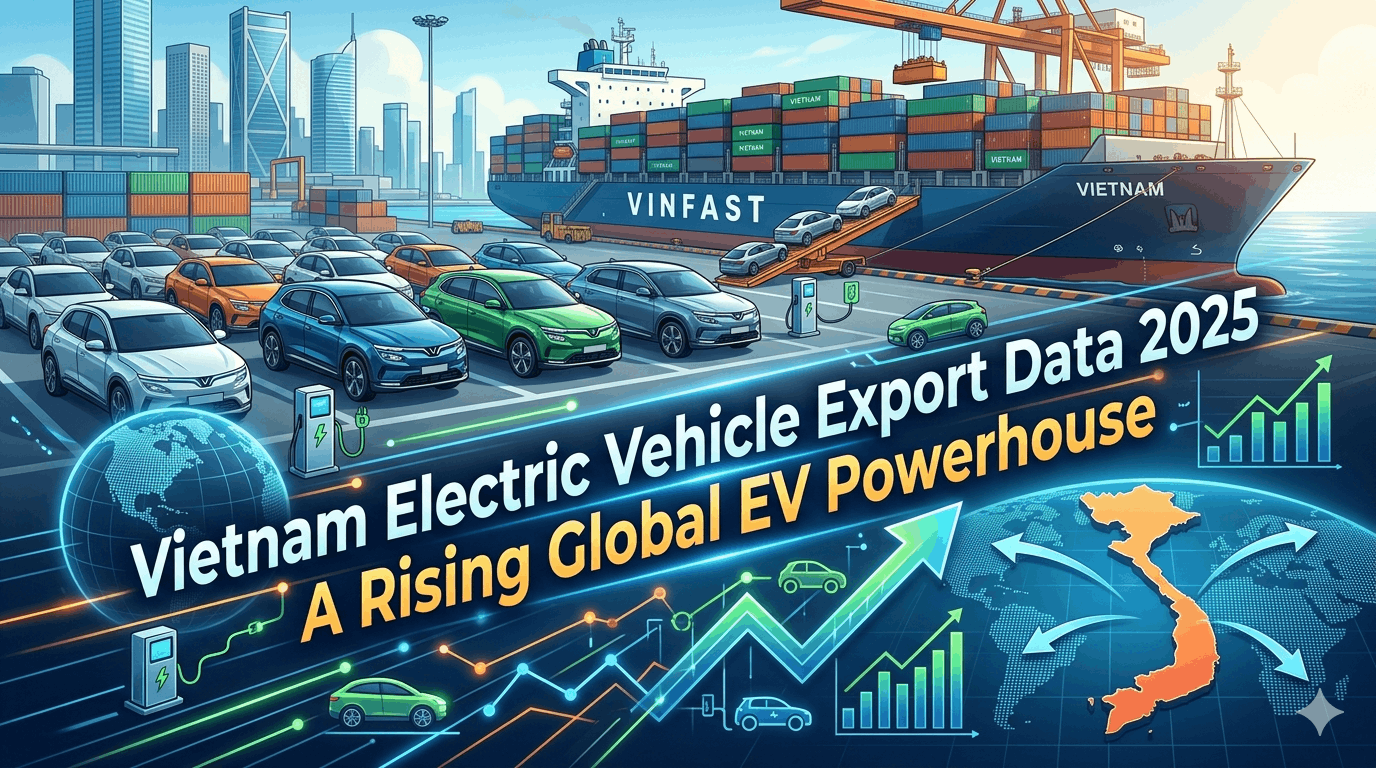
Vietnam’s electric vehicle (EV) industry has undergone a remarkable transformation over the past few years, evolving from a niche experiment into one of the fastest-growing automotive segments globally. By the end of 2026, Vietnam is expected to firmly position itself among the leading EV markets, driven by strong domestic demand, aggressive policy support, and a rapidly expanding manufacturing ecosystem.
At the heart of this transformation lies the steady rise in Vietnam electric vehicle export data, which reflects not only domestic production strength but also the country’s ambitions to become a global EV manufacturing and export hub.
Rapid Growth of Vietnam’s EV Market
Vietnam’s EV market expansion has been nothing short of extraordinary. In 2025, the EV segment recorded a growth rate exceeding 200%, highlighting how quickly electrification is reshaping the country’s automotive landscape. Electric vehicles now account for approximately 30–36% of the total automotive market, a significant milestone for an emerging economy.
The total EV market value reached $3.12 billion in 2025, supported by strong domestic consumption and increasing production capacity. This growth is primarily fueled by the dominance of a leading electric car manufacturer in Vietnam, alongside emerging players and component suppliers.
Government policies have played a crucial role in accelerating EV adoption. Incentives such as reduced registration fees, tax benefits, and a long-term net-zero emissions target by 2050 have created a favorable environment for both manufacturers and consumers.
Vietnam Electric Vehicle Export Data 2025 Overview
The Vietnam electric vehicle export data reveals a significant surge in international shipments. In 2025, Vietnam’s EV exports reached a total value of $433.30 million, marking a 90% increase compared to the previous year.
This growth reflects a gradual shift from a domestically focused industry to one with global ambitions. The number of EVs exported under the electric vehicle HS code 870380 also rose dramatically, indicating increasing global demand for Vietnamese EV products.
Over the past five years, Vietnam’s EV export trajectory has shown consistent upward momentum:
- 2020: $4.22 million
- 2021: $8.06 million
- 2022: $95.46 million
- 2023: $192.44 million
- 2024: $317.01 million
- 2025: $433.30 million
This data highlights how Vietnam exports in the EV sector are accelerating at a rapid pace, positioning the country as an emerging player in global trade.
Key Export Markets for Vietnamese EVs
Vietnam’s EV exports are distributed across a diverse range of global markets, reflecting both strategic partnerships and expanding trade networks.
The United States remains the largest destination, accounting for nearly half of Vietnam’s EV exports. This highlights strong demand for electric vehicles in advanced markets where sustainability and innovation are key priorities.
Other important export destinations include Indonesia, Canada, Slovenia, and the Philippines. These markets are characterized by growing demand for clean mobility solutions and supportive government policies.
Emerging markets such as Laos and the UAE are also becoming important destinations, indicating the expanding geographical reach of Vietnamese EV exports. The presence in European markets like Spain and Germany further demonstrates Vietnam’s gradual integration into global EV supply chains.
Leading Electric Car Manufacturer in Vietnam
The EV ecosystem in Vietnam is dominated by a handful of major players, with one leading electric car manufacturer in Vietnam driving most of the growth. This company has established itself as the market leader through strong domestic sales and expanding export operations.
Key manufacturers shaping the industry include:
- A dominant EV automaker producing SUVs and compact electric cars
- Battery and component manufacturers supporting vertical integration
- Emerging startups focusing on affordable urban EVs
- Bus and commercial EV manufacturers targeting public transport markets
These companies collectively contribute to the growth of Vietnam electric vehicle export data, enabling the country to diversify its export portfolio.
Role of Battery and Component Manufacturing
One of the critical factors behind Vietnam’s EV growth is the development of a robust supply chain. Battery production, electronics, and charging infrastructure components are essential for supporting both domestic manufacturing and export competitiveness.
Vietnam is increasingly positioning itself as a regional hub for EV components, which complements its vehicle manufacturing capabilities. This integrated approach strengthens the country’s position in global Vietnam trade data related to automotive exports.
Battery manufacturers, in particular, are playing a crucial role in enhancing export value. By producing lithium-ion cells and battery packs locally, Vietnam reduces dependency on imports and improves cost efficiency.
Domestic Market Dominance and Export Expansion
Despite the strong growth in exports, the Vietnamese EV market remains primarily driven by domestic demand. In 2025, the majority of EV production was consumed locally, reflecting strong consumer adoption and market confidence.
However, export infrastructure is steadily improving. Investments in overseas assembly plants, CKD (completely knocked down) exports, and international partnerships are laying the foundation for future growth.
The expansion into international markets is expected to accelerate as manufacturers scale production and improve global competitiveness. This transition is clearly reflected in the upward trend of Vietnam electric vehicle export data.
Infrastructure and Production Capacity
Vietnam’s manufacturing capabilities are expanding rapidly to meet both domestic and international demand. Large-scale production facilities are being developed with capacities exceeding current market needs, indicating a strong focus on exports.
The country’s ability to produce hundreds of thousands of EVs annually positions it as a potential global manufacturing hub. This excess capacity is expected to drive future exports and strengthen Vietnam exports in the EV sector.
Market Drivers Behind Growth
Several key factors are driving the rapid growth of Vietnam’s EV industry:
Government Support
Policy incentives such as tax reductions and registration benefits have made EVs more accessible to consumers.
Rising Consumer Demand
Increasing fuel costs and environmental concerns are encouraging consumers to switch to electric vehicles.
Affordable EV Models
The availability of cost-effective models has made EV adoption more widespread, especially in urban areas.
Infrastructure Development
The expansion of charging networks and EV-friendly infrastructure is supporting market growth.
These drivers collectively contribute to the expansion of Vietnam electric vehicle export data and enhance the country’s global competitiveness.
Challenges Facing Vietnam’s EV Export Growth
While the outlook is promising, Vietnam’s EV industry faces several challenges:
Limited Global Brand Recognition
Vietnamese EV brands are still building their presence in international markets.
Pricing Pressure
Competition from established global players and low-cost manufacturers creates pricing challenges.
Infrastructure Gaps Abroad
Export success depends on the availability of charging infrastructure and after-sales services in target markets.
Addressing these challenges is essential for sustaining long-term growth in Vietnam electric vehicle export data.
Opportunities for Vietnam as an EV Export Hub
Despite these challenges, Vietnam has several advantages that position it for success:
Cost-Effective Manufacturing
Lower labor costs provide a competitive edge in global markets.
Strategic Location
Proximity to major ASEAN markets facilitates trade and logistics.
Trade Agreements
Access to international trade agreements enhances export opportunities and reduces tariffs.
These factors strengthen Vietnam’s position in global Vietnam trade data and support its ambitions to become a leading EV exporter.
Future Outlook for Vietnam’s EV Industry
The future of Vietnam’s EV sector looks highly promising. The market is expected to grow significantly over the next decade, with projections indicating strong increases in both domestic sales and exports.
Key trends shaping the future include:
- Expansion into new export markets such as India, the Middle East, and Africa
- Increased production capacity to support global demand
- Greater diversification of EV products and components
- Continued growth of Vietnam electric vehicle export data
By 2030, EVs are expected to account for a substantial share of the automotive market, further solidifying Vietnam’s position as a key player in the global EV industry.
Conclusion
Vietnam’s EV industry is at a pivotal stage of development. The combination of strong domestic growth, expanding manufacturing capabilities, and increasing exports is transforming the country into a significant player in the global electric vehicle market.
The steady rise in Vietnam electric vehicle export data reflects a broader shift toward international competitiveness and export-driven growth. While challenges remain, the opportunities far outweigh the risks.
With continued investment, strategic partnerships, and policy support, Vietnam has the potential to emerge as a major EV manufacturing and export hub in the coming years. For businesses and investors, this evolving market offers substantial opportunities backed by strong data, rapid growth, and global demand for sustainable mobility solutions.
Categories
Read More
Background Music Meaning: Definition, Uses, and Role in Modern Media Background music (BGM) refers to music that plays softly in the background while other primary activities are taking place, such as watching videos, dining in a restaurant, shopping, studying, or working. It is not meant to be the main focus of attention but instead enhances mood, atmosphere, and emotional experience. In...

In Mobile Legends: Bang Bang, owning the rarest skins is a mark of prestige and dedication. These cosmetics are not simply purchased—they demand substantial diamond reserves and, often, a measure of luck in time-limited events and gacha draws. Below is a rundown of five skins that collectors covet most, each distinct for its exclusivity, cost, or visual flair. Aldous – King of...

In a world where attention spans are shrinking by the second, banners stand tall as one of the most powerful ways to command visibility instantly. Whether it’s a bustling event, a retail storefront, or a corporate exhibition, a striking banner has the power to stop people in their tracks. It’s not just about being seen—it’s about being impossible to ignore. Landmark...

Studying abroad is a life-changing decision that opens doors to global education, international careers, and personal growth. However, the process can feel overwhelming due to university research, entrance exams, applications, visas, and financial planning. This is where professional study abroad counselling becomes valuable. With the right guidance, students can avoid mistakes and...

Aluminum Bags and Pouches Market: A Comprehensive Industry Overview Introduction The global Aluminum Bags and Pouches Market has emerged as one of the fastest-growing segments in the flexible packaging industry. Valued at USD 12.13 billion in 2022, the market is projected to reach USD 22.37 billion by 2032, expanding at a compound annual growth rate (CAGR) of 6.3% during the forecast period....