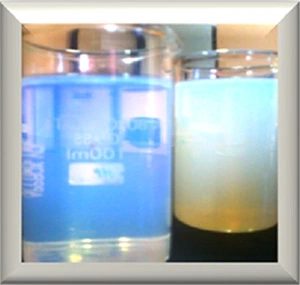
Colloidal Silica Manufacture - Electrodialysis
Batch acidification has been the standard method for producing silica sol for decades. When acid is added to a sodium silicate solution, the pH decreases, leading to the formation of silica particles. However, this process has a challenge known as the transition zone, which is the period between acid addition and equilibrium. During this time, local pH gradients can result in uncontrolled particle growth or premature gelation. While this issue can be managed for commodity silica grades, it becomes a persistent quality concern for products with tighter specifications.
In contrast, the electrodialysis method offers a more controlled approach. In this process, there is no need for acid addition. Instead, sodium ions continuously migrate out of the silicate solution across ion-selective membranes. This gradual and uniform pH shift throughout the cell facilitates particle nucleation under steadier conditions, resulting in a narrower size distribution and more consistent sol characteristics from one production run to the next.
From a financial perspective, eliminating mineral acid from the process reduces costs associated with reagent procurement, handling, and effluent neutralisation—considerations that are significant at a production scale.
Laxminarayan Technologies specialises in constructing commercial electrodialysis plants for colloidal silica production, tailored to each producer's desired particle size range and output volume. Pilot plants are available for validation before full-scale implementation.
For more information, visit:
https://www.electrodialysis.in/appliction-colloidal-silica-manufacture/
Business Credit:
Laxminarayan Technologies
H16, MIDC, Gokul Shirgaon,
Kolhapur, Maharashtra 416234, India
ISO 9001 Certified | Est. 1986
Colloidal Silica Manufacture - Electrodialysis
Batch acidification has been the standard method for producing silica sol for decades. When acid is added to a sodium silicate solution, the pH decreases, leading to the formation of silica particles. However, this process has a challenge known as the transition zone, which is the period between acid addition and equilibrium. During this time, local pH gradients can result in uncontrolled particle growth or premature gelation. While this issue can be managed for commodity silica grades, it becomes a persistent quality concern for products with tighter specifications.
In contrast, the electrodialysis method offers a more controlled approach. In this process, there is no need for acid addition. Instead, sodium ions continuously migrate out of the silicate solution across ion-selective membranes. This gradual and uniform pH shift throughout the cell facilitates particle nucleation under steadier conditions, resulting in a narrower size distribution and more consistent sol characteristics from one production run to the next.
From a financial perspective, eliminating mineral acid from the process reduces costs associated with reagent procurement, handling, and effluent neutralisation—considerations that are significant at a production scale.
Laxminarayan Technologies specialises in constructing commercial electrodialysis plants for colloidal silica production, tailored to each producer's desired particle size range and output volume. Pilot plants are available for validation before full-scale implementation.
For more information, visit: https://www.electrodialysis.in/appliction-colloidal-silica-manufacture/
Business Credit:
Laxminarayan Technologies
H16, MIDC, Gokul Shirgaon,
Kolhapur, Maharashtra 416234, India
ISO 9001 Certified | Est. 1986