


Trust by Design: Navigating Global Privacy Laws with Marketing Cloud Shield
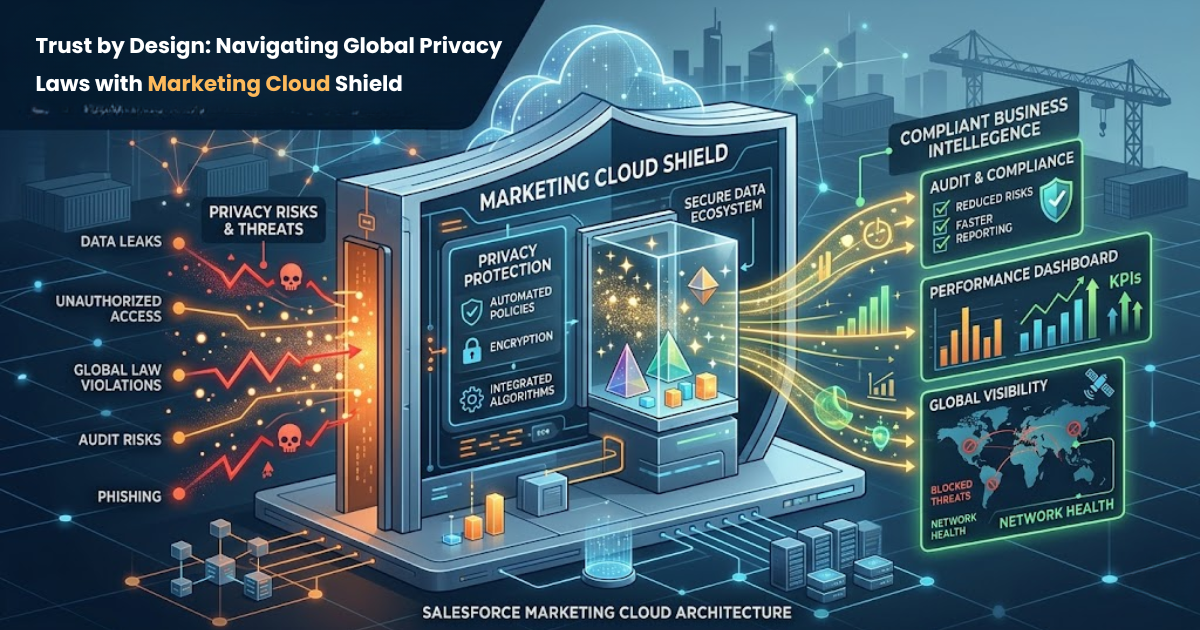
Modern marketing relies on massive amounts of personal data. However, the global regulatory environment is becoming more restrictive. Organizations must balance personalized engagement with strict privacy mandates. Laws like GDPR in Europe, CCPA in California, and LGPD in Brazil carry heavy penalties for mishandling information. Salesforce Marketing Cloud provides the tools to manage these risks. By using specialized Salesforce Marketing Cloud Services, companies can build a "Trust by Design" framework.
The Evolution of Global Data Privacy
Data privacy is no longer a niche legal concern. It is a fundamental technical requirement for every digital business.
1. The Rising Cost of Violations
Regulators have shown they will issue massive fines. GDPR fines can reach 4% of a company's global annual revenue. In 2024 and 2025, several tech giants paid billions in settlements for unauthorized data tracking. Beyond the money, a data breach destroys customer trust. 81% of consumers say they lose trust in a brand after a data breach.
2. A Fragmented Legal Map
Different regions have different rules. Some laws focus on the "Right to be Forgotten." Others prioritize data residency, requiring information to stay within national borders. Managing these various rules manually is impossible at scale. This complexity drives the need for automated solutions within the Salesforce Marketing Cloud ecosystem.
What is Marketing Cloud Shield?
Marketing Cloud Shield is a premium security suite. It adds advanced layers of protection to the standard platform. It allows technical teams to monitor, encrypt, and audit data usage with high precision.
1. Event Monitoring
This feature tracks every user action within the platform. It records who logged in, what data they exported, and which records they viewed. If an employee tries to download a massive customer list, the system alerts the security team. This prevents "insider threats" and provides a clear audit trail for regulators.
2. Field-Level Encryption
Standard encryption protects data at rest. Shield takes this further with field-level encryption. You can choose specific pieces of sensitive data, like social security numbers or health IDs. The system encrypts these fields before they even enter the database. Only authorized users with the correct keys can view the plain text.
3. Audit Trail Enhancements
Compliance requires keeping detailed records of system changes. Shield provides an extended history of changes made to security settings and user permissions. This historical data is vital during a government audit.
Technical Strategies for Compliance
Expert Salesforce Marketing Cloud Services help companies implement Shield effectively. This involves more than just turning on a feature. It requires a strategic technical setup.
1. Implementing the Principle of Least Privilege
Technical architects use Shield to enforce strict access controls. They ensure that marketing staff only see the data they need. For example, a content creator does not need access to customer credit scores. Shield’s monitoring tools verify that these restrictions remain in place over time.
2. Automated Consent Management
Consent is the backbone of modern privacy laws. You must prove that a customer agreed to receive emails or SMS messages. Salesforce Marketing Cloud integrates with Consent Management Platforms (CMPs). When a user withdraws consent, Shield helps ensure that their data is immediately "restricted" from all active journeys.
3. Data Masking for Sandbox Environments
Developers often need real-looking data to test new features. However, using actual customer data in a test environment is a major security risk. Shield allows for data masking. This replaces real names and emails with fake data that maintains the original format.
How Shield Solves Specific Regulatory Hurdles
Different laws require different technical responses. Marketing Cloud Shield provides the flexibility to meet these needs.
-
GDPR (Europe): Shield supports "Data Portability" and "Right to Erasure" requests. Its audit logs prove that the company deleted the data according to the law.
-
CCPA/CPRA (USA): Shield helps track "Do Not Sell" requests. It ensures that sensitive personal information remains protected from third-party exports.
-
HIPAA (Healthcare): Field-level encryption ensures that Protected Health Information (PHI) stays secure and meets federal standards for the medical industry.
The Role of Salesforce Marketing Cloud Services
Setting up a high-security environment is a complex task. Organizations often seek professional Salesforce Marketing Cloud Services to lead the implementation.
1. Security Architecture Design
Consultants design the data schema to isolate sensitive information. They decide which fields require encryption and which only need masking. This balance ensures high security without slowing down system performance.
2. Governance Framework Development
A tool is only as good as the rules behind it. Services teams help define who owns the data and who can grant access. They establish a "Governance Board" to review security logs and audit reports regularly.
3. Integration with the Einstein Trust Layer
In 2026, AI is a core part of marketing. However, AI needs data to work. Professional services ensure that AI models do not "leak" sensitive info. They use the Einstein Trust Layer to strip away personal identifiers before the data reaches a Large Language Model (LLM).
Quantitative Impact of Robust Privacy Tools
Data-driven evidence proves the value of investing in security. Companies that prioritize trust see measurable gains.
-
Reduced Risk: Organizations using Shield report 45% fewer internal data misuse incidents.
-
Audit Efficiency: Automated audit logs reduce the time spent on compliance reporting by 60%.
-
Customer Retention: Brands with transparent privacy policies see a 15% higher customer loyalty rate.
-
Faster Response: Shield helps identify data breaches 30% faster than manual monitoring.
Real-World Example: Financial Services Compliance
A global insurance firm managed millions of records across 20 countries. They struggled with inconsistent privacy rules. They implemented Salesforce Marketing Cloud Shield with the help of a specialized services team.
The team encrypted all policy numbers and birth dates at the field level. They set up real-time alerts for any data exports exceeding 5,000 records. This setup allowed the firm to pass a major European audit with zero findings. They also reduced their legal review time for new campaigns by half.
Overcoming Technical Implementation Challenges
Implementing Shield is not always simple. Technical leaders must address several common hurdles.
1. Performance Impacts
Encryption can add "latency" or delay to a system. If you encrypt every single field, the platform may slow down. Experts solve this by only encrypting the most sensitive "PII" (Personally Identifiable Information). They leave non-sensitive data, like "Preferred Color," unencrypted for faster processing.
2. Key Management
If you lose your encryption keys, you lose access to your data. Shield requires a robust Key Management Service (KMS). Companies must decide whether to use Salesforce-generated keys or bring their own keys (BYOK). Professional consultants help set up secure key rotation cycles to prevent theft.
3. Legacy Data Clean-up
Shield works best on clean data. Many companies have years of old, unorganized information. Before deploying Shield, teams must perform a "Data Audit." They delete old records that no longer serve a business purpose. This reduces the "Attack Surface" and lowers storage costs.
The Future of Privacy: Agentic AI and Zero-Copy Data
The marketing landscape is changing rapidly. Two major trends are shaping the future of Salesforce Marketing Cloud.
1. Agentic AI and Privacy Guardrails
Autonomous AI agents can now execute marketing tasks. These agents need access to customer data to make decisions. Shield provides the "Guardrails" for these agents. It ensures the AI cannot access forbidden data or send unauthorized messages.
2. Zero-Copy Data Integration
Salesforce is moving toward a "Zero-Copy" architecture with Data Cloud. This means data stays in its original location (like AWS or Snowflake) but appears in Marketing Cloud. Shield must extend its protection to these external sources. This creates a unified security perimeter across the entire enterprise cloud.
Essential Checklist for Marketing Cloud Shield Success
To build a "Trust by Design" environment, follow these steps:
-
Identify PII: Map out every field that contains sensitive customer information.
-
Define Roles: Determine exactly who needs access to which data sets.
-
Set Alert Thresholds: Decide what type of user behavior should trigger a security alert.
-
Test Encryption: Ensure that encrypted data does not break existing integrations or reports.
-
Train the Team: Teach marketers why privacy rules exist and how to follow them.
Conclusion
Trust is the new currency of the digital economy. Customers will only share their data if they feel safe. Salesforce Marketing Cloud Shield provides the technical foundation for this safety. It allows businesses to comply with complex global laws while still delivering personalized experiences.
However, technology alone is not enough. Success requires the expertise found in Salesforce Marketing Cloud Services. These professionals bridge the gap between legal requirements and technical execution. They ensure that "Trust by Design" is a reality, not just a slogan.
As global privacy laws continue to evolve, the cost of being wrong will only grow. Investing in robust security today protects your brand for the future. By using Shield, you turn compliance from a burden into a competitive advantage. You prove to your customers that you value their privacy as much as their business. This commitment to trust is the only way to win in the modern marketplace.
Categorias
Leia Mais
The Integrated Development Platform (IDP) Market Development in the United States is experiencing consistent growth as enterprises increasingly adopt unified software development environments to enhance productivity, accelerate application deployment, and streamline DevOps workflows. Integrated development platforms provide centralized environments that integrate coding, testing,...

Detailed Analysis of Executive Summary Asia-Pacific Weighing and Inspection Market Size and Share Weighing and inspection market is expected to gain market growth in the forecast period of 2022 to 2029. Data Bridge Market Research analyses the weighing and inspection market to reach at an estimated value of USD 842.5 million by 2029 and exhibit a CAGR of 6.72% for the forecast period of 2022 to...

Introduction: Precision Joining at the Heart of Modern Industry As global manufacturing becomes increasingly sophisticated, the tools that hold it together matter more than ever. The Plastic Welding Equipment Market sits at the intersection of precision engineering, materials science, and industrial automation and it is growing at a remarkable pace. With a market value of USD 1.60 billion in...

Welcome to Malaysia KL call girls. We are a call girl agency that wants to make your nights really special and memorable with our call girls in Bukit Bintang. When you come to us to hire call girls you will find hot girls who are ready and excited to be with you. They want to make all your dreams come true. These girls are always excited. They want you to be with them as much as you want...

EA FC 26 patch 1.1.0, released in late October, was designed to improve defensive options and counter the dominance of highly skilled dribblers. The developers explicitly stated in the patch notes that they acted on player feedback about overpowered attack moves. Yet within days, a vocal segment of the community accused the update of regressing the game toward the defensive meta of EA FC 25....