


Inside an AI Agent: Memory, Reasoning, and Tool Use Explained
Imagine telling an AI, “Book me a flight for next week.”
A normal chatbot might give suggestions or steps. But an AI agent goes further—it can actually book the flight, update your calendar, notify your team, and handle the entire workflow.
This is the power of modern AI agents. They don’t just respond—they act.
At the core of this capability is something called the agentic loop:
Perceive → Think → Act → Observe → Improve
This loop allows AI agents to continuously learn, adapt, and execute complex tasks efficiently. (Arunangshu Das)
What Makes AI Agents Different from Traditional Automation?
Traditional automation systems follow fixed rules. If something unexpected happens, they fail.
AI agents are different:
-
They adapt to changing situations
-
They plan multi-step workflows
-
They make decisions dynamically
-
They improve over time
Unlike rule-based systems, AI agents are context-aware and can handle real-world complexity with flexibility. (Arunangshu Das)
Core Architecture of an AI Agent
An AI agent is built using multiple layers working together:
-
Input Processing – Understands user instructions
-
Context Retrieval – Pulls relevant past data or memory
-
Reasoning Engine – Decides what to do next
-
Tool Selection – Chooses the right API or system
-
Execution – Performs the action
-
Feedback Loop – Learns from results and improves
This layered system enables agents to handle complex, multi-step workflows efficiently.
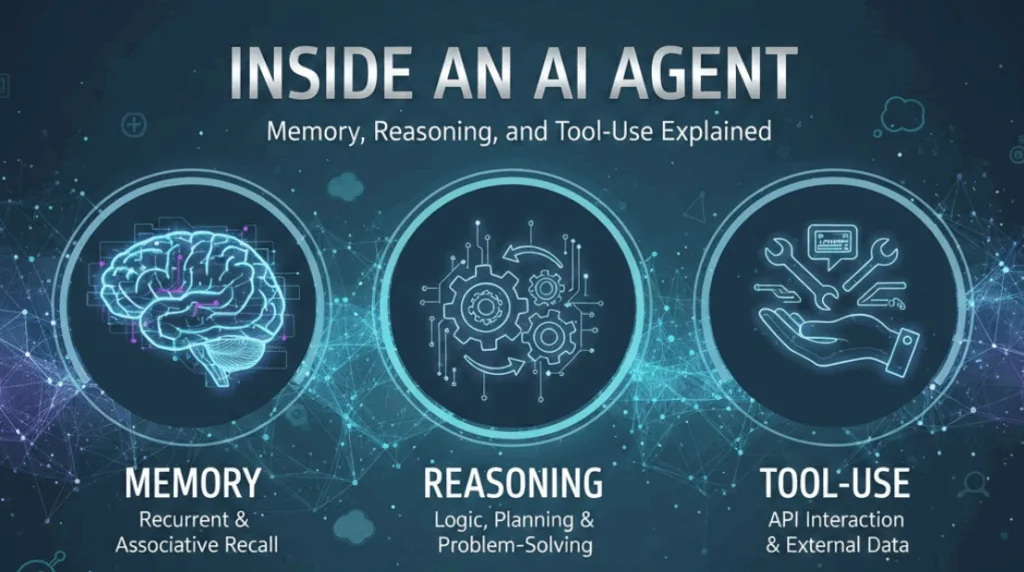
Memory: How AI Agents Remember
Memory is what makes AI agents powerful. Without it, every interaction starts from zero.
AI agent memory allows systems to store, recall, and use past information to improve decisions and maintain context.
Types of Memory:
-
Short-term memory → Handles current conversation or task
-
Long-term memory → Stores user preferences and past data
-
Episodic memory → Records past events and actions
-
Semantic memory → Stores general knowledge
Memory enables agents to personalize responses, track workflows, and avoid repeating mistakes.
Reasoning: How AI Agents Think
Reasoning transforms an AI agent from a text generator into a problem solver.
Key reasoning techniques include:
-
Chain-of-Thought (CoT): Step-by-step logical thinking
-
Task decomposition: Breaking large tasks into smaller steps
-
Multi-path reasoning: Exploring multiple solutions
-
Self-correction: Learning and improving from outcomes
This allows agents to handle complex scenarios like planning trips, managing workflows, or optimizing decisions.
Tool Use: Connecting AI to the Real World
AI models alone cannot interact with the real world. Tools make that possible.
Common tools used by AI agents:
-
APIs (web services, databases)
-
Browsers and search tools
-
Email and messaging systems
-
Code execution environments
-
File systems and spreadsheets
Through function calling, the AI sends structured instructions to external systems, executes tasks, and uses the results to improve future actions.
How Memory + Reasoning + Tools Work Together
The real strength of AI agents comes from combining all three components:
-
Understand user intent
-
Retrieve relevant memory
-
Plan the steps
-
Choose tools
-
Execute actions
-
Observe results
-
Repeat until the goal is achieved
This process allows AI agents to automate entire workflows—not just individual tasks.
Real-World Applications of AI Agents
AI agents are already being used in many areas:
-
Customer support automation
-
Marketing and content pipelines
-
Lead qualification and CRM updates
-
Financial analysis and reporting
-
Daily workflow automation (emails, reports, scheduling)
These systems significantly improve efficiency by reducing manual work.
Challenges and Limitations
Despite their power, AI agents still face challenges:
-
Tool failures or API issues
-
Incorrect reasoning (hallucinations)
-
Limited memory context
-
Higher cost for multi-step tasks
-
Security and privacy concerns
-
Need for human supervision
These limitations are actively being addressed with ongoing research and improvements.
The Future of AI Agents
AI agents are rapidly evolving. The future includes:
-
Better memory systems
-
More advanced reasoning models
-
Multimodal capabilities (text, image, video, voice)
-
Improved tool integration
These advancements will make AI agents even more powerful and capable of handling complex real-world tasks.
Final Thoughts
AI agents represent a major shift from simple automation to intelligent systems that can think, remember, and act.
Key Takeaway
An AI model generates answers.
An AI agent gets things done.
Categorii
Citeste mai mult
Every great business deserves materials that leave a lasting impression. In today's competitive marketplace, ordinary marketing tools simply aren't enough to capture attention. High-quality printing has become an essential investment for businesses that want to build trust, strengthen brand recognition, and inspire customer confidence. Whether you're launching a new campaign or refreshing your...

In response to growing user concerns over digital privacy, Facebook introduces significant updates to its platform. These changes aim to empower individuals with greater control over their personal information and social interactions. A new data portability tool allows users to compile their entire Facebook history into a downloadable archive. This comprehensive file includes posts, messages,...

A tile flooring company in Texas provides professional installation, design guidance, and durable flooring solutions for residential and commercial spaces. Tile is ideal for kitchens, bathrooms, and high-traffic areas due to its strength and water resistance. Experienced contractors help with material selection, layout planning, and precise installation. Quality workmanship ensures long-lasting...

" According to the latest report published by Data Bridge Market Research, the Gluten-Free Products Market The global gluten-free products market size was valued at USD 7.23 billion in 2024 and is expected to reach USD 11.91 billion by 2032, at a CAGR of 6.44% during the forecast period The large scale Gluten-Free Products Market report is produced...
The automotive industry is changing rapidly as more drivers look for vehicles that offer comfort, performance, and better fuel efficiency. Modern SUVs are no longer just about size and power. Buyers now expect advanced technology, refined interiors, Mild-Hybrid Luxury SUV and environmentally conscious engineering. This shift has encouraged manufacturers to create vehicles that combine...
