Coffee Franchise vs Tea Franchise in India – Which Business is More Profitable?
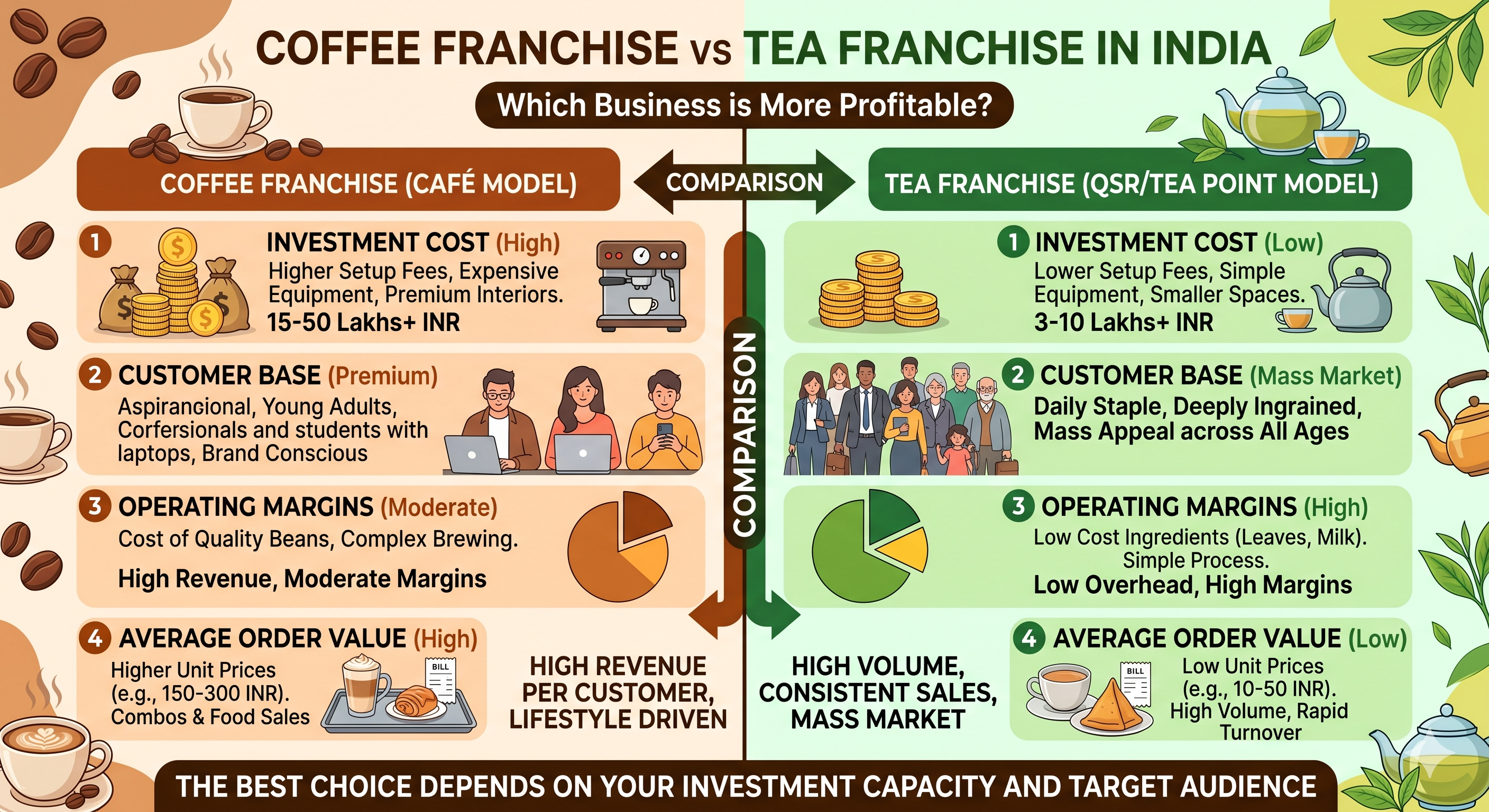
ideas are coffee franchises and tea franchises. Entrepreneurs often face one big question: Which is more profitable in India?
The answer isn’t as simple as choosing between tea and coffee—it depends on investment capacity, target market, and long-term business goals. In this blog, we’ll break down a detailed comparison to help you decide which franchise suits you best.
Understanding the Indian Beverage Market
India is a tea-dominated country, where chai is deeply rooted in everyday culture. Over 80% of Indian households consume tea daily, making it a mass-market beverage .
On the other hand, coffee has carved a niche in urban and premium markets, driven by café culture, millennials, and workspaces. Coffee consumption is growing steadily, especially in Tier-1 and Tier-2 cities .
👉 In short:
-
Tea = Mass consumption + daily habit
-
Coffee = Premium experience + lifestyle product
Initial Investment Comparison
One of the most important differences between coffee and tea franchises is startup cost.
Tea Franchise Investment
-
Approx. ₹8–15 lakhs
-
Small space or kiosk model
-
Basic equipment and setup
-
Lower interior cost
Coffee Franchise Investment
-
Approx. ₹30–70 lakhs
-
Premium café setup
-
Expensive machines (espresso, grinders)
-
High-end interiors and branding
👉 Clearly, tea franchises require significantly lower capital, making them ideal for first-time entrepreneurs .
Profit Margin and Cost Structure
Profitability is not just about selling price—it’s about cost vs revenue.
Tea Franchise Margins
-
Cost per cup: ₹4–₹6
-
Selling price: ₹15–₹30
-
Profit margin: 60–70%
Coffee Franchise Margins
-
Cost per cup: ₹40–₹60
-
Selling price: ₹150–₹250
-
Profit margin: lower due to high overheads
Although coffee sells at a higher price, expenses like rent, staff salaries, and equipment reduce net profit. Tea, on the other hand, benefits from low cost and high volume sales .
Customer Base and Demand
Tea Franchise Demand
-
Appeals to all age groups
-
Popular in rural, semi-urban, and urban areas
-
High repeat customers (multiple times a day)
Coffee Franchise Demand
-
Popular among youth and professionals
-
Mostly urban and metro-centric
-
Occasional consumption
👉 Tea wins in terms of consistent daily demand and wider audience reach .
Break-even Period
The time required to recover your investment is crucial.
Tea Franchise
-
Break-even: 6–12 months (in many cases)
-
Faster ROI due to low setup cost and high footfall
Coffee Franchise
-
Break-even: 2–3 years
-
Requires steady premium customer flow
Tea franchises generally recover capital much faster, making them less risky .
Operational Complexity
Tea Franchise
-
Simple menu
-
Easy to train staff
-
Faster service
-
Low wastage
Coffee Franchise
-
Complex menu (espresso, cappuccino, latte, etc.)
-
Skilled baristas required
-
High maintenance equipment
-
More wastage risk
👉 Tea franchises are easier to manage, especially for beginners .
Scalability and Expansion
Tea Franchise
-
Can expand in Tier-2 and Tier-3 cities
-
Works in small spaces and kiosks
-
Lower expansion cost
Coffee Franchise
-
Best suited for premium locations
-
Expansion requires heavy investment
-
Limited to urban markets
👉 Tea businesses scale faster due to flexibility and lower costs .
Revenue Model: Volume vs Value
This is where the real difference lies.
-
Tea Franchise: Low price + high volume
-
Coffee Franchise: High price + low volume
Tea outlets rely on consistent daily sales, while coffee cafés depend on customer experience and branding.
Risk Factor
Tea Franchise Risk
-
Low investment = lower financial risk
-
Stable demand
-
Less dependency on branding
Coffee Franchise Risk
-
High capital investment
-
Dependent on location and brand value
-
Sensitive to economic downturns
Final Comparison Table
|
Factor |
Tea Franchise |
Coffee Franchise |
|
Investment |
Low (₹8–15L) |
High (₹30–70L) |
|
Profit Margin |
High (60–70%) |
Moderate |
|
Break-even |
Fast (6–12 months) |
Slow (2–3 years) |
|
Customer Base |
Mass market |
Premium niche |
|
Scalability |
High |
Moderate |
|
Risk |
Low |
High |
|
Operations |
Simple |
Complex |
So, Which Business is More Profitable?
✅ Tea Franchise – Best for:
-
Low investment entrepreneurs
-
Faster ROI seekers
-
Expansion in small cities
-
Stable and consistent income
✅ Coffee Franchise – Best for:
-
High investment capacity
-
Premium brand building
-
Metro city locations
-
Long-term business vision
Final Verdict
If your goal is quick profits, low risk, and scalability, a tea franchise is generally more profitable in India. It benefits from massive demand, low costs, and faster break-even.
However, if you’re aiming for brand value, premium positioning, and long-term growth, a coffee franchise can also be highly rewarding, though it requires patience and higher investment.
👉 In 2026, the trend clearly shows that tea franchises are outperforming coffee cafés in ROI and scalability, especially for new entrepreneurs .
Nach Verein filtern
Read More
Le meilleur casino en ligne est une notion en constante évolution, influencée par les avancées technologiques, les attentes des utilisateurs et la concurrence croissante du secteur. Aujourd’hui, de nombreuses plateformes cherchent à se positionner comme le meilleur casino en ligne en améliorant leurs services, leurs jeux et leurs...

Security is one of the most important priorities for homeowners and business owners alike. While many people focus on installing high-quality locks, they often overlook the importance of maintaining them. Regular lock maintenance helps ensure that your security system continues to function effectively and reduces the risk of unexpected lock failures. If you are looking for Locksmith service...

Polaris Market Research has announced the latest report, namely Cold Pain Therapy Market Share, Size, Trends, Industry Analysis Report, By Product (OTC Products and Prescription Products); By Application; By Distribution Channel; By Region; Segment Forecast, 2022 - 2030, that examines the overall market condition both now and in the future. It provides comprehensive and accurate research...
This Facebook malware exploits social connections by mimicking video sharing links through trusted Google platforms. The attack recently adapted to target Picasa and Google Reader users specifically. Victims receive what appears to be a friend's video link only to encounter fabricated "ActiveX Object Errors" prompting downloads of fake video codecs. These downloads actually install the Zlob...

For couples wishing to build a shared life in the United Kingdom, the UK Partner Visa is one of the most important immigration routes available. It allows spouses, civil partners, and long-term unmarried partners of British citizens or settled individuals to live and grow together in the UK. Beyond reunification, this visa offers long-term potential by creating a route toward settlement and...