Coffee Franchise vs Tea Franchise in India – Which Business is More Profitable?
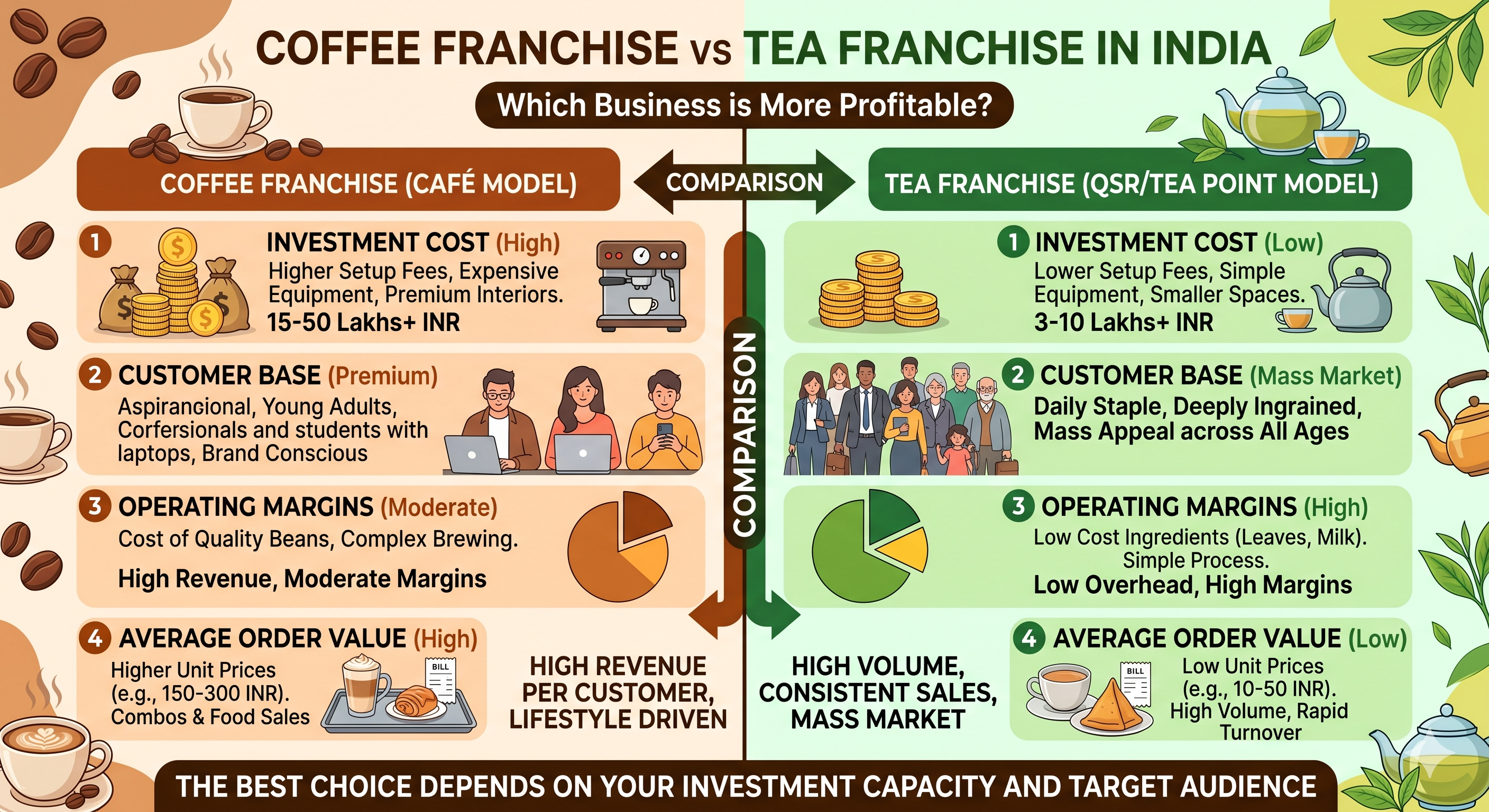
ideas are coffee franchises and tea franchises. Entrepreneurs often face one big question: Which is more profitable in India?
The answer isn’t as simple as choosing between tea and coffee—it depends on investment capacity, target market, and long-term business goals. In this blog, we’ll break down a detailed comparison to help you decide which franchise suits you best.
Understanding the Indian Beverage Market
India is a tea-dominated country, where chai is deeply rooted in everyday culture. Over 80% of Indian households consume tea daily, making it a mass-market beverage .
On the other hand, coffee has carved a niche in urban and premium markets, driven by café culture, millennials, and workspaces. Coffee consumption is growing steadily, especially in Tier-1 and Tier-2 cities .
👉 In short:
-
Tea = Mass consumption + daily habit
-
Coffee = Premium experience + lifestyle product
Initial Investment Comparison
One of the most important differences between coffee and tea franchises is startup cost.
Tea Franchise Investment
-
Approx. ₹8–15 lakhs
-
Small space or kiosk model
-
Basic equipment and setup
-
Lower interior cost
Coffee Franchise Investment
-
Approx. ₹30–70 lakhs
-
Premium café setup
-
Expensive machines (espresso, grinders)
-
High-end interiors and branding
👉 Clearly, tea franchises require significantly lower capital, making them ideal for first-time entrepreneurs .
Profit Margin and Cost Structure
Profitability is not just about selling price—it’s about cost vs revenue.
Tea Franchise Margins
-
Cost per cup: ₹4–₹6
-
Selling price: ₹15–₹30
-
Profit margin: 60–70%
Coffee Franchise Margins
-
Cost per cup: ₹40–₹60
-
Selling price: ₹150–₹250
-
Profit margin: lower due to high overheads
Although coffee sells at a higher price, expenses like rent, staff salaries, and equipment reduce net profit. Tea, on the other hand, benefits from low cost and high volume sales .
Customer Base and Demand
Tea Franchise Demand
-
Appeals to all age groups
-
Popular in rural, semi-urban, and urban areas
-
High repeat customers (multiple times a day)
Coffee Franchise Demand
-
Popular among youth and professionals
-
Mostly urban and metro-centric
-
Occasional consumption
👉 Tea wins in terms of consistent daily demand and wider audience reach .
Break-even Period
The time required to recover your investment is crucial.
Tea Franchise
-
Break-even: 6–12 months (in many cases)
-
Faster ROI due to low setup cost and high footfall
Coffee Franchise
-
Break-even: 2–3 years
-
Requires steady premium customer flow
Tea franchises generally recover capital much faster, making them less risky .
Operational Complexity
Tea Franchise
-
Simple menu
-
Easy to train staff
-
Faster service
-
Low wastage
Coffee Franchise
-
Complex menu (espresso, cappuccino, latte, etc.)
-
Skilled baristas required
-
High maintenance equipment
-
More wastage risk
👉 Tea franchises are easier to manage, especially for beginners .
Scalability and Expansion
Tea Franchise
-
Can expand in Tier-2 and Tier-3 cities
-
Works in small spaces and kiosks
-
Lower expansion cost
Coffee Franchise
-
Best suited for premium locations
-
Expansion requires heavy investment
-
Limited to urban markets
👉 Tea businesses scale faster due to flexibility and lower costs .
Revenue Model: Volume vs Value
This is where the real difference lies.
-
Tea Franchise: Low price + high volume
-
Coffee Franchise: High price + low volume
Tea outlets rely on consistent daily sales, while coffee cafés depend on customer experience and branding.
Risk Factor
Tea Franchise Risk
-
Low investment = lower financial risk
-
Stable demand
-
Less dependency on branding
Coffee Franchise Risk
-
High capital investment
-
Dependent on location and brand value
-
Sensitive to economic downturns
Final Comparison Table
|
Factor |
Tea Franchise |
Coffee Franchise |
|
Investment |
Low (₹8–15L) |
High (₹30–70L) |
|
Profit Margin |
High (60–70%) |
Moderate |
|
Break-even |
Fast (6–12 months) |
Slow (2–3 years) |
|
Customer Base |
Mass market |
Premium niche |
|
Scalability |
High |
Moderate |
|
Risk |
Low |
High |
|
Operations |
Simple |
Complex |
So, Which Business is More Profitable?
✅ Tea Franchise – Best for:
-
Low investment entrepreneurs
-
Faster ROI seekers
-
Expansion in small cities
-
Stable and consistent income
✅ Coffee Franchise – Best for:
-
High investment capacity
-
Premium brand building
-
Metro city locations
-
Long-term business vision
Final Verdict
If your goal is quick profits, low risk, and scalability, a tea franchise is generally more profitable in India. It benefits from massive demand, low costs, and faster break-even.
However, if you’re aiming for brand value, premium positioning, and long-term growth, a coffee franchise can also be highly rewarding, though it requires patience and higher investment.
👉 In 2026, the trend clearly shows that tea franchises are outperforming coffee cafés in ROI and scalability, especially for new entrepreneurs .
Categories
Read More
Let's be honest—snacking has become a bit of a minefield lately. We're torn between satisfying our cravings and making choices that won't leave us feeling guilty an hour later. But what if I told you there's a dessert that's bridging that gap beautifully? Enter frozen yoghurt, the creamy, tangy treat that's revolutionizing our approach to snacking. It's not just another fad that'll...

"Latest Insights on Executive Summary Vinyl Doors Market Share and Size CAGR Value The global vinyl doors market size was valued at USD 244.21 million in 2024 and is expected to reach USD 322.82 billion by 2032, at a CAGR of 3.55% during the forecast period To produce the best market research report, a wide range of objectives is required to be kept in...

Looking for a reliable and elegant Limo Service Winnipeg for your next event or business trip? AAA VIP Limousine offers professional, comfortable, and luxurious transportation designed to meet the needs of modern travelers. Whether you need a limousine for a wedding, prom, corporate meeting, or airport transfer, our service combines luxury vehicles with experienced chauffeurs to...

first two shows felt like a seed of the major fashion moment that even those outside the industry rallied around for a while. Friends of mine who would have known who was the week prior to the show were texting me their thoughts and feelings about the looks and the venue. The grandiose of the outer space set played a role in the inundation of content on socials, generating coverage beyond the...

Apply Pollution NOC in Uttar Pradesh online. Check UPPCB fees, CTE & CTO process, documents, and approval timeline. Fast & easy guide. ( Introduction) Planning to start a factory or business in Uttar Pradesh without a Pollution NOC? That’s a serious risk. Many businesses face penalties, delays, and even shutdowns just because they ignore this one crucial approval. Whether you are...