


BSc Aviation vs BBA Aviation: Scope, Career Opportunities, and Key Differences
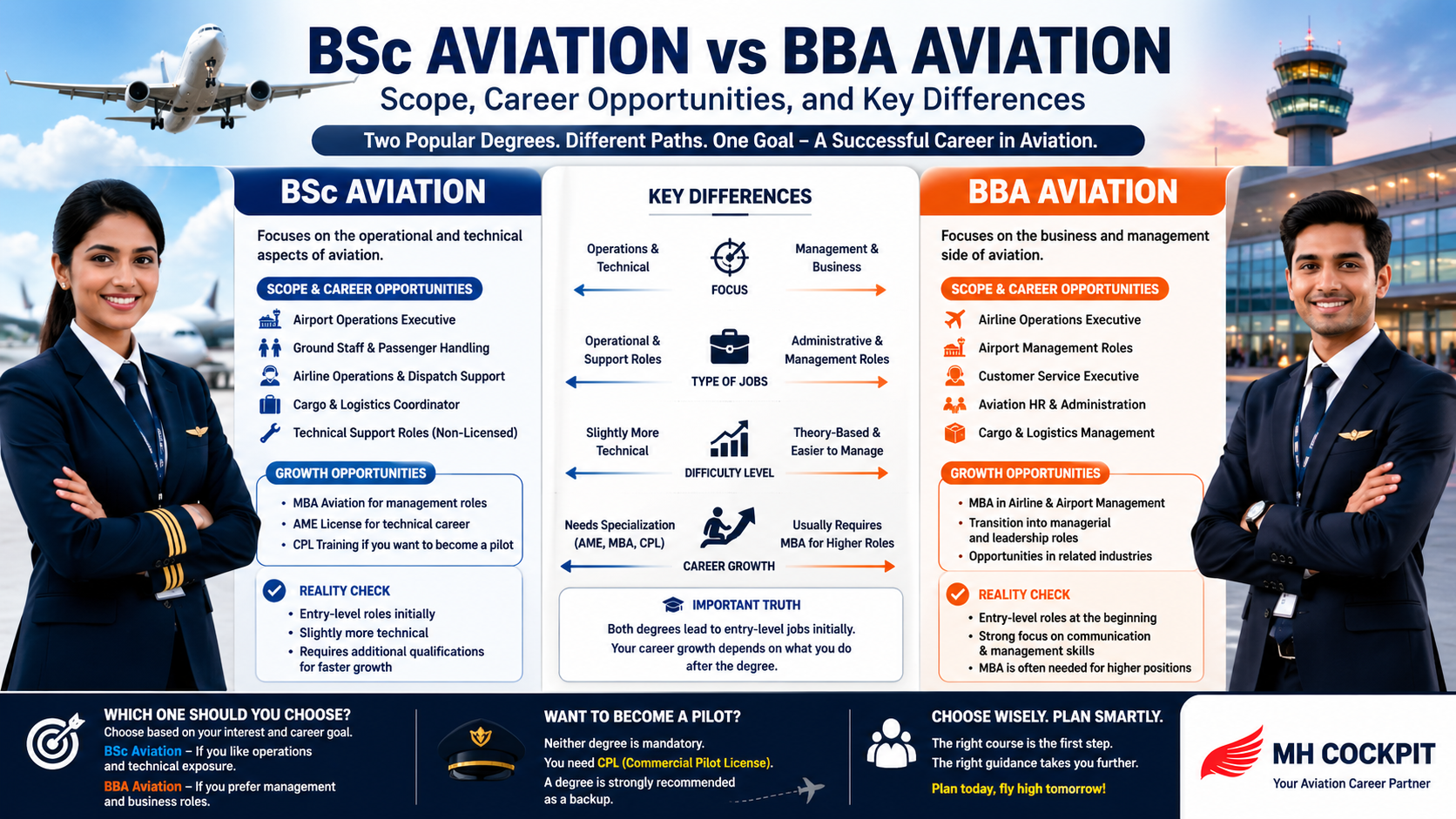
Choosing the right aviation course after 12th can be confusing, especially when two popular options like BSc aviation and BBA aviation seem similar on the surface. Both are 3-year degrees and both lead into the aviation industry, but the career paths they open are quite different.
If you are trying to decide between them, it is important to understand not just the syllabus, but the actual scope, job roles, and long-term growth each course offers.
What is BSc Aviation?
BSc aviation is a degree that focuses on the operational and technical side of aviation. It introduces students to how the aviation industry works from a systems and process perspective.
The course typically covers:
- Aviation operations
- Air navigation
- Aircraft basics and safety
- Airport and airline procedures
It is a good option if you want to understand how flights are managed and how airport systems function on a daily basis.
Scope of BSc Aviation
After completing BSc aviation, most students enter operational roles in the aviation industry.
Common job roles
- Airport operations executive
- Ground staff and passenger handling
- Airline operations assistant
- Cargo and logistics coordinator
- Technical support roles (non-licensed)
These roles are part of the core functioning of airports and airlines.
Growth opportunities
BSc aviation is a foundation degree, so growth depends on what you do next:
- MBA aviation for management roles
- AME license for technical career
- CPL training if you want to become a pilot
Reality check
- Entry-level roles initially
- Slightly more technical than management courses
- Requires additional qualifications for faster growth
What is BBA Aviation?
BBA aviation is a management-focused degree that combines business studies with aviation industry knowledge.
The course focuses on:
- Airline and airport management
- Customer service and passenger handling
- Logistics and cargo operations
- Business and administration
It is designed for students who want to build a career in the business side of aviation.
Scope of BBA Aviation
After BBA aviation, students typically move into management and coordination roles.
Common job roles
- Airline operations executive
- Airport management roles
- Customer service executive
- Aviation HR and administration
- Cargo and logistics management
These roles focus more on planning, coordination, and customer experience.
Growth opportunities
- MBA in airline and airport management
- Transition into managerial and leadership roles
- Opportunities in related industries like logistics and business
Reality check
- Entry-level roles at the beginning
- Strong focus on communication and management skills
- MBA is often needed for higher positions
Key Differences Between BSc Aviation and BBA Aviation
1. Focus of the course
- BSc aviation focuses on operations and basic technical knowledge
- BBA aviation focuses on business and management
2. Type of jobs
- BSc aviation leads to operational and support roles
- BBA aviation leads to administrative and management roles
3. Difficulty level
- BSc aviation is slightly more technical
- BBA aviation is more theory-based and easier to manage
4. Career growth path
- BSc aviation requires specialization like AME, MBA, or CPL
- BBA aviation usually requires an MBA for higher roles
Which One Should You Choose?
The right choice depends entirely on your career goal.
- Choose BSc aviation if you are interested in how aviation systems work and want operational roles
- Choose BBA aviation if you prefer management, coordination, and business roles
If your goal is to become a pilot, neither degree is mandatory. You will need CPL training separately, though having a degree is strongly recommended as a backup.
Common Mistake Students Make
A lot of students choose between BSc aviation and BBA aviation based only on the course name or what others suggest.
This often leads to:
- Lack of clarity about career direction
- Low growth roles after graduation
- Confusion about next steps
The degree alone does not define your career. Your planning after the degree is what really matters.
How MH Cockpit Helps
This is where proper guidance becomes important.
MH Cockp it helps students:
- Understand the difference between aviation career paths
- Choose the right course based on long-term goals
- Plan what to do after graduation, whether it is MBA, CPL, or technical specialization
Instead of choosing blindly, you get a clear direction from the beginning.
Final Thoughts
Both BSc aviation and BBA aviation are valid pathways into the aviation industry. The difference lies in the type of roles you want and how you plan your future steps.
BSc aviation gives you exposure to operations and technical aspects.
BBA aviation prepares you for management and business roles.
Neither course guarantees success on its own. What matters is how you build on it.
Simple Takeaway
- BSc aviation is best for operations and technical exposure
- BBA aviation is best for management and business careers
- Both start with entry-level roles
- Career growth depends on specialization and planning
If you are clear about your goal and make the right choices early, both paths can lead to strong careers in aviation.
الأقسام
إقرأ المزيد
In the fast-paced world of candy production, the need for efficiency and consistency is paramount. Manufacturers across the globe rely on advanced machinery to produce large quantities of candies with uniform quality and high throughput. One such critical piece of equipment is the hard candy machine, which plays an essential role in shaping and creating candies that meet consumer expectations...

Valorant Overview and Agents Since its debut, Valorant by Riot Games has rapidly become a sensation within the gaming world, captivating audiences across platforms like Twitch. As a tactical shooter, the game emphasizes strategic play and skillful aim, making it a favorite among both casual players and professional eSports teams alike. Central to Valorant's gameplay are the diverse agents,...

Festive celebrations are about joy, connection, and creating memorable moments with family, friends, and loved ones. From cozy gatherings at home to elegant parties and cheerful outings, the holiday season brings a special atmosphere that feels different from the rest of the year. Along with decorations, music, and food, clothing plays a powerful role in shaping this experience. This naturally...

For a long time, the biggest "tell" of an AI-generated video was the movement. While static frames looked breathtaking, the moment characters started to move—especially complex actions like dancing, sprinting, or interacting with objects—the physics would often fall apart. For creators trying to produce professional-grade content, these "uncanny valley" glitches were more than just...

The Visual Analytics Market is gaining significant momentum as organizations increasingly rely on data-driven decision-making. The growing visual analytics industry is transforming the way businesses interpret complex datasets by combining advanced analytics with interactive data visualization tools. These platforms enable organizations to convert large volumes of raw data into intuitive...