The "Travel Mixology" Trend: Blending Generative AI with Social Data for Unique Trips
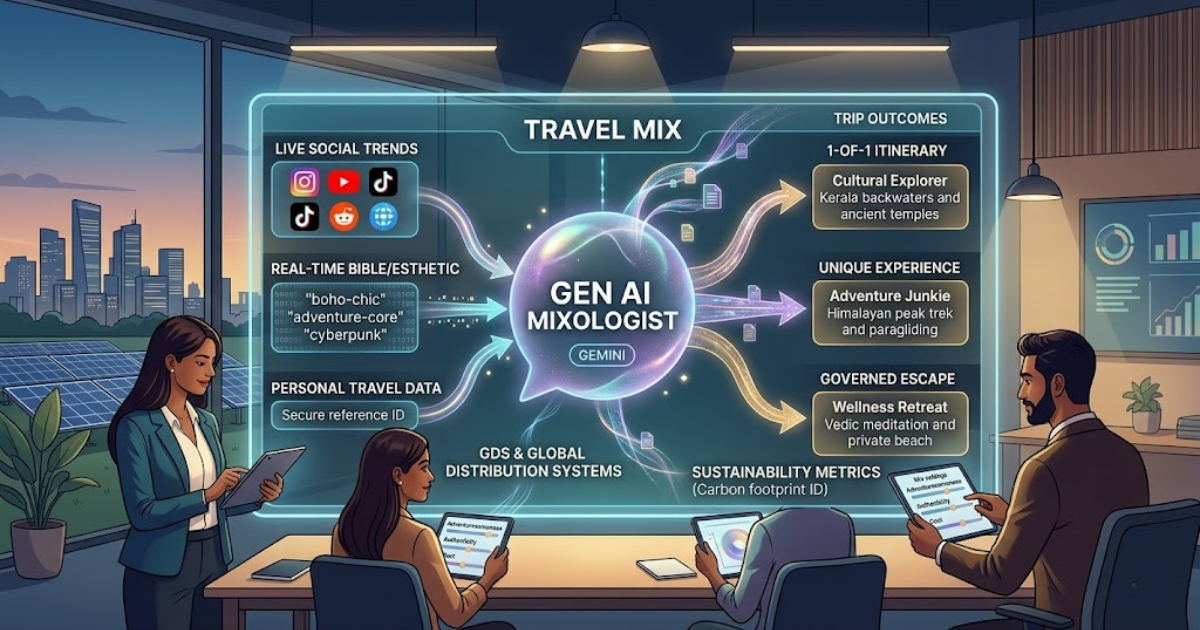
The tourism landscape in 2026 has moved beyond the era of generic holiday packages. We have entered the age of "Travel Mixology." This technical trend represents the sophisticated blending of Generative AI (GenAI) with real-time social data to create highly curated, "one-of-one" travel experiences. Today, a successful itinerary does not just come from a database; it emerges from a complex analysis of digital "vibes," social sentiments, and predictive modeling.
Travel Technology has evolved to bridge the gap between inspiration and execution. For service providers, the challenge lies in harmonizing unstructured social media signals with structured booking engines.
The Anatomy of Travel Mixology
Travel Mixology is the technical process of synthesizing high-velocity social data with the reasoning capabilities of Large Language Models (LLMs). Traditional search engines rely on static keywords like "hotels in Paris." In contrast, Travel Mixology focuses on "intent" and "aesthetic," which are often found in social media captions, short-form videos, and community forums.
Technical Components of the Mix
-
Social Data Ingestion: Aggregating data from platforms like Instagram, YouTube, and Reddit.
-
Sentiment Analysis: Using Natural Language Processing (NLP) to determine the "vibe" of a destination.
-
Generative Reasoning: Employing models like Gemini to draft itineraries based on those vibes.
-
API Orchestration: Connecting the AI output to Global Distribution Systems (GDS) for real-time booking.
By April 2026, research indicates that 42% of travelers have transitioned from traditional search engines to AI-powered travel designers. These tools act as digital concierges that understand a user’s aesthetic preferences better than any manual filter.
Ingesting the "Vibe": The Role of Social Data
Social data serves as the raw material for modern Travel Technology. While a hotel website shows professional photos, social media shows the reality. In 2026, Gen Z and Millennial travelers prioritize trips that "look good on the 'gram," with 43% of Indian Gen Z travelers explicitly choosing destinations based on social media appeal.
1. Data Extraction and Cleaning
The first step in Travel Mixology is cleaning the "noisy" data from social feeds. Travel Technology Solutions use specialized scrapers and vision AI to analyze images and videos.
-
Visual Recognition: Identifying a specific "hidden gem" cafe from a viral TikTok video.
-
Geospatial Tagging: Mapping "vibe" descriptions (e.g., "cottage-core," "cyberpunk") to specific GPS coordinates.
-
Trend Detection: Identifying when a destination is becoming "over-touristed" in real-time to suggest alternatives.
2. Statistics on Social Influence
-
70% of Gen Z Travelers: Use Instagram and YouTube as their primary source of inspiration.
-
46% Posting Rate: Nearly half of travelers post their journeys online, creating a continuous loop of fresh data for AI models.
-
20% Booking Surge: Specific regions, like Alberta, saw a 20% increase in international bookings in early 2026 due to "scripted tourism" (travel inspired by films and digital content).
The Generative Engine: From Inspiration to Itinerary
Once the system gathers social signals, the Generative AI engine begins the "mixology" process. Unlike a simple database query, GenAI uses multi-step reasoning to build a narrative around a trip.
1. Behavioral Personalization
Modern Travel Technology platforms like Expedia and Trip.com use GenAI to learn user behavior. If a traveler frequently engages with "mountain trekking" content on social media, the AI pivots its suggestions toward hill stations and cozy lodges. It moves beyond basic filtering by anticipating the user's "emotional value" and "autonomy."
2. The Zero-Click Reality
We are witnessing the onset of "Zero-Click" travel planning. In 2026, AI platforms answer travel queries directly. They do not just provide links; they provide a full, bookable plan. This "Generative Engine Optimization" (GEO) has caused traditional organic traffic for some destination websites to decline by 30% to 40%. The value has shifted from the content itself to the AI’s ability to cite and synthesize that content.
Technical Architecture of an AI-Powered Travel App
To build a "Travel Mixology" platform, developers must move toward an "Agentic AI" architecture. This involves creating autonomous agents that can navigate the web, check prices, and verify availability without human intervention.
1. The Three Pillars of 2026 Travel Architecture
-
Clean Data Rooms: AI models require structured, high-quality data to avoid "hallucinations."
-
Semantic Search Layers: Allowing users to search by "vibe" (e.g., "I want a weekend that feels like a 90s indie movie").
-
Predictive Logic: Anticipating disruptions like weather or over-crowding before they officially occur.
2. Disruption Prediction Tools
Travel Technology Solutions now use real-time data from air traffic control and weather services to forecast delays.
-
Aviation Metrics: Modern systems forecast turbulence and wind shear hours in advance.
-
Proactive Rerouting: Airlines like United use predictive AI to notify passengers of alternatives before a flight is even canceled.
-
Sentiment Monitoring: Analyzing customer communication helps platforms identify frustration early, preventing negative reviews.
ROI and Efficiency: Why Businesses are Scaling AI
The financial argument for Travel Mixology is undeniable. Companies that operationalize AI see measurable gains in both conversion and revenue.
|
Metric |
Traditional Planning |
AI-Powered "Mixology" |
|
Itinerary Draft Time |
2 - 4 Hours |
< 30 Seconds |
|
Booking Conversion Rate |
~3% |
~7% - 10% |
|
Manual Service Load |
High |
Low (Automated Agents) |
|
Customer Retention |
15% |
25%+ |
|
Dynamic Pricing Revenue |
Standard |
+15% Increase |
Case Study: The "Pick 'n' Stays" Model
A major hotel chain implemented a "Pick 'n' Stays" model using Travel Technology Solutions. This allowed guests to choose room amenities—from Pilates machines to wellness minibars—based on their social media fitness profiles.
-
The Result: 63% of customers were willing to pay extra for these personalized experiences.
-
The Outcome: The chain saw a 12% increase in RevPAR (Revenue Per Available Room) in the first quarter of 2026.
Overcoming Technical Obstacles in AI Travel
Despite the speed of adoption, developers face three primary technical hurdles.
1. Data Privacy and Biometrics
By 2026, digital boarding passes and biometrics are standard. Using tools like facial recognition, airports verify identity swiftly. However, the "Mixology" trend requires access to social data. Consultants must ensure that this data is used in a "GDPR-compliant" and "HIPAA-secure" manner, especially when handling health-related wellness travel data.
2. The "Unseen" Truth: Data Quality
Agentic AI is only as good as its backend. If the supplier data (hotel rates, flight times) is messy, the AI agent will make poor decisions. Successful companies in 2026 are not just automating; they are "cleaning their data rooms." They focus on automating high-friction workflows, like rate validation, while leaving complex service issues to humans.
3. Combating Overtourism
AI-planned itineraries must account for destination capacity. High-performance systems now integrate "Overtourism Controls." If a "hidden gem" becomes too viral, the AI proactively suggests "dupe" destinations—lesser-known spots that offer a similar vibe but lower costs and crowds.
The 2026 Playbook for Travel Providers
To capture growth in the "Travel Mixology" era, providers must follow a specific technical roadmap:
-
Integrate Multi-Channel Signals: Don't just look at past bookings. Look at current social trends.
-
Embrace Vibe Coding: Allow users to build trips using natural language and aesthetic descriptions.
-
Optimize for Answers: Ensure your property or service is cited in the results of AI travel designers.
-
Automate the "Unsexy" Tasks: Use AI to handle supplier onboarding and booking approvals.
-
Anticipate, Don't React: Use predictive AI to solve travel issues before the customer even knows they exist.
Conclusion
The "Travel Mixology" trend represents the ultimate convergence of human inspiration and machine precision. By blending Generative AI with the vast ocean of social data, Travel Technology is finally delivering on the promise of true personalization. We are no longer limited by the " industry assumptions" of the past.
Travelers in 2026 move fast. They expect instant clarity, personalized value, and a journey that reflects their digital identity. Travel Technology Solutions provide the tools to meet these expectations. As the industry matures, the winners will be the ones who master the "Mix"—the perfect blend of real-time social sentiment and robust, AI-driven execution. The future of travel is not just a destination; it is a perfectly mixed, data-driven experience.
Categorias
Leia Mais
Training Manual. Please contact us for your hands-on Jeuveau training. How to Inject Jeuveau®: a Beginner’s Guide to Jeuveau Certification What is Jeuveau®? Jeuveau® is a purified botulinum toxin made by a company called Evolus that temporarily relaxes the muscles that cause wrinkles on the face. Jeuveau® works on the neuromuscular junction by blocking the...

The recent release of Valorant patch 11.08 caught many players and enthusiasts off guard, sparking widespread debate across the community. Fans are divided on the update: some appreciate the increased focus on gunplay, believing it enhances skill expression, while others criticize the nerfs to several agent abilities, feeling it diminishes strategic diversity. Notably, professional players and...

The API Marketplace Market is witnessing rapid expansion as organizations increasingly rely on application programming interfaces (APIs) to accelerate digital transformation and enable seamless integration between applications, platforms, and services. The market was valued at USD 21.36 billion in 2025 and is projected to reach USD 112.61 billion by 2035, growing at a CAGR of 18.13% during the...

Grow your exports with a reliable bulk baby milk exporter UK for global markets. British Chemist provides quality products, efficient logistics, and dependable service for international trade. bulk baby milk exporter UK
A well-planned Patio Installation can completely transform your backyard into a functional and stylish outdoor living space. Homeowners today are investing in patios to improve comfort, increase property value, and create spaces for relaxation and entertainment. Whether you’re considering a simple concrete design or a custom outdoor layout, understanding the process, materials, and...