


What certifications are required for an Ophthalmic Modular OT With Laminar Airflow?
INTRODUCTION
In modern healthcare infrastructure, ensuring safety, sterility, and compliance is essential—especially in surgical environments like ophthalmic operation theatres. An Ophthalmic Modular OT With Laminar Airflow is designed to maintain ultra-clean conditions for delicate eye procedures, but its effectiveness depends heavily on meeting strict certifications and regulatory standards.
Certifications validate that the operation theatre meets national and international guidelines for air quality, infection control, safety, and performance. Without proper certification, even a well-designed OT may fail to meet clinical and legal requirements.
In this comprehensive blog, we will explore the key certifications required, their importance, and how they ensure optimal functioning of an ophthalmic modular OT.
Why Certifications Are Important in Ophthalmic OTs
Certifications are not just formalities—they are essential for ensuring that the OT environment is safe for both patients and medical staff.
Key Benefits:
- Ensures infection control
- Validates air quality and airflow performance
- Confirms compliance with healthcare regulations
- Enhances patient safety
- Improves hospital credibility
An Ophthalmic Modular OT With Laminar Airflow must meet these standards to operate effectively and legally.
Major Certifications Required in India
1. NABH Accreditation (National Accreditation Board for Hospitals & Healthcare Providers)
NABH is one of the most important certifications for healthcare facilities in India.
Key Focus Areas:
- Patient safety and quality of care
- Infection control protocols
- OT design and maintenance standards
NABH accreditation ensures that the Ophthalmic Modular OT With Laminar Airflow meets national healthcare quality benchmarks.
2. ISO 14644 Cleanroom Certification
ISO 14644 is an international standard for cleanroom classification.
Covers:
- Airborne particle concentration
- Cleanliness levels
- Airflow performance
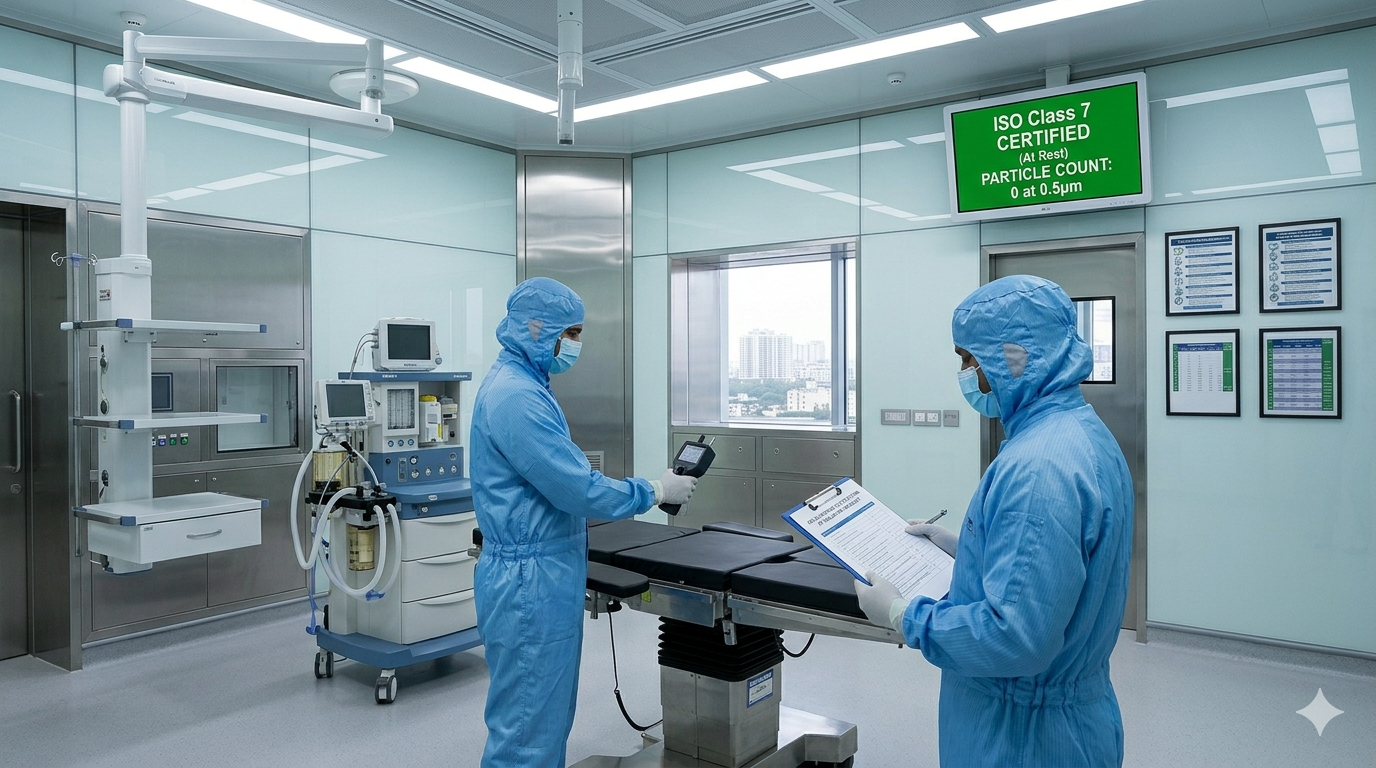
Ophthalmic OTs typically fall under ISO Class 5 to Class 7, depending on design and usage.
3. HVAC Validation Certification
HVAC systems are critical for maintaining air quality.
Includes:
- Air Change Rate (ACH) validation
- Temperature and humidity control
- Pressure differential testing
This certification ensures that the laminar airflow system functions correctly.
4. HEPA Filter Certification
HEPA filters are essential for removing airborne contaminants.
Testing Includes:
- Filter integrity testing (DOP/PAO test)
- Efficiency validation (99.97% at 0.3 microns)
This ensures clean air supply in the OT.
5. Electrical Safety Certification
Electrical systems must be safe and reliable.
Includes:
- Load testing
- Earthing verification
- Compliance with electrical safety standards
This reduces the risk of electrical hazards in the OT.
6. Fire Safety Certification
Fire safety is critical in healthcare environments.
Includes:
- Fire-resistant materials
- Fire detection systems
- Emergency evacuation compliance
This certification ensures preparedness for emergencies.
7. Biomedical Waste Management Certification
Proper disposal of medical waste is mandatory.
Ensures:
- Safe handling of biological waste
- Compliance with pollution control regulations
This protects both staff and the environment.
International Certifications and Guidelines
1. WHO Guidelines
The World Health Organization provides global standards for healthcare facilities.
Focus Areas:
- Infection prevention
- Sterile environments
- Patient safety
2. ESHRE Guidelines
The European Society of Human Reproduction and Embryology provides standards for reproductive labs but also influences OT design practices.
3. CDC Guidelines
The Centers for Disease Control and Prevention provides infection control standards.
Cleanroom Classification in Ophthalmic OTs
Cleanroom classification is a key requirement for certification.
Typical Classification:
- ISO Class 5: Critical surgical zones
- ISO Class 6–7: General OT areas
These classifications ensure controlled particle levels.
Validation and Testing Certifications
Before certification, the OT must undergo rigorous validation.
Key Tests Include:
- Airflow velocity testing
- Particle count testing
- Microbial testing
- Pressure differential checks
These tests confirm that the Ophthalmic Modular OT With Laminar Airflow meets required standards.
Documentation Required for Certification
Proper documentation is essential for obtaining certifications.
Includes:
- Design and layout drawings
- HVAC system reports
- Validation test reports
- Equipment calibration records
- SOPs and maintenance logs
Accurate documentation ensures smooth certification processes.
Role of Laminar Airflow in Certification
Laminar airflow systems are central to achieving certification.
Benefits:
- Maintains unidirectional airflow
- Reduces contamination
- Supports cleanroom standards
Without proper laminar airflow, achieving certifications becomes difficult.
Challenges in Obtaining Certifications
Despite their importance, certifications can be challenging to obtain.
Common Challenges:
- Complex regulatory requirements
- High cost of compliance
- Time-consuming validation processes
- Need for expert guidance
Working with experienced professionals helps overcome these challenges.
Importance of Regular Audits and Re-Certification
Certification is not a one-time process.
Ongoing Requirements:
- Periodic audits
- Re-validation of systems
- Maintenance of standards
This ensures long-term compliance and performance.
Benefits of Certified Ophthalmic Modular OT
A certified Ophthalmic Modular OT With Laminar Airflow offers:
- Enhanced patient safety
- Reduced infection rates
- Improved surgical outcomes
- Compliance with legal requirements
- Increased hospital credibility
Future Trends in Certification
The future of OT certification includes:
- Digital compliance tracking
- AI-based monitoring systems
- Real-time air quality validation
- Global standard harmonization
These advancements will simplify certification processes.
Choosing the Right Partner for Certification
Selecting the right provider is crucial for achieving certifications.
Look for:
- Experience in healthcare projects
- Knowledge of regulatory standards
- End-to-end services
- Validation and testing expertise
A reliable partner ensures smooth certification and compliance.
Conclusion
Certifications are essential for ensuring that an Ophthalmic Modular OT With Laminar Airflow meets the highest standards of safety, hygiene, and performance. From NABH accreditation and ISO cleanroom standards to HVAC validation and HEPA filter testing, each certification plays a vital role in maintaining a sterile surgical environment.
By adhering to these standards and working with experienced professionals, healthcare facilities can ensure optimal performance and patient safety. With expertise in advanced healthcare infrastructure, Altus Airflow delivers certified and compliant modular operation theatre solutions tailored to modern medical requirements.
Frequently Asked Questions (FAQs)
1. What certifications are required for an Ophthalmic Modular OT With Laminar Airflow?
An Ophthalmic Modular OT With Laminar Airflow requires certifications like NABH, ISO 14644, HVAC validation, and HEPA filter certification.
2. Why is NABH accreditation important?
NABH ensures that an Ophthalmic Modular OT With Laminar Airflow meets national healthcare quality and safety standards.
3. What is ISO 14644 certification?
ISO 14644 certification defines cleanroom standards for an Ophthalmic Modular OT With Laminar Airflow, including air quality and particle limits.
4. Is HVAC validation mandatory?
Yes, HVAC validation is essential for an Ophthalmic Modular OT With Laminar Airflow to ensure proper airflow and contamination control.
5. How often should certification be renewed?
An Ophthalmic Modular OT With Laminar Airflow requires periodic audits and re-certification to maintain compliance.
Read Our Previous Blog------>What materials are used in an Ophthalmic Modular Operation Theatre?
Categorias
Leia mais
Dubai’s luxury real estate market continues to attract investors and homebuyers from around the world, and one development that is generating significant attention is Sobha Sanctuary. Located in the rapidly developing Dubailand district, this premium residential community by Sobha Realty combines elegant architecture, spacious homes, lush green surroundings, and world-class amenities to...

Get the best quality School Furniture from Maskeen Overseas, Delhi NCR - Most popular Play School Toys, School Furniture Manufacturers & Suppliers in India at Factory Price. Call +91-9090877070 Toys Play School Toys Preschool Toys Wooden Play School Toys Classroom Toys Nursery School Toys Kids Plastic Toys Educational Toys Kindergarten Toys Play School Wooden Puzzle...

In-Depth Study on Executive Summary Indonesia At-Home Testing Kits Market Size and Share CAGR Value Data Bridge Market Research analyses that the market is growing with a CAGR of 4.6% in the forecast period of 2022 to 2029 and is expected to reach IDR 16, 81,367.36 million by 2029 from IDR 10, 13,289.31 million in 2021. This Indonesia At-Home Testing Kits Market report is structured...
Stress has become an unavoidable part of modern life, making it more important than ever to invest in moments of complete relaxation. If you have been searching for nuru massage marbella, now is the perfect time to experience a treatment designed to refresh both body and mind. Every session is carefully tailored to create a calming atmosphere where tension melts away and comfort takes center...

"Bio-Isobutene Market Summary According to the latest report published by Data Bridge Market Research, the Bio-Isobutene Market The global bio-isobutene market size was valued at USD 31.9 billion in 2025 and is expected to reach USD 97.78 billion by 2033, at a CAGR of 15.03% during the forecast period In this persuasive Bio-Isobutene Market report,...