How to Start a Skincare Brand in India ( A Complete Guide )
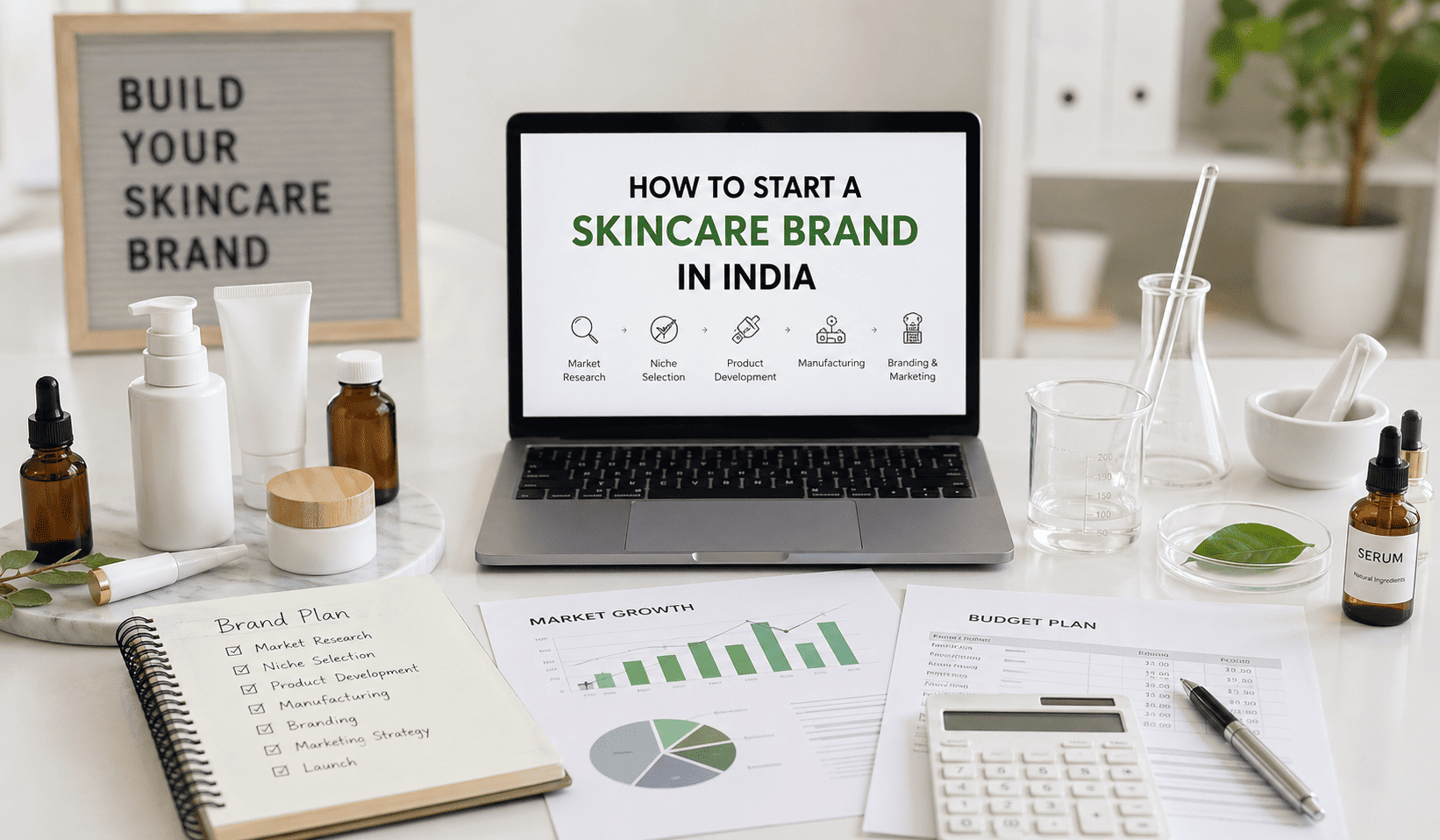
The idea of starting a skincare brand in India has become more popular than ever. With growing awareness around personal care, natural ingredients, and self-grooming, the market is expanding rapidly. But while it looks attractive from the outside, building a skincare brand is not just about launching a product and selling it online. It requires a clear understanding of market demand, regulatory requirements, manufacturing, branding, and financial planning.
Many new founders enter this space with excitement but without proper structure, and that’s where most of them struggle. This guide will walk you through how to start a skincare brand in India in a realistic, practical way—based on how the industry actually works.
Understanding the Skincare Market in India
Before you start anything, it’s important to understand the opportunity. The skincare market in India is growing due to increasing consumer awareness, rising disposable income, and a shift toward preventive self-care. Products that are Ayurvedic, herbal, or clean-label are seeing strong demand, especially among younger consumers.
At the same time, competition is intense. Brands like Mamaearth, Minimalist, and Plum have already captured large portions of the market by focusing on specific problems like acne, pigmentation, or sensitive skin. This means entering the market with a generic product is not enough anymore. You need to clearly define your niche and positioning from the beginning.
Choosing the Right Niche and Product Strategy
One of the most important decisions you will make is selecting your niche. Instead of trying to serve everyone, it is more effective to focus on a specific audience or problem. For example, targeting “acne-prone oily skin” or “sensitive skin with pigmentation issues” gives you a clearer direction compared to launching a general face cream.
It is also advisable to start with a limited product range. Many new brands make the mistake of launching five or six products at once, which increases investment and complexity. A better approach is to begin with one or two well-developed products, test the market, and then expand gradually based on customer response.
Manufacturing: Own Setup vs Third-Party
When it comes to production, you have two main options—setting up your own manufacturing unit or working with a third-party cosmetic manufacturer.
Setting up your own facility requires significant investment in machinery, infrastructure, licensing, and skilled staff. It also involves ongoing operational costs and compliance responsibilities. This model is usually suitable for large-scale businesses with strong capital backing.
On the other hand, third-party manufacturing is the preferred route for most startups. In this model, an existing manufacturer produces products under your brand name. This allows you to enter the market faster without heavy investment. The manufacturer takes care of formulation, production, and quality processes, while you focus on branding and sales. However, choosing the right manufacturer is critical, as product quality and consistency depend heavily on them.
Legal Requirements and Compliance
Starting a skincare brand in India involves certain regulatory steps that cannot be ignored. If you are working with a third-party manufacturer, they typically hold the cosmetic manufacturing license. However, as a brand owner, you still need to ensure proper compliance.
You will need GST registration to operate legally, and it is strongly recommended to register your trademark to protect your brand identity. Product labeling must include details such as ingredients, batch number, manufacturing date, expiry date, and manufacturer information. Incorrect labeling is one of the most common mistakes made by new brands and can lead to serious issues.
Product Development and Testing
Product development is not just about mixing ingredients—it requires careful formulation and testing. A reliable product should be stable, safe for skin use, and consistent across batches. Before launching, you should always test samples personally and, if possible, get feedback from a small group of users.
Skipping this step can lead to poor customer experience and damage your brand reputation early on. Good manufacturers usually assist with formulation and stability testing, but as a brand owner, you should stay involved in the process. A reliable third party cosmetic manufacturer will also guide you through formulation, stability testing, and product safety before final production.
Branding and Packaging
In the skincare industry, branding plays a major role in success. Your brand is what customers connect with, not just the product. This includes your name, logo, packaging, and the message you communicate.
Packaging should not only look attractive but also be functional and compliant with regulations. It should clearly communicate the product’s purpose and benefits. Many successful brands focus on clean, minimal, and professional packaging rather than overly complex designs.
Pricing and Profit Structure
Pricing is another area where many new founders make mistakes. It’s important to understand your cost structure before deciding your selling price. This includes manufacturing cost, packaging cost, logistics, marketing expenses, and platform commissions.
For example, if your product costs around ₹100 to produce, selling it at ₹399 gives you enough margin to cover marketing and operational costs. However, your actual profit will depend on how efficiently you manage advertising and customer acquisition.
Sales Channels and Marketing
Once your product is ready, the next step is deciding where and how to sell it. Most new brands start with either a D2C website or marketplaces like Amazon. It’s better to focus on one primary channel initially rather than spreading resources across multiple platforms.
Marketing is what drives growth in a skincare business. Today, platforms like Instagram play a huge role. Short-form videos, influencer collaborations, and educational content can help build trust and attract customers. Instead of hard selling, showing real product usage and results works much better.
Budget Planning
Starting a skincare brand does not require crores, but it still needs proper financial planning. For a small launch, your total investment can range between ₹1.5 lakh to ₹5 lakh, depending on the number of products and production scale.
A large portion of this budget goes into production and packaging, followed by branding and initial marketing. It is also important to keep some buffer capital for operations and unexpected expenses.
Common Mistakes to Avoid
Many skincare startups fail due to avoidable mistakes. These include choosing the cheapest manufacturer without checking quality, ignoring compliance requirements, launching too many products at once, and overspending on marketing without understanding customer behavior.
Another common issue is lack of clear positioning. Without a defined niche, it becomes difficult to stand out in a crowded market.
Future Trends in the Skincare Industry
The skincare industry is evolving quickly. Consumers are becoming more aware of ingredients and are looking for transparency. Trends like personalized skincare, sustainable packaging, and Ayurvedic formulations combined with modern science are gaining attention.
Brands that adapt to these trends early and maintain product quality will have a better chance of long-term success.
Conclusion
Starting a skincare brand in India is a real opportunity, but it requires careful planning and execution. It is not just about launching a product—it is about building a system that includes compliance, manufacturing, branding, and marketing.
If you approach it step by step, start small, and focus on quality and customer trust, you can build a strong and scalable skincare business. The key is to stay consistent and make informed decisions rather than rushing into the market.
FAQs
How to start a skincare brand in India with low investment?
You can start with third-party manufacturing and a limited product range to keep costs manageable.
Do I need a license to sell skincare products in India?
Yes, proper compliance with cosmetic regulations and GST registration is required.
How much investment is needed to start a skincare brand?
A basic setup typically requires ₹1.5 lakh to ₹5 lakh depending on scale.
Can I sell skincare products online?
Yes, you can sell through your own website or marketplaces like Amazon once compliance is ensured.
Is third-party manufacturing a good option?
Yes, it is the most practical option for startups as it reduces investment and speeds up product launch.
Categories
Read More
[Bangkok, Thailand – October 2025] — For decades, the Maldives has been the ultimate escape a constellation of coral islands scattered across the Indian Ocean where the world’s elite go to disconnect. But now, a quiet evolution is taking place. The same destination once known purely for barefoot luxury and overwater villas is emerging as one of the most desirable frontiers in...

69vn15 là nền tảng cá cược trực tuyến uy tín, chất lượng, an toàn và được đông đảo người chơi quan tâm. Nhờ hệ thống vận hành mượt mà, ổn định và tối ưu, nền tảng mang lại trải nghiệm giải trí nhanh chóng, tiện lợi và hiệu quả. Người dùng có thể dễ dàng truy cập và tham gia...

The United Arab Emirates (UAE) continues to dominate global travel headlines in 2026, positioning itself as one of the most dynamic and future-ready tourism destinations. From luxury experiences in Dubai to cultural expansions in Abu Dhabi, the UAE is rapidly evolving its tourism ecosystem to attract millions of international visitors. Travel And Tour World (travelandtourworld.de) brings you...

Grit and Tonic stands at the forefront as the first dedicated online destination in the Middle East for endurance athletes passionate about triathlon, cycling, running, and swimming. More than just a retailer, Grit and Tonic is rooted in performance, forged in the terrain they know best, and driven by a singular mission: to equip athletes with exceptional gear and trusted advice so they can...
The technical textiles industry is entering a decade of transformation, driven by sustainability, advanced material innovation, and expanding applications across agriculture, construction, healthcare, sports, and protective industries. Technical textiles are more than just fabrics—they are engineered solutions that combine strength, durability, and functionality, making them...