


Why We Turn Down Every Sixth Client for an Industrial Piercing Due to Ear Anatomy
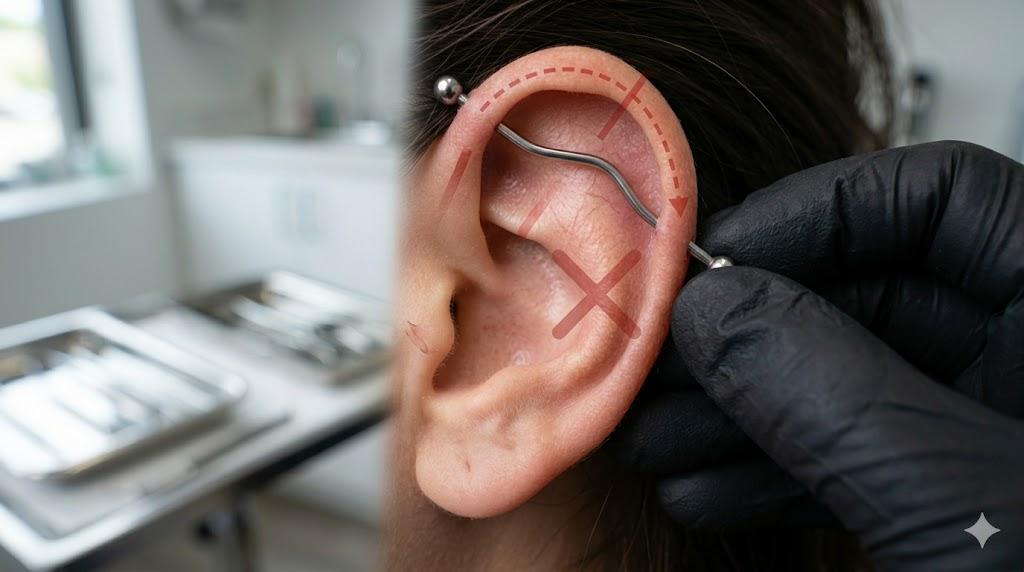
Industrial piercings demand precision. They thread through two points on the upper ear cartilage and require a straight, stable path for a clean heal. In our shop in New York, we follow a simple rule to protect clients: if anatomy makes a safe, properly placed piercing unlikely, we decline the job. That’s the 15% Rule. It’s not a sales pitch. It’s safety in plain terms.
What is the 15% Rule?
The 15% Rule means we turn down roughly one in six potential industrial piercing candidates after a thorough assessment of the ear’s anatomy. The decision isn’t about taste or style. It hinges on the path the jewelry must take and whether that path can stay stable over weeks and months. A piercing that looks good in the moment can shift as you move, chew, or sleep. If the anatomy won’t support a safe, long-lasting placement, we say no.
We use a practical, evidence-based approach. The process blends two core ideas: verify a straight tunnel for the jewelry and confirm enough cartilage on both sides to bear the implant without risking migration or tissue damage. When either condition fails, the risk of infection or rejection climbs. The end goal is a piercing that remains safe and presentable over time.
Navigating the massive body art scene in a major city can be overwhelming for beginners who don't know what red flags to look for in a shop. If you are wondering where to get pierced in nyc, always prioritize studios that strictly use single-use needles instead of reusable guns, ensuring maximum safety and precision.
Ear anatomy basics you should know
Anyone can become a candidate for an industrial piercing, but certain structural features increase or decrease safety. Here are the essentials we check during a standard assessment:
- Cartilage thickness and consistency in the planned path.
- The angle at which the pierce would traverse the cartilage.
- Presence of existing defects or asymmetries that might alter healing.
- Skin elasticity around the outer ear and behind the ear, including any scar tissue.
- Proximity to nerves or fragile regions where irritation could cause complications.
These factors are not cosmetic. They influence healing, the risk of snagging the jewelry, and how well the piercing stays aligned as you sleep or exercise. A clear, straight path through two piercing points is ideal. When the path curves or makes contact with uneven cartilage, the odds of a stable outcome drop significantly.
Why ear anatomy matters for an industrial piercing
An industrial piercing is a long, straight piece of jewelry that connects two separate holes. It relies on a clean, uninterrupted tunnel through the upper ear cartilage. If the tunnel must bend or press against thick cartilage, two problems arise: the jewelry can irritate or erode tissue, and the healing process becomes unpredictable. In practice, this means longer healing times, higher chances of infection, and a greater likelihood that the jewelry will migrate or reject.
We don’t rely on guesswork. We measure, map, and compare. If the anatomy supports a straight, even line—perfect. If not, we walk away, even if the client is eager. That’s how we minimize risk for both parties. In New York’s busy studios, this rule keeps healing clean and outcomes consistent.
What we measure during the assessment
Before we place a single needle, we map the ear with a few practical checks. You can expect a careful, candid review.
- Marking two potential entry points with the client seated upright, so gravity won’t skew the path.
- Assessing the distance between the two points to ensure a standard long barbell can span without bending.
- Testing the cartilage’s resilience by gentle palpation to gauge potential irritation during healing.
- Evaluating symmetry between ears to ensure consistency in final appearance.
- Verifying no underlying skin conditions or infection signs that would complicate healing.
Even with a strong, straight path on one ear, we may find variance on the other side. In those cases, the risk calculus favors declining the procedure if it would create a compromised piercing. That honesty saves time, money, and later pain.
What happens when the 15% rule applies
Declining a prospective client is never personal. It’s guided by a simple outcome: a safe, lasting piercing. When the anatomy doesn’t support a stable, healthy installation, we outline alternatives. These options keep your goals in sight without compromising safety.
- Suggest alternative placements that fit your anatomy, such as a multi-spot forward helix or a traditional helix in a more favorable location.
- Offer a staged plan. Some clients choose to work on cartilage conditioning or wait until cartilage changes with age or after certain activities settle.
- Recommend a different jewelry type or shorter post to reduce movement and irritation during healing.
All alternatives come with clear expectations. We explain healing timelines, aftercare, and what success looks like for each option. The goal is a safe, aesthetically pleasing result, not a rushed plan.
What clients can do to improve chances
If you’re focused on an industrial piercing, there are steps you can take to maximize your odds of a successful outcome during future assessments.
- Keep ears clean and free of infection before any appointment.
- Discuss your sleep habits and any head positioning that might affect healing.
- Share medical history and prior piercing experiences openly with the clinician.
- Avoid heavy lifting or jaw-intensive activities immediately after piercing until healing begins.
These measures can help us see your anatomy more clearly and tailor a plan that respects both safety and your desired look.
How the 15% rule protects you
Protection is the core purpose. When a path isn’t stable, the risks jump. Migration, rejection, infection, and scarring become real possibilities. By declining the procedure in uncertain cases, we reduce long-term pain, avoid unnecessary healing setbacks, and preserve the overall integrity of your ear.
In practice, this approach means you won’t walk away with a piercing that looks good for a week and then fails. You’ll have a clearer plan, realistic timelines, and a solution that fits your anatomy and lifestyle.
Common questions about the 15% rule
Here are quick clarifications drawn from routine conversations with clients in New York studios.
- Is it possible my ears will change enough to permit an industrial later? Yes, cartilage can remodel slightly with time and activity, but we don’t count on changes to make a risky placement safe.
- Can someone with a strong preference for an industrial still get one? If the anatomy doesn’t support a safe path, we’ll propose alternatives that meet your goals without compromising safety.
- Does pain predict a bad outcome? Pain alone isn’t a reliable indicator. It’s the stability of the piercing path and tissue reaction that matters.
Each client receives a straightforward assessment and an honest recommendation. No guesswork, just practical judgment grounded in ear anatomy and healing realities.
Table: Key anatomy factors that influence industrial piercings
The table summarizes the top factors we consider. It helps you see where risks cluster and why some ears are better suited to an industrial piercing than others.
| Factor | Impact on safety | What we look for |
|---|---|---|
| Cartilage thickness | Higher thickness can resist irritation but may bend the path | Even thickness along the proposed tunnel |
| Cartilage curvature | Curved paths raise risk of contact with bone or skin | Straight line between entry points |
| Ear asymmetry | Disparities complicate symmetry of the final look | Balanced geometry between ears |
| Scar tissue history | Scar tissue heals differently and can irritate | No extensive scarring near the planned path |
| Skin elasticity | Low elasticity increases tension during healing | Multiple quick checks during assessment |
If the table highlights several risk areas, that reinforces the 15% rule in your case. It’s not a verdict on you; it’s a practical appraisal of what works best over time.
Real-world example from a New York studio
A client arrived with a desire for an industrial piercing on the right ear. Markings showed a clean potential path, but the left ear presented a slight bend where the bar would sit. We explained the difference clearly: a straight, two-point tunnel on the right and a curved, unstable route on the left. The client chose a different placement for the left ear that respected the anatomy. The right ear received a two-point placement as planned, with excellent healing signs at the subsequent check. The outcome was a safe, symmetrical result, and the client appreciated the honest assessment more than a forced yes.
Bottom line
The 15% Rule keeps your ear safe and your healing predictable. If anatomy doesn’t guarantee a stable, long-lasting path for an industrial piercing, we won’t proceed. You’ll get clear alternatives and a well-mapped plan. The result is a look you want, built on solid, safe foundations.
Categorías
Read More
Opritschnik-Fatui: Kampf und Strategie Die Eliteeinheit der Fatui-Opritschnik präsentiert im Kampf besondere Herausforderungen. Ihre Ausrüstung verfügt über Modifikationen zur Nutzung von Kryo-Kräften, was ihre Effektivität steigert. Diese Frontkämpfer aus Snezhnaya gelten aufgrund ihrer oft vornehmen Abstammung als bevorzugte Truppe. Gegen ihre Angriffe...

That being said, a handful of couples embrace individuality instead. It feels just a touch more fanged than borrowing masculinity. Even on a rainy day, the tread had me striding confidently through the slippery streets of. spend a lot of time taking care of myself. While many find this burgeoning market appealing, for some authors and buyers alike, the lack of regulation is where it gets a bit...

A sofa is more than just a piece of furniture—it’s the heart of your living space. It’s where families relax after long days, guests gather for conversations, and memories are made. Over time, however, sofas accumulate dust, stains, allergens, and odors that not only affect their appearance but also your indoor air quality. This is where Sofa Cleaning Dubai services play a...

At Titan Botanicals, premium concentrates meet craftsmanship. The bulk rosin for sale through our curated category highlights pure, solventless extractions. For those looking to stock up on high-grade concentrates, our rosin wholesale offerings make it easier to access the best in live rosin and THCA rosin. Each batch is carefully processed, giving distributors, shops, and processors...

Polaris Market Research has introduced the latest market research report titled Powder Coating Equipment Market Size, Share, Trends, & Industry Analysis Report By Equipment Type, By End-Use Industry, and By Region – Market Forecast, 2026-2034 that highlights the major revenue stream for the forecast period. The report contains clear, reliable, and thorough Powder...
