


Why Qualified Electronic Archiving is Crucial for Business Legal Compliance
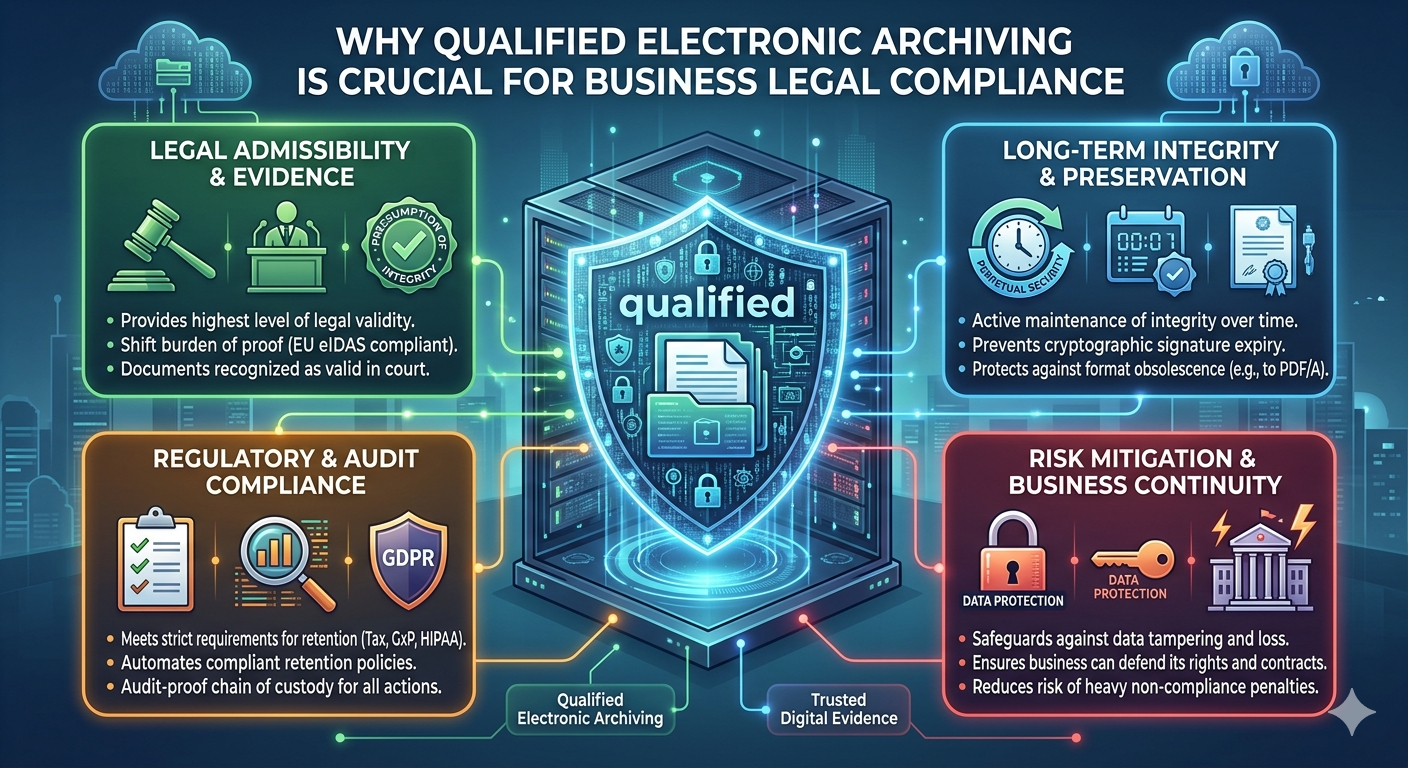
In today’s fast-paced digital world, businesses need to store vast amounts of electronic records. But how can companies ensure these records are legally valid and tamper-proof? Qualified Electronic Archiving (QEA) offers an essential solution. This system ensures that digital records, whether contracts, invoices, or emails, are preserved securely and are legally recognized. But what exactly does QEA entail, and why should businesses invest in it? Let’s explore the importance of maintaining legally reliable records and how QEA plays a pivotal role.
Defining Qualified Electronic Archiving: The Backbone of Digital Record Keeping
At its core, Qualified Electronic Archiving is a process designed to safeguard the authenticity, integrity, and accessibility of electronic records over time. With QEA, digital documents are preserved in a way that ensures they can’t be altered, destroyed, or lost without leaving a clear trace. This system utilizes advanced cryptographic technologies to "seal" the documents and guarantee their reliability.
For businesses, this method of archiving is not just about security it’s about trust. A qualified electronic archive ensures that all documents stored in it are compliant with legal standards, making them suitable for audits, disputes, or any legal scrutiny. Industries such as finance, healthcare, and law benefit immensely from this system, as the integrity of their documents is paramount for both regulatory compliance and maintaining customer trust.
Legal Challenges Businesses Face Without Qualified Electronic Archiving
Imagine a scenario where a business is asked to produce critical records for an audit or legal case. Without a robust and reliable archiving system, the business risks losing the original documents or having them tampered with. The legal consequences can be severe, ranging from fines to losing a case in court.
This is where QEA steps in. It addresses the following challenges that businesses often face:
-
Risk of Document Alteration: Without QEA, it's easy for digital records to be altered or tampered with. QEA ensures that any modification of a record is detectable, maintaining the document's integrity.
-
Compliance Failures: Many industries have strict regulations about how long certain records must be kept. A lack of reliable archiving can lead to non-compliance and costly penalties.
-
Data Loss: Data stored on physical servers or in unstructured formats is more prone to loss. QEA keeps records safe in a centralized, structured digital format, reducing the risk of data loss.
For example, consider a financial institution that needs to preserve transactional records for several years. Using QEA ensures that these records remain intact, authentic, and accessible in case of an audit or investigation.
The Core Benefits of Implementing Qualified Electronic Archiving Systems
Adopting Qualified Electronic Archiving doesn’t just help businesses avoid legal pitfalls it also brings a range of operational advantages:
1. Legal Protection and Compliance
By using QEA, businesses meet stringent legal standards for document retention and archiving. Laws such as the European Union’s eIDAS regulation and various tax laws require businesses to ensure the authenticity of their digital records. With QEA, businesses can confidently comply with these laws, avoiding penalties and maintaining their reputation.
2. Enhanced Security and Integrity
QEA uses cryptographic techniques to ensure that once a document is archived, it cannot be altered. The system makes it impossible to modify records without detection, ensuring the data’s integrity. This is critical for industries like finance, where the authenticity of records is vital to business operations.
3. Improved Efficiency in Document Retrieval
Unlike traditional paper-based archives, QEA allows businesses to retrieve documents quickly and efficiently. With digital archiving, records are indexed and categorized, making it easier to search and access the necessary information in seconds. This is particularly beneficial in situations like audits, where time is of the essence.
4. Cost Savings
Investing in Qualified Electronic Archiving helps businesses save on physical storage costs. Instead of maintaining physical filing cabinets and warehouses, records are stored digitally. Businesses can save on physical space and reduce the costs associated with lost or damaged documents.
How QEA Supports Various Industries
Healthcare: Protecting Patient Records
In healthcare, patient records must be stored securely and in compliance with regulations like HIPAA. Qualified Electronic Archiving helps healthcare providers ensure that patient data remains intact, secure, and accessible, even years after the initial record creation. It also supports the quick retrieval of patient records in case of emergencies or audits.
Finance: Ensuring Transparency in Financial Records
The financial industry requires meticulous record-keeping to ensure regulatory compliance and avoid fraudulent activities. QEA allows financial institutions to store records like transactions, loans, and contracts securely, ensuring that all data is verifiable and protected from tampering.
Legal: Safeguarding Case Files and Contracts
Law firms and legal professionals handle large volumes of contracts, legal filings, and case files. Qualified Electronic Archiving offers law firms a secure and reliable way to preserve their documents for future reference, reducing the risk of document loss or alteration. It also enables quick access to important case materials during litigation or review.
How to Choose the Right Qualified Electronic Archiving Solution
When selecting a QEA solution for your business, it’s crucial to consider a few key factors:
-
Regulatory Compliance: Ensure that the solution complies with industry-specific regulations regarding document retention and accessibility.
-
Security Features: The archiving system should offer strong encryption and authentication mechanisms to prevent unauthorized access and tampering.
-
Scalability: Choose a solution that can scale with your business needs, especially if you expect an increase in document volume over time.
-
Ease of Integration: The system should integrate seamlessly with your existing IT infrastructure and business processes.
Conclusion
In today’s digital landscape, Qualified Electronic Archiving is more than just a convenience, it's a necessity for businesses looking to ensure legal compliance and document integrity. With the right QEA solution, businesses can safeguard their critical records, improve operational efficiency, and reduce the risks associated with data loss or alteration. As digital transformation continues to reshape business practices, implementing a qualified electronic archiving system is essential for companies to maintain transparency, security, and compliance.
Categorias
Leia mais
In Singapore’s fast-paced industrial and commercial environment, safe and efficient material handling is essential for smooth operations. From warehouses and logistics hubs to manufacturing plants and maintenance facilities, businesses rely on lifting solutions that improve productivity while maintaining high safety standards. This is where Scissor Table Lifts Singapore solutions play a...

The most complex and complicated network of the body is the human nervous system. It serves as the control center of all activities such as voluntary ones such as walking, and involuntary ones such as breathing and digestion Neurology & Nerve Testing. In case of a breakdown of this system, the symptoms may be disabling - chronic pain and numbness, muscle weakness, and cognitive...

"Global Demand Outlook for Executive Summary Acrylic Emulsions Market Market Size and Share CAGR Value Global acrylic emulsions market size was valued at USD 10.53 billion in 2024 and is projected to reach USD 19.85 billion by 2032, with a CAGR of 8.25% during the forecast period of 2025 to 2032. The wide-ranging report deals with the new business challenges and investment research on...

Koulibaly en version fantasy Une nouvelle carte DCE vient d’être dévoilée sur FC 26, mettant en avant Kalidou Koulibaly en version fantasy. Ce défenseur central sénégalais 🇸🇳 est reconnu pour sa robustesse et son leadership exemplaire sur le terrain. Grâce à sa combinaison unique de puissance physique et de rapidité, Koulibaly...

Path of Exile 2 (PoE 2) is an exciting expansion to the already incredibly complex and rewarding action RPG. It promises to bring new mechanics, skills, and builds that will further deepen the game's character customization and gameplay. One of the most intriguing and dynamic builds players can experiment with in Poe 2 trade is the Hollow Palm Technique. This unique ability offers a distinctive...