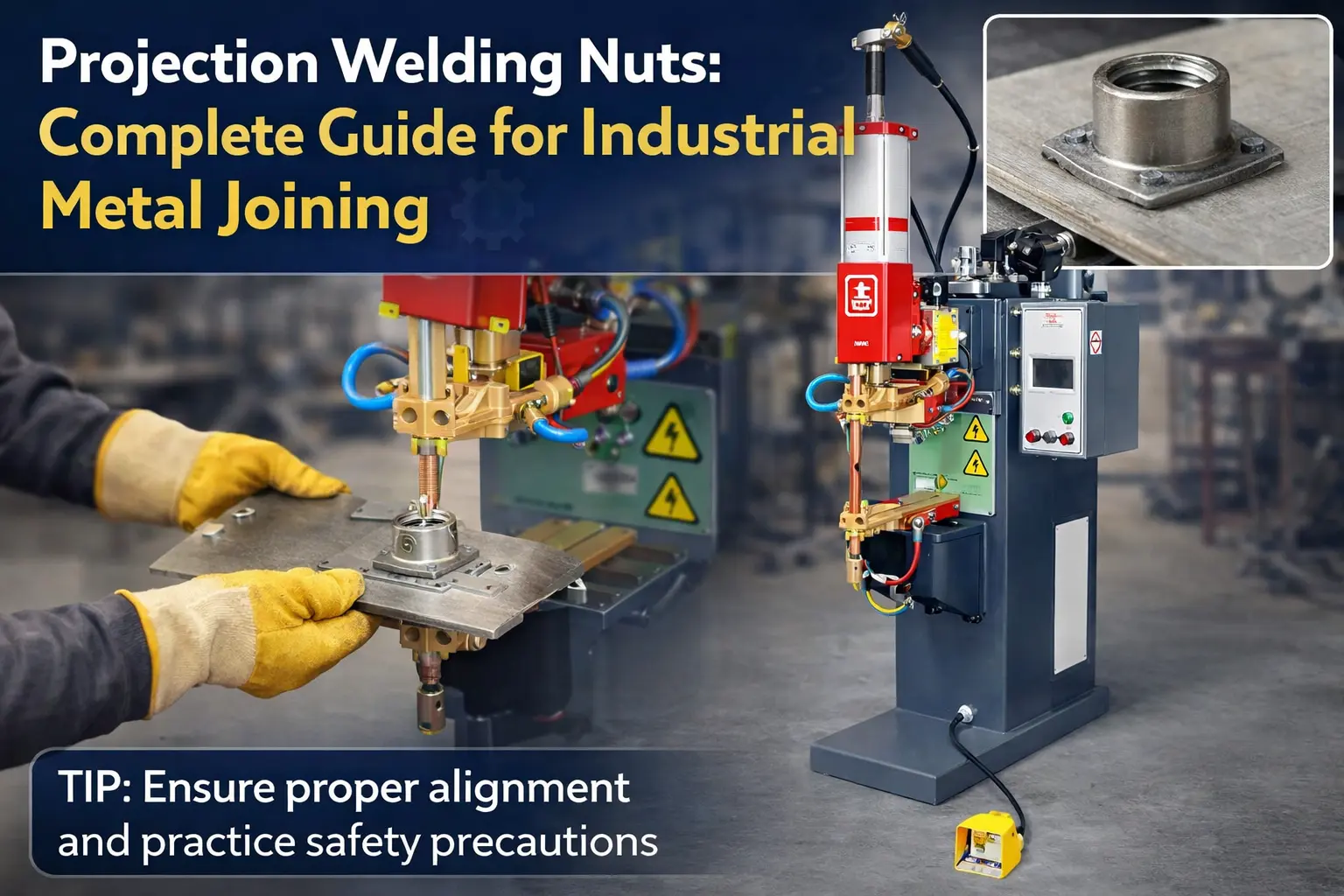
In modern manufacturing, projection welding has become a highly efficient and precise resistance welding technique widely used in automotive, appliance, electrical, and heavy industrial production lines. For OEMs, automation integrators, and production engineers, it offers a reliable method to achieve repeatable weld quality while optimizing cycle time and reducing production variability.
At Heron Welder, we specialize in advanced resistance welding systems including projection welding machines, MFDC controllers, and automated welding production lines designed to meet the demands of high-volume, precision-driven manufacturing.
What is Projection Welding?
Projection welding is a resistance welding process where pre-formed projections (raised points) on a metal surface concentrate electrical current and pressure at specific locations. When current passes through these projections under force, heat is generated due to electrical resistance, causing localized melting and fusion of the metals.
This process allows multiple welds to be created simultaneously in a single cycle, making it highly efficient for mass production environments.
Unlike spot welding, where the weld location depends on electrode contact, projection welding uses engineered geometry in the workpiece itself to define the weld points, ensuring greater consistency and control.
Working Principle of Projection Welding
The process follows a controlled resistance welding cycle:
1. Preparation of Projections
Metal components are designed or stamped with small raised points (embossments) that act as localized current concentrators.
2. Clamping and Force Application
The workpieces are placed between flat electrodes, which apply mechanical pressure.
3. Current Flow and Heat Generation
When welding current passes through the projections, resistance at these small contact points generates intense localized heat.
4. Fusion and Weld Formation
The projections collapse under heat and pressure, forming a strong metallurgical bond.
Because the current is concentrated only at predefined points, projection welding delivers precise, repeatable, and high-strength joints.
Key Advantages of Projection Welding in Industrial Manufacturing
Projection welding is widely adopted in automated production systems due to its technical and operational benefits.
1. High Production Efficiency
Multiple welds can be completed in a single cycle, significantly reducing cycle time and increasing throughput.
2. Consistent Weld Quality
Since weld location is defined by projection geometry, the process ensures repeatability and minimal operator dependency.
3. Reduced Electrode Wear
Flat electrodes with larger contact areas experience lower wear compared to spot welding tips, improving tool life and reducing maintenance costs.
4. Strong and Reliable Joints
Projection welding produces high-strength joints with minimal defects, suitable for structural and load-bearing components.
5. Minimal Heat Distortion
Heat is localized at projection points, reducing deformation in surrounding material especially important for thin sheet metals.
Industrial Applications of Projection Welding
Projection welding is extensively used across industries where precision and repeatability are critical:
Automotive Manufacturing
- Seat frames
- Brackets and reinforcements
- Nut and bolt welding
- Electrical grounding components
Electrical and Electronics Industry
- Switchgear assemblies
- Busbars and terminals
- Electrical contacts
Appliance Manufacturing
- Compressor parts
- Motor housings
- Sheet metal assemblies
Heavy Engineering
- Structural steel assemblies
- Industrial fasteners
- Grating and mesh welding
Its ability to weld multiple points simultaneously makes it especially valuable in high-volume automated production lines.
Projection Welding vs Spot Welding
While both processes belong to resistance welding, they differ significantly in execution and application:
- Spot Welding relies on electrode pressure at a single contact point.
- Projection Welding uses pre-designed projections to define weld locations.
Projection welding offers:
- Better weld consistency
- Higher production efficiency
- Longer electrode life
- Capability for multiple welds in one cycle
This makes it a preferred choice for automated and precision manufacturing systems.
Best Practices for Optimizing Projection Welding
To achieve stable performance in production environments, engineers should consider the following:
Proper Projection Design
Projection size, shape, and spacing must be optimized for current concentration and uniform collapse.
Material Compatibility
Ensure compatible materials with controlled electrical resistance to avoid uneven heating.
Precise Force Control
Incorrect pressure can lead to incomplete welds or excessive deformation.
Advanced Power Control Systems
Using MFDC-based controllers improves current stability and weld consistency.
Regular Electrode Maintenance
Even though wear is reduced, periodic inspection ensures long-term process stability.
Heron Welder: Engineering Precision in Projection Welding Systems
At Heron Welder, we design and manufacture advanced projection welding machines and automated resistance welding solutions tailored for industrial-scale production.
Our systems integrate:
- MFDC inverter welding technology
- Intelligent welding control systems
- Automated production line integration
- Custom fixture and electrode design
- Real-time process monitoring
These technologies help manufacturers achieve:
- Higher productivity
- Lower operating costs
- Stable weld quality
- Seamless automation integration
Whether you are upgrading an existing production line or developing a fully automated welding system, Heron provides engineering-driven solutions built for modern manufacturing demands.
Frequently Asked Questions (FAQs)
1. What materials are suitable for projection welding?
Projection welding is commonly used for steel, stainless steel, and certain non-ferrous metals, depending on conductivity and projection design.
2. Is projection welding suitable for automation?
Yes, it is highly compatible with robotic and automated systems, making it ideal for high-volume manufacturing.
3. What is the main difference between projection welding and spot welding?
Projection welding uses pre-formed projections to control weld locations, while spot welding depends on electrode placement.
4. Why is projection welding preferred in automotive production?
Because it allows multiple welds per cycle, reduces cycle time, and ensures consistent joint quality.
5. Can projection welding reduce production costs?
Yes, it improves efficiency, reduces electrode wear, and minimizes rework, lowering overall production costs.
Final Thoughts
Projection welding is a cornerstone of modern resistance welding technology, offering precision, speed, and repeatability for industrial manufacturing. Its ability to support automation and multi-point welding makes it essential for today’s high-performance production environments.
At Heron Welder, we help manufacturers unlock the full potential of projection welding through advanced engineering, intelligent control systems, and customized automation solutions.
Ready to Upgrade Your Welding Production?
Contact Heron Welder today to request a customized consultation or quotation. Our engineering team will help you design a high-efficiency projection welding solution tailored to your production needs.