The Digital Thread: Connecting Salesforce Manufacturing Cloud to On-Premise ERPs
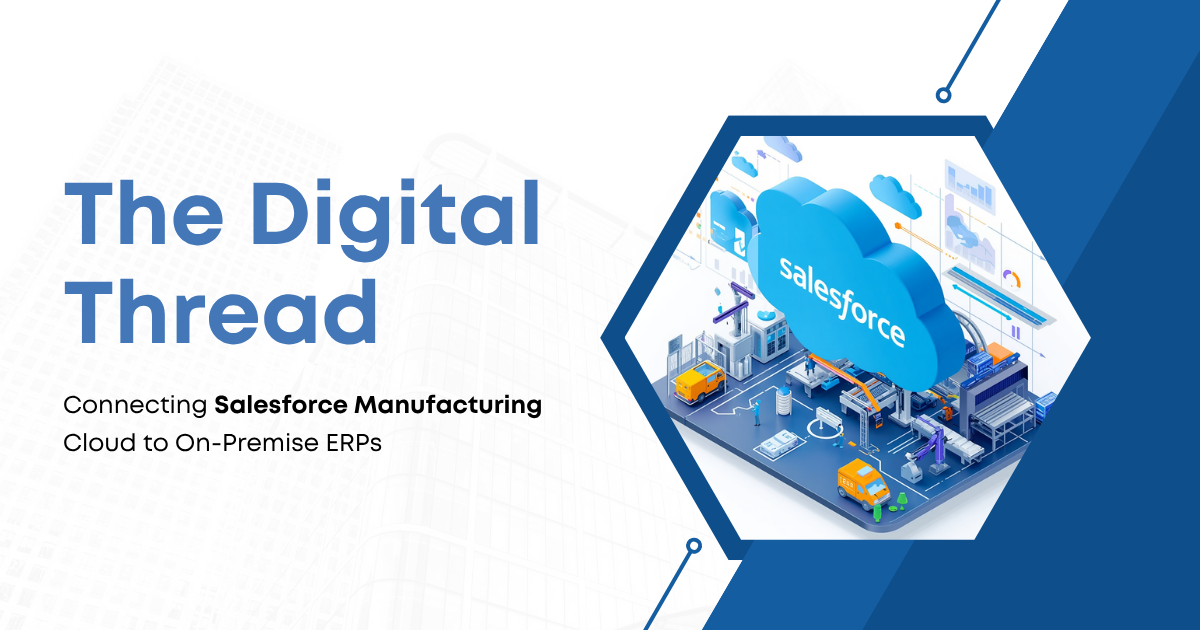
The manufacturing sector is undergoing a massive digital shift in 2026. For decades, a wall stood between the front office and the shop floor. Sales teams worked in CRM systems. Production teams lived in Enterprise Resource Planning (ERP) tools. This gap caused data silos and missed deadlines. Today, leading firms use the "Digital Thread" to bridge this divide. Salesforce Manufacturing Cloud acts as the primary connector for this thread. It links customer demand directly to production capacity. Implementing Salesforce Manufacturing Cloud Solutions requires a deep technical understanding of both cloud and on-premise systems.
The Problem of Disconnected Data
Many manufacturers still rely on manual data entry. Sales reps close a deal in the CRM. They then email the details to the production manager. The manager types that data into an on-premise ERP. This process is slow and prone to errors.
Statistics show that data silos cost manufacturers $1.1 trillion globally each year. Furthermore, 60% of manufacturing leaders cite poor data integration as their biggest hurdle. Inaccurate forecasts lead to overproduction or stockouts. Overproduction wastes money on storage. Stockouts frustrate customers and lose revenue. A digital thread ensures that every department sees the same truth in real-time.
What is Salesforce Manufacturing Cloud?
Salesforce built this platform specifically for the industrial sector. It does not just track contacts. It manages the complex relationships between sales agreements and production schedules.
Key Features for Integration
-
Sales Agreements: This feature tracks volume commitments over time. It compares planned volumes against actual orders.
-
Account-Based Forecasting: It combines sales, marketing, and product data. This creates a granular view of future demand.
-
Data Cloud for Manufacturing: This tool ingests millions of data points. it unifies data from web, mobile, and IoT devices.
Understanding On-Premise ERP Systems
On-premise ERPs like SAP, Oracle, or Microsoft Dynamics often store "The Golden Record." This includes inventory levels, Bill of Materials (BOM), and machine capacity. These systems usually sit behind a firewall. They are often highly customized. They do not naturally "talk" to cloud platforms. Connecting them requires a "Hybrid Cloud" strategy. This strategy keeps sensitive data local while sharing insights with the cloud.
Technical Strategies for Integration
Building the digital thread involves moving data across different environments. You must choose the right technical path for your specific needs.
1. Middleware and Integration Platforms (iPaaS)
Most firms use middleware like MuleSoft or Dell Boomi.
-
API Management: The middleware calls the ERP’s legacy APIs.
-
Data Transformation: It converts ERP data formats into Salesforce-friendly JSON.
-
Orchestration: It ensures that data moves in the correct sequence. Middleware acts as a translator between the old world and the new world.
2. Salesforce Connect and OData
This is a "Live" connection method. It allows Salesforce to view ERP data without storing it.
-
Real-Time Access: You see live inventory levels directly in Salesforce Manufacturing Cloud.
-
Reduced Storage Costs: You do not pay to store duplicate data in the cloud.
-
OData Protocol: Most modern ERPs support OData. This makes the connection relatively simple to set up.
3. Zero-Copy Integration (Data Federation)
In 2026, Zero-Copy is the gold standard. It uses Data Cloud to "link" to your on-premise data lake.
-
No Data Movement: You do not physically move the data.
-
Direct Querying: Salesforce queries the on-premise database in real-time.
-
High Security: Data stays behind your company firewall until it is needed.
Implementing the Digital Thread Step-by-Step
A specialized Salesforce Manufacturing Cloud Solutions provider follows a rigorous process. This ensures system stability and data accuracy.
Step 1: Mapping the Data Model
You must align the "Objects" in both systems.
-
Does "Part_Number" in the ERP match "Product_Code" in Salesforce?
-
How do you handle different units of measure? A clear data map prevents logic errors later.
Step 2: Establishing Security Protocols
Security is the top priority for manufacturers.
-
Mutual TLS: Ensure both systems verify each other's certificates.
-
OAuth 2.0: Use secure tokens instead of passwords for API calls.
-
IP Whitelisting: Only allow data from specific, trusted IP addresses.
Step 3: Configuring Sales Agreements
Once the pipes are built, you configure the business logic.
-
The ERP sends "Actuals" (completed orders) to Salesforce.
-
Salesforce compares these to the "Sales Agreement."
-
The system highlights "Variance" in red if production falls behind.
The Strategic Value of Real-Time Forecasting
When you connect your ERP to Salesforce Manufacturing Cloud, your forecasts become "Alive."
Traditional forecasts are static. You make them once a quarter. But market conditions change weekly. With the digital thread:
-
A sales rep enters a new deal in the cloud.
-
The system checks the ERP for raw material availability.
-
The AI predicts if the factory can meet the deadline.
-
The rep gives the customer a "Guaranteed" delivery date.
This precision reduces the "Bullwhip Effect." This effect happens when small changes in demand cause massive swings in production. Real-time data keeps the supply chain steady.
Overcoming Legacy Technical Debt
Many manufacturers use ERPs that are 20 years old. These systems lack modern APIs. This is a significant hurdle for Salesforce Manufacturing Cloud Solutions.
-
Custom Adapters: Developers write custom code to "Scrape" data from old screens.
-
Flat File Exchange: As a last resort, systems exchange CSV files via Secure FTP.
-
Database Triggers: The system detects a change in the ERP database. It then pushes that change to Salesforce. Modernization is a journey. You do not have to replace your ERP to build a digital thread.
Measuring Success: Technical KPIs
How do you know if your integration is working? You must track specific metrics.
|
Metric |
Target Goal |
|
Sync Latency |
< 5 Minutes for Inventory |
|
Data Accuracy |
99.9% Match Rate |
|
API Success Rate |
> 99.5% |
|
Forecast Variance |
< 10% Deviation |
Regular audits ensure that the digital thread remains strong. If the sync fails, the sales team will lose trust in the data.
The Role of IoT in the Digital Thread
In 2026, the digital thread extends to the machines themselves. Sensors on the shop floor send data to the on-premise ERP. This data then flows to Salesforce Manufacturing Cloud.
-
Predictive Maintenance: A machine shows signs of wear. Salesforce automatically creates a service case.
-
Real-Time Capacity: If a machine breaks, Salesforce updates the sales forecast. Reps immediately see that production is limited. This creates a "Self-Aware" manufacturing ecosystem.
Security and Compliance in 2026
Global manufacturers must follow strict rules. These include ITAR for aerospace and GDPR for data privacy.
-
Data Residency: Some data must stay in a specific country.
-
Encryption at Rest: All data in the cloud must be encrypted.
-
Access Logs: You must track every person who views sensitive production data. A specialized Salesforce Manufacturing Cloud Solutions partner ensures you meet these standards.
Impact on Employee Productivity
The digital thread saves time for everyone.
-
For Sales Reps: No more calling the warehouse to check stock. They see it on their phone.
-
For Production Managers: No more guessing which orders are the highest priority. They see the real-time sales pipeline.
-
For Executives: They get a single dashboard showing the whole company.
Data shows that integrated teams are 25% more productive. They spend less time on meetings and more time on high-value tasks.
Common Implementation Mistakes
Even with the best tools, things can go wrong.
-
Over-Engineering: Do not sync every single data point. Only sync what is useful for sales and production.
-
Ignoring Latency: Some data needs to be real-time. Other data can be daily. Choose the right speed for each data type.
-
Poor Training: If staff do not know how to use the new "Unified" view, the project will fail.
The Future: AI-Driven Autonomous Planning
As we look toward 2027, the digital thread will become "Autonomous." AI agents will live within the thread.
-
They will detect a shipping delay in the ERP.
-
They will automatically reschedule the production run.
-
They will send an apology email to the customer via Salesforce. This reduces the need for human intervention in routine tasks.
Conclusion
The digital thread is no longer a luxury. It is a requirement for survival. Connecting Salesforce Manufacturing Cloud to your on-premise ERP is the only way to gain true visibility. It allows you to respond to market changes in minutes instead of months. It protects your margins by reducing waste and overproduction.
Building this connection is a technical challenge. But the rewards are massive. You gain a faster, smarter, and more resilient business. Don't let your data stay in silos. Connect your office to your factory. Let the digital thread drive your growth in 2026 and beyond. The future of manufacturing is connected. Your journey starts with the right integration strategy.
Категории
Больше
Azura Hospital Cancún (Quintana Roo): Comprehensive Hospital Care in Mexico’s Caribbean Hub Azura Hospital Cancún in Quintana Roo is a modern multi-specialty hospital designed to provide advanced medical care in one of Mexico’s most internationally connected destinations. Located in the heart of Cancún, the hospital serves both local residents and international...

Global Self-Cleaning Coating Market Set to Witness Robust Growth by 2035 The global Self-Cleaning Coating Market was valued at USD 4.18 billion in 2025 and is expected to reach USD 9 billion by 2035, growing at a CAGR of 7.99% from 2026-2035. The market growth is driven by increasing demand for low-maintenance, durable, and environmentally friendly surface solutions across...

Munirka is one of South Delhi’s well-known residential and commercial hubs located close to important areas like Vasant Vihar and the airport zone. Due to its prime location and busy lifestyle, many visitors and professionals look for private companionship services in the area. Escorts in Munirka have become a popular option for individuals seeking elegant company for social gatherings,...

The market research for the global Chromatography Syringes market is an accumulation of first-hand facts and quantitative and qualitative evaluation and analysis for the forecast period (2024-2032). The report offers a comprehensive assessment of macro-economic indicators, parent market trends, and several factors influencing the market dynamics. In addition, it also assesses the...

It can be one of the most dramatic legal battles when families struggle in court over who gets to keep their kids. It can be hard for parents to agree on where their kids should live and who should make decisions for them when they are getting a divorce or separating. If you live in Orange County and need help with a custody battle or want to keep your parental rights,...