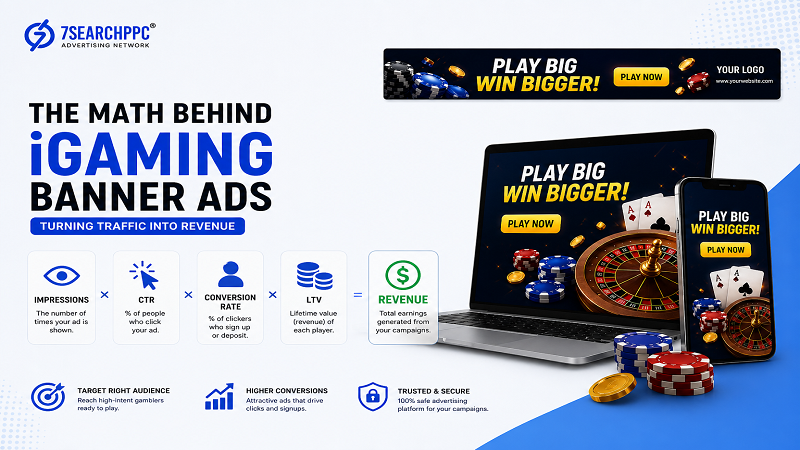
The Math Behind iGaming Banner Ads: Turning Traffic into Revenue
Most advertisers entering the banner space in gambling quickly discover a frustrating reality: traffic is easy to buy, but revenue is hard to produce. The disconnect isn’t creative alone—it’s mathematical. iGaming banner ads operate within a tight system of probabilities, costs, and behavioral drop-offs. Without understanding that system, even high CTR campaigns quietly lose money.
In many real-world setups, especially on alternative ad platforms or network like 7SearchPPC, the cost of entry is low—but so is initial traffic intent. That shifts the burden onto conversion math, not just reach. If the numbers don’t align across impressions, clicks, registrations, and deposits, the campaign fails regardless of scale.
This is where most operators miscalculate. They optimize for surface metrics—CTR, impressions, even registrations—without fully understanding the revenue equation beneath them.
The math behind iGaming banner ads is driven by a chain of metrics: CPM or CPC cost, click-through rate, conversion rate, and average deposit value. Profitability emerges only when revenue per user exceeds acquisition cost. Small inefficiencies at any stage—especially post-click conversion—compound quickly, turning high-traffic campaigns into loss-generating funnels.
The Core Equation Advertisers Rarely Model Properly
At its simplest, banner campaign profitability follows a predictable structure:
Revenue = Traffic Volume × Conversion Rate × Average Deposit Value
Cost = Traffic Volume × Cost per Click (or CPM equivalent)
But in practice, each variable contains hidden layers:
- CTR doesn’t equal intent—it often reflects curiosity or misleading creatives
- Registration rates vary drastically by GEO and bonus framing
- Deposit rates drop sharply when traffic quality is low
- Retention value is rarely accounted for early enough
This is why many online iGaming banner ads appear profitable at first glance but collapse when deposit data comes in.
For advertisers studying iGaming banner ads within broader format comparisons, the key takeaway is this: banners generate volume efficiently, but require tighter funnel discipline than intent-driven formats like search.
Where the Real Leakage Happens: Post-Click Economics
In most campaigns, the biggest mathematical distortion doesn’t happen at the ad level—it happens after the click.
Advertisers often notice:
- High CTR but low registration completion
- Strong registrations but weak deposit rates
- Bonus-driven signups with zero long-term value
This creates a false sense of performance. On paper, the campaign looks active. In reality, the revenue layer is broken.
One recurring issue is mismatch between banner messaging and landing page expectation. If a banner over-promises (e.g., exaggerated bonuses), users click—but don’t convert meaningfully. This inflates cost without increasing value.
At lower budgets, this leakage can go unnoticed. At scale, it becomes financially unsustainable.
Key Factors Behind Banner Profitability
Banner ad performance in iGaming depends on four interconnected variables: traffic cost, click intent, conversion efficiency, and deposit value. Low-cost traffic can still be profitable if conversion rates are stable. However, when cheap traffic also carries low intent, advertisers must compensate with stronger funnel alignment and realistic expectations around deposit behavior.
The Hidden Trade-Off: Cheap Traffic vs Conversion Quality
There’s a persistent belief in the industry that cheaper traffic automatically improves margins. In reality, the opposite often happens.
In lower-cost environments—such as remnant inventory or alternative ad network like 7SearchPPC—advertisers frequently see:
- Lower CPCs but weaker deposit intent
- Higher click volumes but lower user commitment
- Increased bot or accidental traffic risk (depending on source filtering)
This doesn’t make the traffic unusable. It simply changes the math.
To compensate, campaigns must:
- Use stricter landing page qualification
- Align bonus messaging with realistic user expectations
- Focus on conversion depth, not just acquisition volume
Many operators underestimate how quickly low-quality traffic erodes ROI—even when initial metrics look strong.
Why CTR Is Often a Misleading Metric in Banner Campaigns
CTR is one of the most visible metrics in iGaming banner advertising, but also one of the least reliable indicators of profitability.
High CTR can be driven by:
- Curiosity-based creatives
- Misleading visuals or exaggerated offers
- Poor placement quality (accidental clicks)
Advertisers often optimize toward CTR because it’s immediately visible. But mathematically, CTR only matters if it leads to downstream conversion.
A lower CTR campaign with higher deposit rate will almost always outperform a high CTR, low-intent funnel.
This becomes especially important when planning iGaming advertising campaigns ideas, where creative direction must balance attention with intent—not just clicks.
Funnel Compression: The Real Optimization Lever
In most banner-driven funnels, conversion loss happens in layers:
- Impression → Click
- Click → Landing engagement
- Engagement → Registration
- Registration → Deposit
Each stage compounds inefficiency.
For example:
- 10,000 impressions
- 1% CTR → 100 clicks
- 20% registration rate → 20 users
- 10% deposit rate → 2 paying users
If acquisition cost exceeds the revenue from those 2 users, the campaign fails—even with “good” CTR.
This is why experienced advertisers focus less on top-of-funnel metrics and more on compression—reducing drop-off at each stage.
Traffic Source Behavior Shapes the Math
Not all banner traffic behaves equally. Different sources produce different mathematical profiles.
For example:
- Premium placements → higher CPC, stronger intent
- Remnant inventory → lower CPC, weaker intent
- Mobile-heavy traffic → faster clicks, lower conversion depth
When advertisers try to get high quality iGaming traffic, they often focus on source selection without adjusting funnel expectations. That creates mismatch.
The correct approach is alignment:
- High-intent traffic → simpler funnels
- Low-intent traffic → stronger qualification layers
The math must adapt to the traffic—not the other way around.
Creative Psychology and Its Mathematical Impact
Creative decisions directly influence conversion math, even if the impact isn’t immediately visible.
For instance:
- A “Free Bonus” banner increases CTR but attracts low-intent users
- A “Play & Win Real Cash” banner reduces CTR but improves deposit rate
Over time, the second option often produces better ROI—even with fewer clicks.
This is a classic trade-off between volume and value. Many iGaming banner campaigns fail because they optimize for visibility instead of profitability.
Advertisers working across networks—including environments similar to a high-converting iGaming ad network—often discover that conservative, trust-driven creatives outperform aggressive ones in deposit-focused funnels.
What Advertisers Often Get Wrong
Across campaigns, a few consistent miscalculations appear:
- Overvaluing CTR while ignoring deposit rate
- Assuming cheap traffic equals scalable profit
- Ignoring funnel-stage drop-offs
- Using generic landing pages across different traffic types
- Chasing volume without measuring revenue per user
The pattern is consistent: surface metrics look healthy, but the underlying math doesn’t support long-term profitability.
This usually becomes visible only when campaigns scale—and by then, budget inefficiency is already significant.
Frequently Asked Questions (FAQs)
How do you calculate ROI for iGaming banner ads?
Ans. ROI is calculated by comparing total revenue generated from deposits against total ad spend. The key variables include CPC or CPM, conversion rates, and average deposit value. Accurate ROI measurement requires tracking beyond registration—down to actual depositing users.
Why do banner ads bring traffic but not revenue?
Ans. This typically happens when click intent is low. Users may engage with the ad but lack genuine interest in depositing. Misaligned creatives, weak landing pages, or low-quality traffic sources often contribute to this gap.
Are banner ads still effective for iGaming?
Ans. Yes, but their effectiveness depends on execution. Banner ads work best when supported by strong funnel design, realistic messaging, and traffic-source alignment. They are more volume-driven than intent-driven compared to search ads.
What is the biggest mistake in banner campaign optimization?
Ans. Focusing on CTR instead of conversion depth. High CTR campaigns often mask poor downstream performance. Sustainable optimization requires analyzing the full funnel—from click to deposit.
Ultimately, the math behind iGaming banners is unforgiving but predictable. Once advertisers stop chasing vanity metrics and start modeling real conversion economics, banner ads shift from being a traffic tool to a revenue engine.
Nach Verein filtern
Read More
Your smile plays a vital role in your overall health, confidence, and daily comfort. When teeth become damaged, decayed, or missing, even simple activities like eating, speaking, and smiling can become challenging. Fortunately, restorative dentistry offers effective solutions that not only repair dental problems but also significantly improve your quality of life. Modern advancements in...

Executive Summary Purpura Treatment Market Size and Share Forecast In terms of a fast-growing market, the purpura treatment market has been considered and is also expected to grow at an enormous rate. There is huge demand followed by a seamless flow of the supply chain mechanism in various regions worldwide for purpura treatment. These blood spots are painful and can occur at any age...

Physics is a subject that explains how the universe works, but for many students, it often feels overwhelming. Complex formulas, abstract theories, and time-consuming numerical problems can make physics homework stressful and difficult to manage. This is where professional Physics Homework Help at stuydunicorn.com plays a crucial role in supporting students throughout their academic journey. At...

In the fast-moving world of beauty and wellness, brands that succeed are the ones that plan strategically behind the scenes. While customers see elegant packaging and calming fragrances, what truly sustains a business is strong sourcing, dependable production, and scalable supply systems. Midwest Sea Salt Company works with brands that understand this difference. Built for Businesses That Think...

Why Maintenance Is Important Every measuring instrument needs care, but electronic tools require extra attention. A vernier caliper digital device contains sensitive components such as sensors, display screens, and batteries. Dust, moisture, or rough handling can affect its performance. If not maintained properly, it may give incorrect readings, which can lead to errors in work. Regular...