


Creative Testing for Casino Banner Ads: How Many Variations Do You Need?
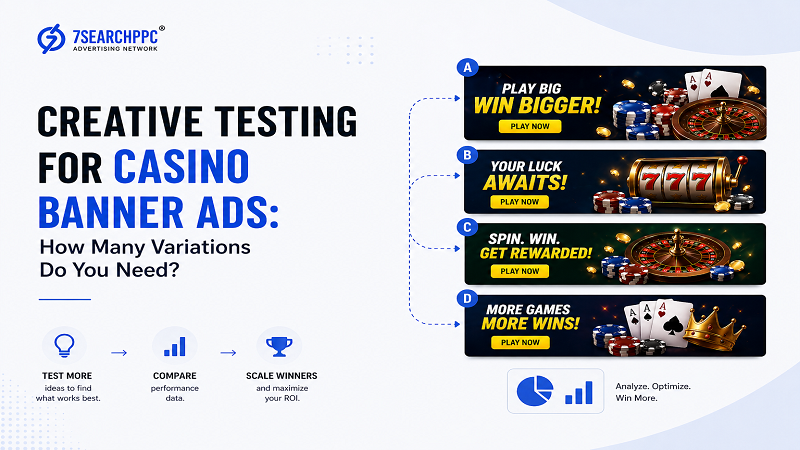
Most advertisers underestimate how quickly casino banner ads lose efficiency once they enter competitive traffic environments. At low budgets, one or two creatives may appear “good enough.” But once campaigns scale across multiple placements, GEOs, and user segments, creative fatigue and intent mismatch begin to erode performance quietly.
This is where testing discipline becomes a revenue lever—not just a design task. Advertisers working within gambling ecosystems, including platform like 7SearchPPC, often discover that the bottleneck isn’t traffic volume—it’s the lack of structured creative variation.
In practice, the question is rarely “how many banners should I design?” It’s “how many controlled variations do I need to reach statistical clarity without wasting budget?”
And that answer depends less on volume—and more on testing architecture.
How Many Variations Do You Actually Need?
For most casino banner campaigns, 6–12 structured variations per testing cycle is the practical baseline. This typically includes 2–3 core angles, each expressed through 2–4 creative executions. Fewer variations limit learning, while excessive variation fragments data and delays optimization. The goal is controlled diversity—not creative overload.
Why “More Creatives” Doesn’t Always Mean Better Performance
A common mistake in casino banner advertising is assuming that increasing creative count automatically improves results. In reality, too many uncontrolled variations dilute signal quality.
What often happens:
- Budget spreads too thin across creatives
- No clear winner emerges due to low impression density
- Optimization decisions become guesswork
This becomes especially visible when campaigns run across mixed-quality inventory. On network such as 7SearchPPC, where traffic costs may be lower, advertisers sometimes over-test without structure—mistaking volume for insight.
The issue isn’t creative quantity. It’s lack of testing hierarchy.
The Real Variable: Angles, Not Just Designs
High-performing banner ads for casino are rarely differentiated by color or layout alone. The underlying performance driver is the “angle”—the psychological entry point into the user’s intent.
Typical angle clusters include:
- Bonus-driven (e.g., “Claim Free Spins”)
- Winning aspiration (e.g., “Big Jackpots Today”)
- Urgency-based (e.g., “Limited-Time Offer”)
- Trust-based (e.g., “Licensed & Secure Play”)
Each angle should be tested through multiple executions—not mixed randomly.
For example:
- Angle A: Bonus → 3 design variations
- Angle B: Jackpot → 3 design variations
- Angle C: Urgency → 3 design variations
This creates structured comparison rather than noise.
Key Factors That Determine Testing Volume
The number of variations you need is not fixed—it depends on campaign conditions.
1. Traffic Volume and Distribution
High-volume environments allow more variations because each creative can accumulate meaningful impressions quickly. In lower-volume setups, fewer variations are required to maintain statistical clarity.
2. Funnel Objective
Testing for clicks (CTR) requires fewer impressions than testing for deposits. If your KPI is FTD (first-time deposit), you need longer test cycles and more controlled creative groups.
3. Traffic Quality Variability
In environments where traffic quality fluctuates—common in casino banner traffic—creative performance may reflect traffic differences rather than actual creative strength. This requires tighter testing control.
4. GEO and Device Segmentation
Indian mobile traffic behaves differently from Tier-1 desktop audiences. A creative that performs in one segment may underperform elsewhere, increasing the need for localized variations.
Structured Testing Framework (What Actually Works)
Instead of asking “how many creatives,” experienced media buyers operate with a layered testing model:
Phase 1: Angle Validation
- 3–4 angles
- 1–2 creatives per angle
- Objective: identify dominant messaging
Phase 2: Creative Expansion
- Top 2 angles retained
- 3–5 variations each
- Objective: optimize CTR and engagement
Phase 3: Conversion Filtering
- Top creatives tested against landing variations
- Objective: identify deposit-driving combinations
This approach avoids premature scaling and reduces wasted spend.
Where Most Casino Banner Campaigns Break Down
Across many casino banner campaigns, a recurring issue appears once budgets increase:
- Creatives optimized for CTR fail to convert
- Bonus-heavy messaging attracts low-intent users
- Winning creatives burn out within days
This usually becomes visible when campaigns attempt to get high quality casino traffic at scale. What initially looked like a strong creative often turns out to be a mismatch between message and user intent.
The fix isn’t just adding more creatives—it’s refining the testing logic behind them.
How Do You Know When You Have Enough Variations?
You have enough variations when each creative receives sufficient impressions to produce stable performance signals, and when additional creatives no longer introduce new insights. If adding new banners doesn’t change your top-performing angle or improve conversion quality, you’ve reached diminishing returns.
The Hidden Risk of Creative Fatigue
Creative fatigue is not just a visibility issue—it directly impacts acquisition cost.
In most banner traffic for casino environments:
- CTR declines gradually over 48–72 hours
- CPC increases as engagement drops
- Conversion rates weaken due to repeated exposure
This is particularly aggressive in mobile-heavy traffic segments, where users scroll quickly and ignore repeated visuals.
Advertisers using network like 7SearchPPC often notice that lower-cost traffic accelerates fatigue cycles, requiring more frequent creative refreshes.
This reinforces the need for a continuous testing pipeline—not one-time variation sets.
Creative Testing vs Budget Efficiency
There’s a direct trade-off between testing depth and cost control.
Testing too little:
- Misses high-performing angles
- Limits scalability
Testing too much:
- Wastes impressions
- Delays optimization
The balance lies in controlled iteration.
When planning casino advertising campaigns ideas, experienced advertisers allocate a fixed percentage of budget (typically 20–30%) to testing cycles while protecting the rest for proven creatives.
How Traffic Source Influences Creative Volume
Not all traffic behaves the same—and this directly affects how many creatives you need.
- Premium inventory → fewer variations, higher precision
- Remnant/low-cost inventory → more variations, faster rotation
- Push + banner hybrid flows → require cross-format alignment
Within a high-converting casino ad network, creative testing tends to stabilize faster because traffic patterns are more predictable. In fragmented traffic environments, more variations are needed to account for inconsistency.
Key Factors Behind Effective Creative Variation
Effective variation is not about changing everything—it’s about isolating variables. The most useful tests modify one element at a time: headline, CTA, color contrast, or visual focus. This allows advertisers to identify causation rather than correlation, which is critical for scaling campaigns without guesswork.
What Experienced Advertisers Do Differently
There’s a clear behavioral difference between beginners and experienced operators in how they approach creative testing.
Experienced advertisers:
- Test angles before designs
- Limit variations per cycle
- Kill underperformers quickly
- Refresh creatives continuously
- Align creatives with funnel intent (not just clicks)
They also understand that High-volume banner traffic for casino doesn’t guarantee profitability. Without strong creative filtering, high volume often amplifies inefficiency.
Final Perspective
The real question isn’t how many variations you need—it’s how intelligently you structure them.
In most campaigns, the difference between average and scalable performance comes down to testing discipline. Advertisers who treat creatives as a system—not a collection of banners—consistently outperform those who rely on volume alone.
And in a competitive gambling advertising ecosystem, that distinction directly impacts acquisition cost, deposit quality, and long-term campaign viability.
Frequently Asked Questions (FAQs)
How long should a creative test run before making decisions?
Ans. Most tests require enough impressions to stabilize CTR and early conversion signals. In high-volume environments, this can happen within 24–48 hours. For deposit-based KPIs, longer windows are needed to avoid premature conclusions.
Should I test completely different designs or small variations?
Ans. Start with distinct angles (macro differences), then refine with smaller design changes (micro variations). Testing only minor changes too early limits learning.
How often should casino banner creatives be refreshed?
Ans. In fast-moving traffic environments, creatives often need refreshing every 3–7 days. Fatigue cycles depend heavily on traffic quality and audience saturation.
Is CTR the best metric for creative testing?
Ans. No. CTR is an early signal, but it doesn’t reflect deposit intent. High CTR creatives can attract low-quality users, especially in bonus-driven campaigns.
Categorías
Read More
Jewelry has always been more than decoration. It tells stories, preserves memories, and marks milestones that define our lives. From engagement rings to anniversary pendants, each piece carries emotional weight. While ready-made collections offer beauty and convenience, nothing compares to the personal connection created through custom jewelry design. When you transform your unique vision into...

Press releases have a reputation problem. People think of them as old-fashioned. Something companies used before Twitter existed. A relic of the pre-digital PR world. That reputation is unfair, and honestly, a little outdated. When used correctly, press releases still deliver real, measurable value for SEO and brand visibility. Let's talk about why. What a Press Release Actually Does for...

Have you ever heard someone say massage is only for people with pain? Or maybe you have heard that every massage is exactly the same. Many people believe these things, but they are not always true. Asian Massage Services in NYC are popular because they help people relax, unwind, and take a break from busy schedules. Yet many myths still exist. Some people have never visited a massage spa and...

The landscape for Application Modernization Services is shifting dramatically, with a notable market size projected to reach USD 61.28 billion by 2035. This growth, characterized by a compound annual growth rate (CAGR) of 16.5%, is driven by the increasing need for organizations to adapt to digital transformation initiatives. As companies aim to enhance their operational efficiency, the...

" According to the latest report published by Data Bridge Market Research, the Asia-Pacific Yeast Market The Asia-Pacific Yeast market size was valued at USD 1.50 billion in 2024 and is expected to reach USD 3.02 billion by 2032, at a CAGR of 9.10% during the forecast period Getting thoughtful about competitive landscape is another significant aspect of...