Can You Become a Pilot After Aeronautical Engineering? The Right Path to an Airline Career
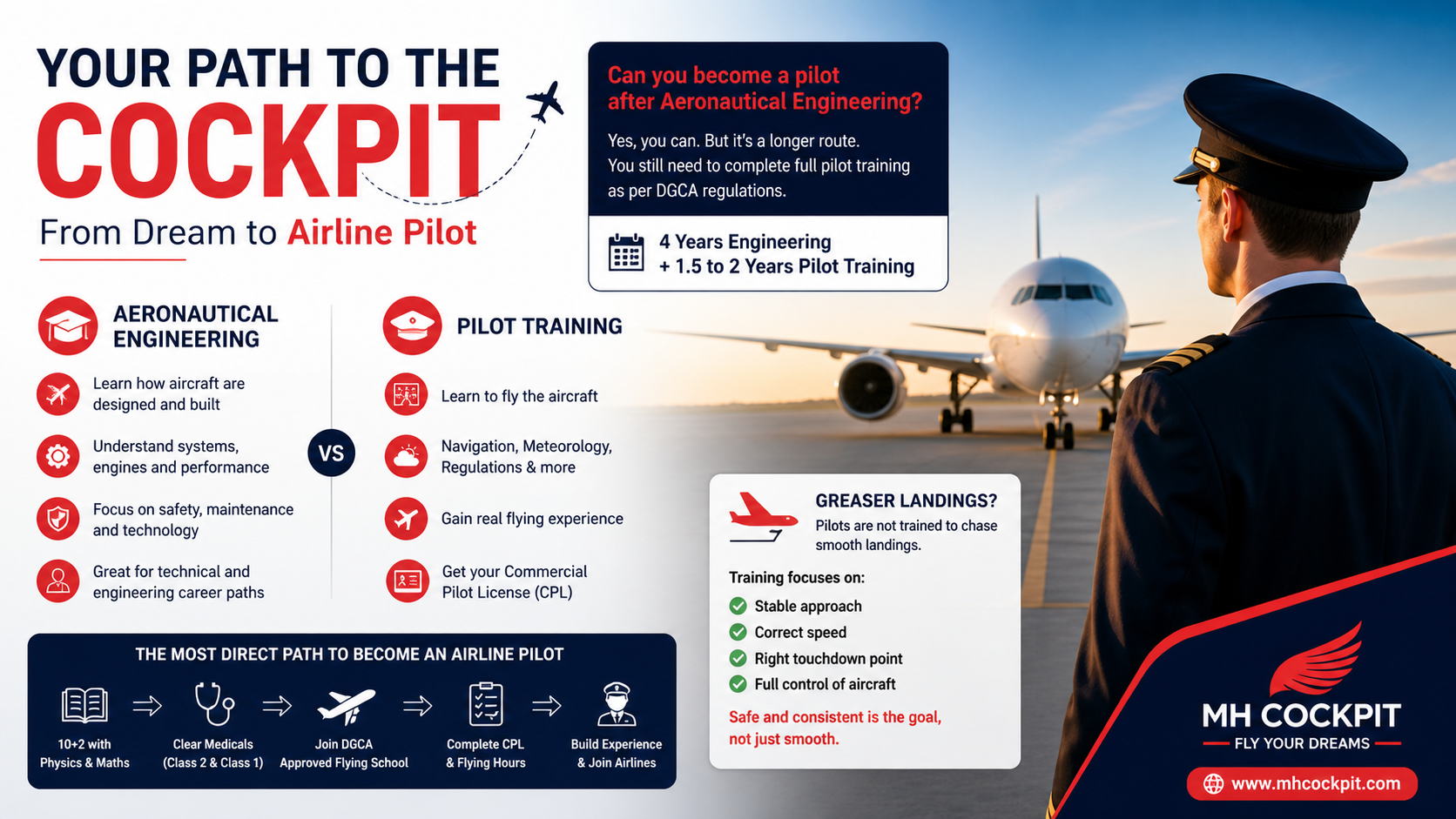
If you’re thinking about a career in aviation, you’ve probably come across two popular options: aeronautical engineering and becoming a pilot. A common question many students ask is simple but important. Can you become a commercial pilot after completing aeronautical engineering, and is it the right path?
The short answer is yes, you can. But the better question is whether it’s the most efficient way to get there.
Let’s break it down in a clear, practical way so you can make the right decision early.
Aeronautical Engineering vs Pilot Training: What’s the Real Difference?
Aeronautical engineering focuses on the technical side of aviation. You learn how aircraft are designed, how engines and systems work, and how safety and performance are maintained. It’s a deep, theory-heavy field.
Pilot training is completely different. It is about flying the aircraft. You learn navigation, meteorology, regulations, and most importantly, you spend time in the air building real flying experience.
So while both belong to aviation, they lead to very different careers.
Can You Become a Pilot After Engineering?
Yes, but there is no shortcut.
Even after completing a 4-year aeronautical engineering degree, you still need to follow the full licensing process set by the Directorate General of Civil Aviation.
This includes:
- Enrolling in a flying school
- Clearing DGCA ground exams
- Completing required flying hours
- Obtaining your Commercial Pilot License (CPL)
Your journey becomes:
4 years (engineering) + 1.5 to 2 years (pilot training)
This is where most students start to rethink their path.
What Is the Easiest Way to Become an Airline Pilot?
There is no “easy” way, but there is a most direct one.
If your goal is to become a pilot, the most efficient route is:
- Complete 10+2 with Physics and Maths
- Start pilot training immediately
- Focus on CPL and flying hours
This path helps you:
- Save time
- Enter the industry earlier
- Avoid unnecessary detours
Airlines do not prioritize engineering degrees. They look at your license, your flying hours, and your performance.
Does Engineering Help in Pilot Training?
It helps, but only to a certain extent.
Students with an aeronautical background may:
- Understand aircraft systems faster
- Be more comfortable with technical subjects
- Grasp performance concepts more easily
But here’s the reality:
- It does not reduce flying hours
- It does not skip DGCA exams
- It does not improve hiring chances significantly
The advantage is academic, not career-defining.
The Role of Training and Right Guidance
One of the biggest mistakes students make is starting without clarity.
At MH Cockpit, many students come in with the same confusion. They often believe engineering will give them an edge in becoming a pilot.
What they learn instead is:
- Pilot training is a separate pathway
- Time and planning matter more than degrees
- Starting early gives a strong advantage
The focus is always on building a clear roadmap so students don’t lose years switching paths later.
What Makes a Good Pilot? Not Smooth Landings Alone
Another misconception is that becoming a pilot is about things like “perfect” or smooth landings.
In reality, training focuses on:
- Stable approaches
- Correct speed and descent
- Proper touchdown point
- Full control of the aircraft
A smooth landing is good, but not the priority. Safety, consistency, and control always come first.
This mindset is built early during training and stays throughout a pilot’s career.
Engineering vs Direct Pilot Path: Which Should You Choose?
It depends on your goal.
Choose aeronautical engineering first if:
- You are genuinely interested in aircraft design and technology
- You want a backup career in aviation
Choose direct pilot training if:
- You are clear that flying is your main goal
- You want to start your career faster
- You want to avoid extra time and cost
There is no wrong choice, but there is a smarter one depending on your priorities.
Final Thoughts
Yes, you can become a commercial pilot after aeronautical engineering. But it is a longer and more expensive route.
The aviation industry values:
- Your Commercial Pilot License
- Your flying hours
- Your skills in real-world situations
If your dream is to sit in the cockpit, the best move is to stay focused on flying from the beginning.
Planning your path early can save you years. And in aviation, that time matters more than most people realize.
Categories
Read More
Sell Saudi Arabia vs Uruguay Tickets: The Saudi Arabia national football team has made a late managerial change ahead of the FIFA World Cup 2026, with Hervé Renard reportedly sacked and replaced by Georgios Donis just weeks before their Group H clash with the Uruguay national football team. Renard, famous for Saudi Arabia’s shock win over Argentina in 2022, leaves a mixed legacy,...

IMARC Group has recently released a new research study titled “South Korea Tourism Market Report by Tourism Type (Medical, Sports, Cultural, Culinary, Wellness, Educational, and Others), Tourist Type (Domestic, International), Travel Type (Solo, Group), Booking Channel (OTA Platform, Direct Booking), Age Group (Below 30 Years, 30 to 41 Years, 42 to 49 Years, 50 Years and Above), and...

In today’s fast-paced lifestyle, people often look for ways to relax, unwind, and enjoy meaningful companionship. Cities like Gurgaon (also known as Gurugram) and Ghaziabad have become modern hubs where lifestyle, nightlife, and social experiences blend together. Gurgaon, in particular, is known for its vibrant nightlife and urban culture, making it a popular destination for...

Innovation in the kitchen often starts with the right tools. Aluminum cookware provides versatility that encourages creative cooking techniques. With its even heat distribution and lightweight design, chefs can experiment with various methods, from delicate sautéing to precise browning. Working with a Professional Kitchen Cookware Supplier ensures access to cookware that supports...

Expanding Opportunities in Polypropylene Absorbent Hygiene Market Amid Growing Consumer Awareness The Polypropylene Absorbent Hygiene Market is experiencing robust growth as global demand for personal care and hygiene products continues to rise. The Polypropylene Absorbent Hygiene Market size was valued at USD 9.56 Billion in 2024 and is projected to reach USD 13.93 Billion by 2032,...