The Future of CSR Reporting in India: Why Automation is No Longer Optional
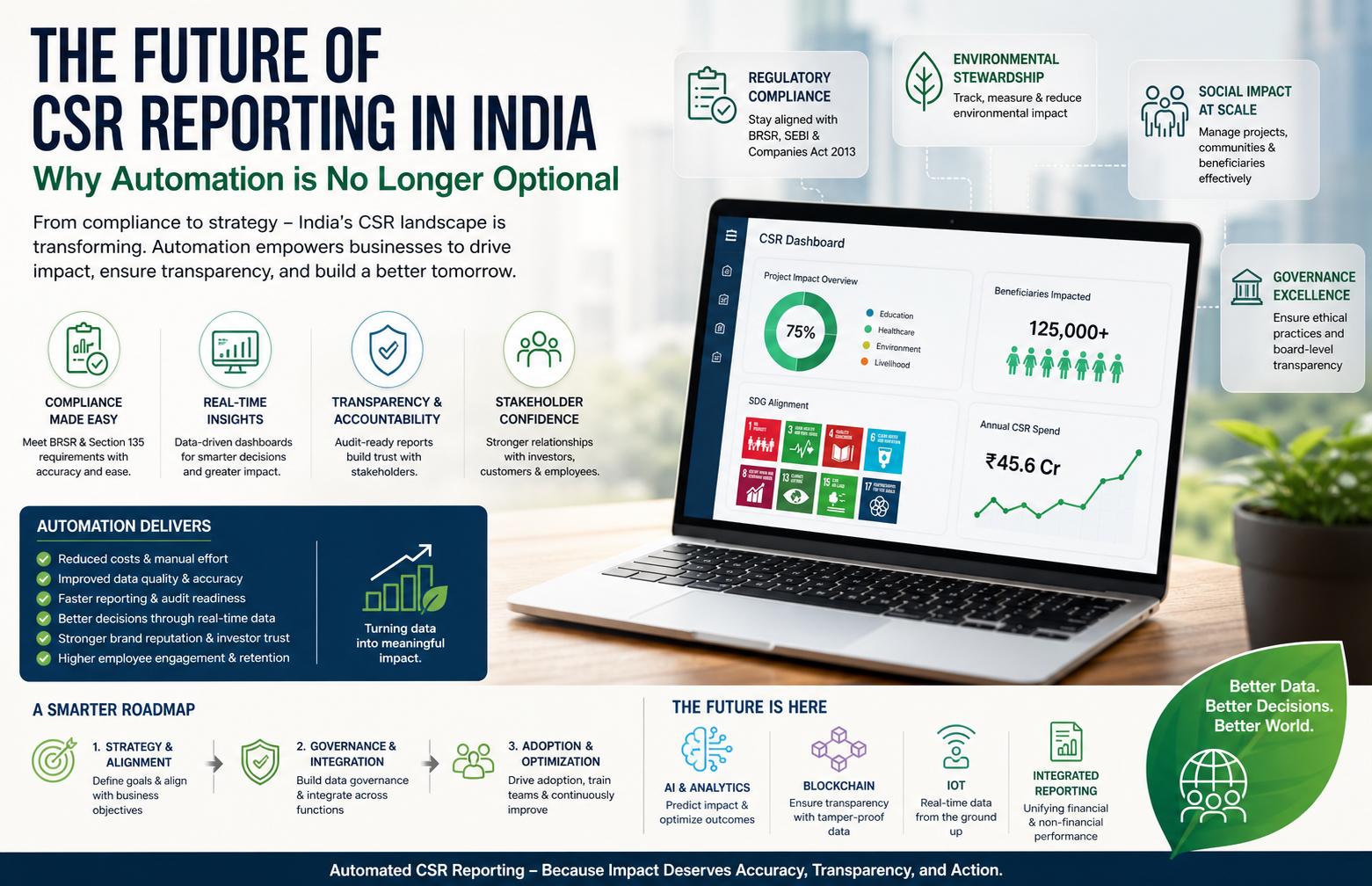
India is standing at the edge of a transformative shift in corporate responsibility. Over the past decade, Corporate Social Responsibility (CSR) has evolved from a goodwill-driven activity into a structured, regulated, and strategically important business function. With the introduction of stricter compliance frameworks and the 2025 mandate for enhanced reporting, companies can no longer rely on outdated methods.

The message is clear: CSR reporting must become automated, data-driven, and integrated into core business operations.
From Compliance to Strategy
For years, CSR in India was often treated as a checkbox activity—something companies did to meet regulatory requirements. Donations to charities, occasional community projects, and limited reporting were considered sufficient.
However, this approach is rapidly becoming obsolete. Regulatory frameworks like Section 135 of the Companies Act and SEBI’s Business Responsibility and Sustainability Reporting (BRSR) have redefined expectations. Companies are now required to provide detailed, auditable, and standardized disclosures about their environmental, social, and governance (ESG) performance.
This shift marks a fundamental change: CSR is no longer just about spending—it’s about measuring impact, ensuring transparency, and demonstrating accountability.
The Problem with Manual Reporting
Despite the changing landscape, many organizations still rely on spreadsheets and manual processes to manage CSR data. While this may have worked in the past, it is increasingly proving inadequate.
Manual reporting comes with several challenges:
- Data inaccuracies and inconsistencies
- High time and labor costs
- Difficulty in consolidating data from multiple sources
- Limited audit trails and compliance risks
As highlighted in the document, manual systems often collapse under the weight of modern ESG requirements. When data must be tracked across projects, geographies, and stakeholders, spreadsheets simply cannot keep up.
Why Automation is a Game-Changer
Automation transforms CSR reporting from a reactive task into a proactive, strategic capability. By leveraging technology, companies can streamline data collection, improve accuracy, and generate real-time insights.
Tangible Benefits
Organizations adopting automated CSR systems experience:
- Reduced labor costs: Automation eliminates repetitive tasks like data entry and reconciliation.
- Improved accuracy: Built-in validations reduce human errors.
- Audit readiness: Digital trails make compliance easier and faster.
- Faster reporting: Real-time dashboards replace time-consuming manual compilation.
Strategic Advantages
Beyond efficiency, automation unlocks deeper value:
- Better decision-making through real-time insights
- Enhanced brand reputation and stakeholder trust
- Improved access to capital due to transparent ESG data
- Stronger employee engagement, especially among younger workforces
In essence, automation allows companies to move from “reporting what happened” to actively managing and improving impact.
The Stakeholder Revolution
One of the biggest drivers of this transformation is the growing influence of stakeholders. Investors, regulators, customers, and employees are all demanding greater transparency and accountability.
Investors now evaluate ESG performance as a key factor in decision-making. Customers prefer brands that demonstrate genuine social responsibility. Employees, particularly younger generations, want to work for organizations that align with their values.
This convergence of expectations has turned CSR into a competitive differentiator. Companies that embrace transparency and impact measurement are more likely to succeed in today’s market.
Lessons from Industry Leaders
Leading Indian companies have already begun integrating CSR into their core strategies.
- Tata Group has embedded social responsibility into its business philosophy, focusing on long-term impact rather than fragmented initiatives.
- Infosys emphasizes measurable outcomes, using data-driven approaches to track progress and ensure effectiveness.
- ITC Limited has integrated sustainability into its business model, achieving milestones like water positivity and carbon reduction.
These examples demonstrate that successful CSR is not about isolated efforts—it’s about systematic, scalable, and measurable impact.
Building a Strong Business Case
One common misconception is that CSR automation is purely a compliance expense. In reality, it delivers significant returns.
Hard ROI
- Lower operational costs
- Reduced compliance risks
- Decreased audit expenses
Soft ROI
- Increased investor confidence
- Stronger brand positioning
- Higher employee retention
- Improved stakeholder relationships
When viewed holistically, CSR automation is not a cost center—it is a strategic investment that drives long-term value.
Choosing the Right Technology
The CSR software ecosystem in India is expanding rapidly, offering solutions tailored to different needs. Key features to look for include:
- BRSR and Section 135 compliance support
- Scalability across multiple projects and geographies
- Real-time data collection and dashboards
- Integration with existing business systems
- Impact measurement aligned with global frameworks like SDGs
Platforms like Relific, Sopact Sense, Submittable, Benevity, and Salesforce Philanthropy Cloud each offer unique capabilities, from impact analytics to grant management and employee engagement.
The key is to choose a solution that aligns with your organization’s size, complexity, and strategic goals.
A Practical Implementation Roadmap
Adopting CSR automation requires more than just purchasing software. It involves a structured approach:
1. Strategy and Alignment
Define clear objectives and align CSR initiatives with business goals.
2. Governance and Integration
Establish data governance frameworks and integrate systems across departments.
3. Adoption and Optimization
Focus on change management, training, and continuous improvement.
The document emphasizes that technology alone is not enough—success depends on people, processes, and culture.
Common Pitfalls to Avoid
Organizations often face challenges during implementation. Some common pitfalls include:
- Treating CSR automation as a one-time project
- Ignoring data quality and governance
- Underestimating employee adoption challenges
- Choosing tools without aligning them to business needs
- Lack of leadership buy-in
Avoiding these mistakes requires careful planning, stakeholder engagement, and ongoing monitoring.
The Future of CSR Reporting
Looking ahead, emerging technologies will further reshape CSR reporting.
Artificial Intelligence
AI will enable predictive analytics, helping companies anticipate risks and optimize impact.
Blockchain
Blockchain will enhance transparency by creating tamper-proof records, particularly in supply chains.
IoT
IoT devices will provide real-time data on environmental and social metrics.
Integrated Reporting
Financial and non-financial data will merge, making sustainability a core part of business performance.
These advancements will make CSR reporting more accurate, transparent, and strategic than ever before.
The Changing Role of CSR Professionals
As technology takes over routine tasks, CSR professionals will transition into more strategic roles. They will focus on:
- Data analysis and insights
- Impact design and optimization
- Stakeholder engagement
- Driving sustainable business transformation
This evolution will position CSR leaders as key contributors to organizational success.
Conclusion: A Defining Moment for Indian Businesses
India’s CSR landscape is undergoing a profound transformation. Regulatory mandates, stakeholder expectations, and technological advancements are converging to redefine how companies approach social responsibility.
The shift from manual to automated reporting is not just about compliance—it’s about building resilient, transparent, and purpose-driven organizations.
Companies that embrace this change will not only meet regulatory requirements but also unlock new opportunities for growth, innovation, and impact.
The question is no longer whether to adopt CSR automation—it’s how quickly you can make the transition.
الأقسام
إقرأ المزيد
Online platforms are evolving to provide multiple types of entertainment in a single, secure environment. FFWin is a Brazilian platform offering diverse online betting options in 2025. From slots and poker to other interactive games, FFWIN provides a safe and organized space for users. The platform focuses on security, usability, and regional relevance, ensuring a smooth and engaging experience...

Netflix's Exclusive Release: Ricky Gervais and Eric Bana Comedy Coming This Spring On April 29, 2016, Netflix will exclusively release the highly anticipated comedy film "Special Correspondents" to its global audience. The production features the talented duo of Ricky Gervais and Eric Bana in leading roles. Written and directed by Golden Globe winner Ricky Gervais, this Netflix original tells...

在香港這個競爭激烈、節奏極快的市場中,企業面對的最大挑戰之一,就是如何在正確的時間,把訊息送到正確的客戶手上。廣告成本不斷上升,但客戶回應卻越來越慢,讓不少企業開始尋找更直接的溝通方式。 香港企業的溝通痛點 不少企業發現,電郵常被忽略,社交平台觸及率又受演算法影響,即使花了預算,也未必能即時接觸到客戶。當促銷、提醒或重要通知無法即時送達,轉化機會往往就此流失。 什麼是 bulk whatsApp bulk whatsApp 是指企業透過系統,將相同或分眾訊息,一次過發送給大量已同意接收訊息的客戶。由於 WhatsApp 是香港最常用的通訊工具之一,訊息會直接出現在客戶的聊天列表中,自然更容易被閱讀。 bulk whatsApp 的運作方式...

Singapore Changi Airport, widely known by the airport code SIN Airport, is one of the most recognized travel hubs in the world. Located in Singapore, it serves millions of passengers each year and connects travelers to destinations across Asia, Europe, the Middle East, Australia, and beyond. More than just a transit point, it is often praised for making airport travel comfortable, efficient,...

Accounts Payable Outsourcing Services for Healthcare Organizations The healthcare industry is experiencing rapid transformation driven by technological advancements, regulatory changes, and increasing demand for high-quality patient care. Alongside clinical innovation, healthcare organizations must manage complex financial operations that directly influence sustainability and service delivery....