India Aviation Fuel Terminals Market Outlook 2034: Growth Driven by Rising Air Traffic, Infrastructure Investments, and Sustainable Aviation Fuel Adoption
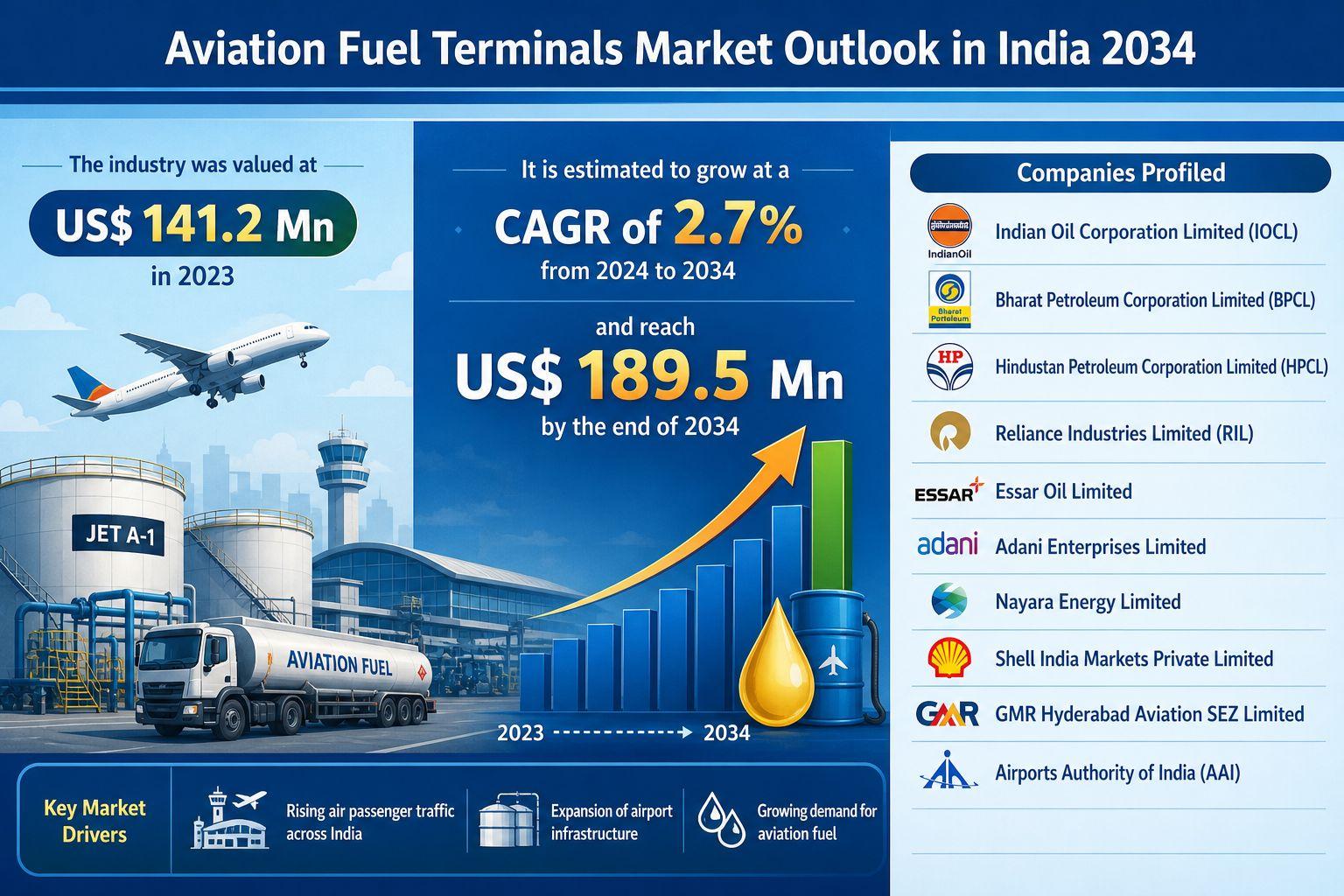
The aviation fuel terminals market in India is witnessing steady expansion, supported by the country’s rapidly evolving aviation ecosystem and increasing demand for reliable fuel supply infrastructure. The market was valued at US$ 141.2 Mn in 2023 and is projected to reach US$ 189.5 Mn by 2034, growing at a CAGR of 2.7% from 2024 to 2034.
While the growth rate appears moderate compared to other high-growth aviation segments, the aviation fuel terminals industry plays a critical backbone role in ensuring uninterrupted airport operations and flight safety. As India positions itself as one of the fastest-growing aviation markets globally, investments in fuel infrastructure are becoming increasingly strategic.
Analyst Viewpoint
The expansion of the aviation fuel terminals market in India is strongly tied to the surge in both domestic and international air travel. A rapidly expanding middle-class population, rising disposable incomes, and improved connectivity are driving passenger traffic across the country.
Additionally, the privatization of airports and increased participation of private players have accelerated infrastructure development. This has created a strong demand for modern, efficient, and scalable fuel terminal systems.
Another key trend shaping the market is the shift toward sustainability and decarbonization. Major industry players are actively exploring alternatives such as Sustainable Aviation Fuel (SAF), aligning with global Net Zero commitments. This transition is expected to redefine fuel storage, handling, and distribution infrastructure in the coming decade.
Market Introduction
Aviation fuel terminals are a vital component of the aviation fuel supply chain. These terminals typically include:
- Fuel unloading facilities such as tanker berths
- Transfer pipelines
- Storage tanks
- Hydrant systems and delivery pumps
Their primary role is to ensure a continuous, safe, and efficient supply of aviation turbine fuel (ATF) to aircraft.
Inadequate fuel infrastructure can lead to operational disruptions such as delayed flights, diversions, or payload restrictions. Consequently, airport operators, oil companies, and government bodies are increasingly investing in advanced fuel terminal infrastructure to ensure seamless operations.
Growth in Air Travel Boosting Market Expansion
India’s aviation sector has been experiencing remarkable growth over the past few years. Domestic passenger traffic is projected to grow significantly, reaching 165–170 million passengers by FY2025, according to industry estimates.
International travel has also rebounded strongly, surpassing pre-pandemic levels. This surge in passenger movement directly translates into higher fuel demand, necessitating expansion and modernization of fuel terminals.
The rise in low-cost carriers, improved regional connectivity under government initiatives, and increasing airline fleet sizes are further contributing to the need for robust fuel infrastructure.
Surge in Investment in Aviation Infrastructure
Government and private sector investments are playing a crucial role in shaping the aviation fuel terminals market in India. The Indian government has outlined plans to invest approximately US$ 11.88 Bn by 2025 to develop new airports and upgrade existing ones.
Privatization initiatives have brought in leading infrastructure developers, resulting in:
- Expansion of airport capacities
- Development of greenfield airports
- Modernization of fueling systems
A notable example includes the collaboration between Air India and Tata Advanced Systems Limited (TASL) with the Karnataka government to establish aviation manufacturing and R&D facilities. Such initiatives not only strengthen the aviation ecosystem but also indirectly boost demand for fuel terminals.
Emerging Market Trends
Technical Refueling Hubs Gaining Importance
Indian airports are increasingly becoming strategic refueling hubs for international airlines. This trend gained momentum during the Sri Lankan fuel crisis, when flights began using South Indian airports such as Cochin, Chennai, and Thiruvananthapuram for refueling.
For instance, Cochin International Airport introduced technical landing services for refueling international aircraft. This has led to a noticeable increase in aviation turbine fuel sales and boosted demand for fuel terminal infrastructure.
Growing Focus on Sustainable Aviation Fuel (SAF)
Sustainability is emerging as a central theme in the aviation fuel ecosystem. Companies such as Indian Oil Corporation Limited are investing in SAF production through partnerships with global clean energy firms like LanzaJet Inc..
SAF, derived from renewable sources such as used cooking oil and animal fats, offers a significant reduction in lifecycle carbon emissions. As adoption increases, fuel terminals will need to adapt to handle blended fuels and new storage requirements.
Competitive Landscape and Key Players
The aviation fuel terminals market in India is moderately consolidated, with major oil and infrastructure companies dominating the landscape. Key players include:
- Indian Oil Corporation Limited
- Bharat Petroleum Corporation Limited
- Hindustan Petroleum Corporation Limited
- Reliance Industries Limited
- Adani Enterprises Limited
- Nayara Energy Limited
- Shell India Markets Private Limited
- Airports Authority of India
These players are focusing on enhancing operational efficiency, expanding storage capacities, and integrating digital technologies to improve fuel handling and safety.
Technology Integration and Safety Enhancements
Safety and efficiency are critical in airport fueling operations. Companies are increasingly deploying advanced technologies such as:
- AI-based fleet monitoring systems
- Real-time analytics for driver behavior
- Multi-camera visibility solutions
For example, IndianOil Skytanking partnered with Netradyne to deploy AI-powered driver safety platforms across airport fueling operations. These innovations help minimize risks in high-activity zones and ensure compliance with aviation safety regulations.
Key Developments
Recent developments highlight the industry’s focus on innovation and sustainability:
- Cochin International Airport Limited (CIAL) partnered with BPCL Kochi Refinery to establish a green hydrogen plant, promoting clean energy usage within airport operations.
- IndianOil Skytanking introduced advanced AI-based fleet safety systems to enhance operational efficiency and reduce risks.
These initiatives reflect a broader industry shift toward digitalization and environmental responsibility.
Market Segmentation
The aviation fuel terminals market in India can be segmented based on:
By Terminal Type:
- Fixed Base Operator (FBO) Terminal
- Commercial Airport Terminal
- Military Airbase Terminal
- Helipad Terminal
- Others
By Ownership:
- Government-owned terminals
- Private-owned terminals
- Public-private partnership terminals
By Capacity:
- Small-scale terminals
- Medium-scale terminals
- Large-scale terminals
This segmentation highlights the diverse applications and ownership structures shaping the market.
Future Outlook
The future of the aviation fuel terminals market in India will be defined by steady demand growth, sustainability initiatives, and infrastructure modernization.
Key trends expected to shape the market include:
- Expansion of regional airports under connectivity schemes
- Increasing adoption of SAF and alternative fuels
- Integration of digital technologies for efficient fuel management
- Growth in international transit and refueling operations
Although the market is growing at a moderate pace, its importance in supporting India’s aviation ambitions cannot be overstated. As the country moves toward becoming a global aviation hub, fuel infrastructure will remain a critical enabler of long-term growth.
Conclusion
The India aviation fuel terminals market is evolving as a strategic infrastructure segment driven by rising air traffic, increased investments, and a shift toward sustainable aviation practices. With a projected market size of US$ 189.5 Mn by 2034, the sector offers stable growth opportunities for stakeholders.
As the aviation industry continues to expand, the demand for efficient, safe, and sustainable fuel terminal systems will remain strong—positioning this market as a vital pillar in India’s aviation growth story.
Categorias
Leia Mais
The twin-twin transfusion syndrome treatment market is expected to witness market growth at a rate of 4.50% in the forecast period of 2021 to 2028. The global business landscape is undergoing a transformation, with industries increasingly leaning on deep research and actionable insights to make strategic decisions. One segment seeing tremendous traction is the Twin-Twin Transfusion...

Bola88 Sportbook: Platform Digital untuk Hiburan dan Strategi Bola88 Sportbook menjadi salah satu istilah yang semakin populer di dunia hiburan digital modern. Platform ini tidak hanya menawarkan hiburan berbasis olahraga, tetapi juga memberikan pengalaman interaktif yang menuntut strategi dan pemikiran cermat. Dengan kemajuan teknologi, pengguna kini dapat menikmati layanan yang mudah...
Transporting your vehicle from one city to another can feel like a stressful experience, especially when you’re dealing with tight schedules, valuable vehicles, or long distances. Choosing a reliable car transport company can make all the difference between a smooth process and a frustrating one. Whether you’re relocating, buying a car from another city, or sending a vehicle to a...

Executive Summary Sterile and Antiviral Packaging Market Size and Share Forecast The global sterile and antiviral packaging market size was valued at USD 29.23 billion in 2024 and is expected to reach USD 49.11 billion by 2032, at a CAGR of 6.70% during the forecast period Competitive analysis performed in this Sterile and Antiviral Packaging Market...
In modern industrial environments, pipelines are expected to perform flawlessly under continuous operation. Chemical plants, power stations, water treatment facilities, and process industries operate 24/7, where even minor pipeline failures can result in costly downtime, safety risks, and production losses. This is where reliable CPVC pipe fittings for continuous duty operations play...