


Crypto Accepted VPS: Secure, Anonymous Hosting for Cryptocurrency Businesses
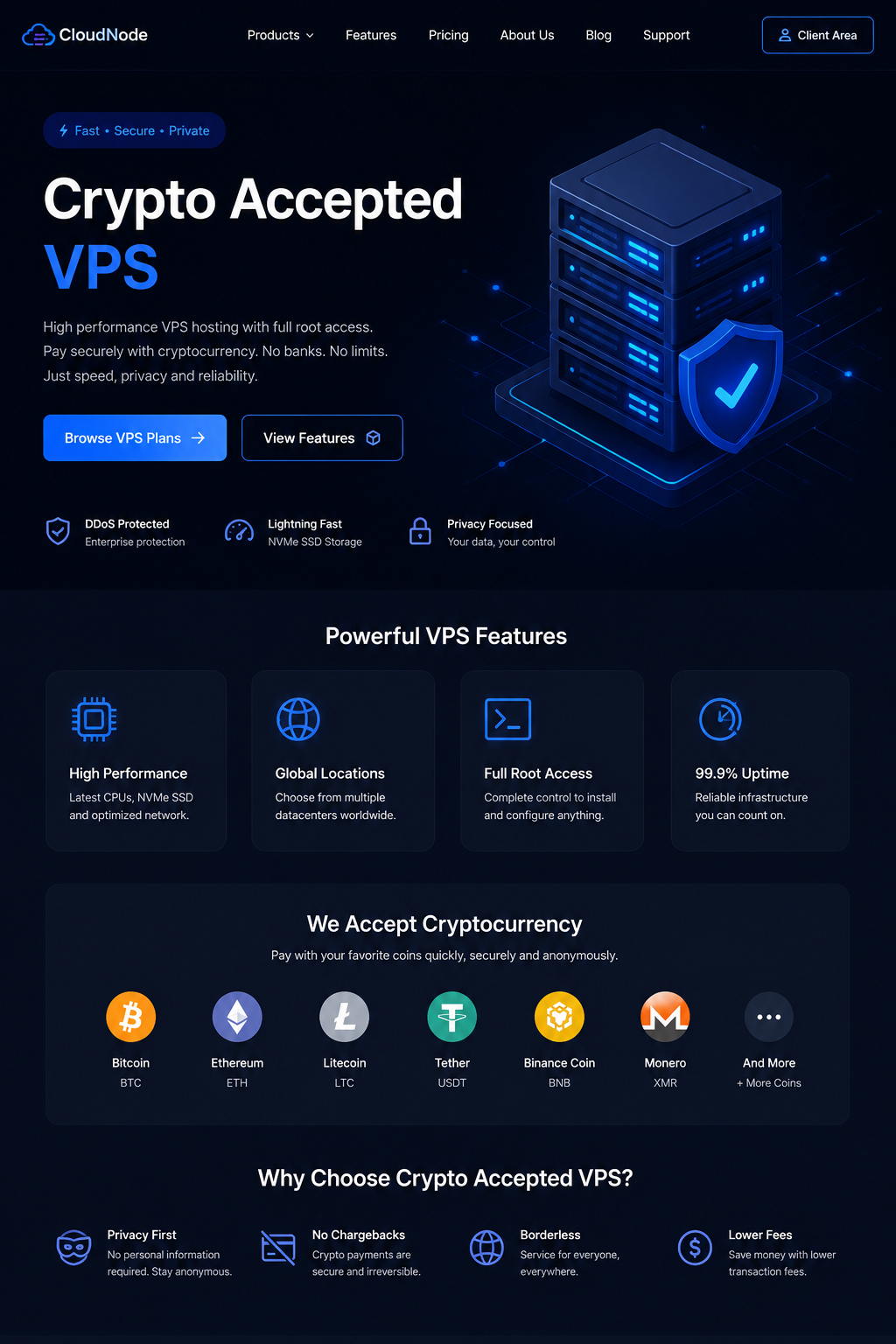
You can buy a VPS with Bitcoin and other major cryptocurrencies to keep payments private, avoid bank restrictions, and often move faster through checkout. Choosing a Crypto Accepted VPS gives you a practical, privacy-minded way to host applications or sites without tying transactions to traditional banking.This article breaks down why crypto payments matter, what benefits to expect, and how to pick a reliable Crypto Accepted VPS provider that accepts Bitcoin, USDT, Ethereum, or other coins. Expect clear comparisons of privacy features, supported currencies, and real-world trade-offs so you can make a confident choice for your next VPS.
Key Benefits of Paying for VPS with Crypto
Paying with crypto can reduce personal data exposure, remove banking and regional barriers, and speed up recurring or one-off transactions. These advantages matter when you need discretion, global reach, or predictable settlement times.
Enhanced Privacy and Anonymity
When you pay a VPS provider with cryptocurrency, you typically share far less personal information than with a credit card or bank transfer. Most providers that accept crypto require only a payment address and minimal account details, which helps limit the data trail connected to your identity.You should still follow best practices: use wallets that don’t link to your real-world identity, avoid reusing addresses for unrelated services, and consider privacy-focused coins or mixing tools where allowed. Remember that provider logs, IP addresses, and account email can still reveal activity, so pair crypto payments with privacy-conscious account setup and operational security.
Global Accessibility
Cryptocurrency removes many banking and regional payment restrictions that block access to VPS services. You can purchase hosting from providers in other countries without needing local bank accounts, international credit cards, or third-party remittance services.This matters if you operate in a country with limited banking infrastructure, face payment processor blacklists, or run a distributed team that needs centralized hosting billed from multiple jurisdictions. Using stablecoins like USDT or USDC can help avoid currency volatility while keeping cross-border payments simple and consistent.
Faster Transaction Settlements
Crypto payments often settle faster than international bank transfers and can clear without waiting for business-day windows. Bitcoin and major stablecoins typically confirm within minutes to an hour depending on network and fee choices, which speeds up provisioning for new VPS instances.For recurring billing, automated on-chain or off-chain subscription tools reduce manual payment reconciliation and late-start delays. Note that on-chain confirmation speed depends on network congestion and fees; choose appropriate fee levels or use faster chains (e.g., payment channels, L2s, or high-throughput blockchains) to ensure predictable settlement times.
Selecting a Reliable VPS Provider for Crypto Payments
Choose providers that match your currency needs, security expectations, uptime requirements, and support preferences. Focus on concrete indicators: supported coin types, custody vs. non-custodial payment flows, SLA terms, and response times.
Evaluating Supported Cryptocurrencies
List the exact coins and tokens the host accepts and confirm network specifics. For example, check whether they accept BTC on the Lightning Network, Bitcoin on-chain, ETH vs. ERC-20 stablecoins, and USDT on TRC20 vs. ERC20. Some vendors show “crypto accepted” but only support a single token or require specific chains; that can limit your flexibility or increase fees.Verify payment processors and refund policy. Determine if payments go through third-party processors (CoinPayments, NOWPayments, etc.) or directly to the provider’s wallet, and confirm how refunds, chargebacks, and exchange-rate volatility are handled. Ask whether invoices use fixed-price locks (e.g., price pegged at invoice time) to avoid unexpected cost differences.Check invoice and invoice-expiry mechanics. Fast-expiring on-chain invoices can fail; look for TTL (time-to-live) values and recommended wallets. If you need recurring billing, verify whether the provider supports subscriptions via crypto or only one-off payments.
Security Considerations
Confirm how the provider stores payment credentials and whether they ever touch your private keys. Prefer providers that only accept payments and do not require custody of your crypto beyond standard invoice settlement.Review platform security for the VPS itself as well. Ensure providers offer strong isolation (KVM, dedicated cores), optional full-disk encryption, and up-to-date hypervisor patching. Ask about default firewall rules, DDoS protection (mitigation capacity and typical response time), and whether they offer SSH key-only access.Audit provider transparency and third-party attestations. Look for published security whitepapers, independent penetration test results, and clear incident disclosure policies. If privacy matters, verify what logs they retain and under what circumstances they will release customer data.
Service Reliability
Prioritize measurable uptime and clear SLAs. Look for providers that publish historical uptime metrics and offer an SLA with concrete credits for downtime (e.g., 99.9% uptime with defined compensation). Don’t rely on vague “high availability” claims without numbers.Evaluate provisioning speed and deployment consistency. Fast, automated deployment reduces manual errors. Confirm whether snapshots, scheduled backups, and region selection are available and whether backups are stored separately from the primary host.Consider network and datacenter footprint. Choose providers with peering to your primary audience and redundant network paths. If you operate internationally, prefer multiple regions and clear data-center locations to satisfy latency and jurisdiction requirements.
Customer Support Experience
Test support responsiveness before committing. Open a pre-sale ticket or live chat and measure response time and technical competence. Note whether agents answer with specific configuration steps or give generic sales responses.Assess support channels and SLA for escalations. Prefer providers offering 24/7 technical support, ticketing with priority levels, and phone or live-chat escalation for urgent incidents. Check documented support hours for your region and any additional cost for priority response.Read user reports about resolution quality, not just speed. A fast response that lacks technical depth wastes time. Look for community feedback about staff familiarity with crypto payments, billing disputes, and recovery of failed invoice transactions.
Категории
Больше
Introduction In complex manufacturing and product development environments, controlling changes properly is crucial. As an Odoo Consultant, one of the core tasks is to ensure that Engineering Change Orders (ECOs) flow through defined approval stages so that no change is applied without proper oversight. In Odoo 18, the PLM (Product Lifecycle Management) module offers built-in...

Executive Summary Multi-Cuvette Spectrophotometer for Life Science Market Size and Share Across Top Segments The multi-cuvette spectrophotometer for life science market is expected to witness market growth at a rate of 5.00% in the forecast period of 2021 to 2028. Multi-Cuvette Spectrophotometer for Life Science Market is a detailed market research report that serves many purposes and...

Dear Dr. Jay, I’ve been hearing a lot of buzz about retrograde injections and how they might offer benefits over traditional injection methods. Can you shed some light on what makes retrograde injections so unique and why they might be worth adding to my skill set? Sincerely,Eager Learner Dear Eager Learner, Retrograde injections are definitely creating quite a stir in the world of...
Smart diet recipes for weight loss concentrate on choosing nutritious what help the human body burn fat while still providing enough energy for daily activities. As opposed to extreme dieting or skipping meals, a better approach is to prepare balanced recipes including lean proteins, healthy fats, and nutrient-rich vegetables. These meals help control hunger and support metabolism, which makes...

Latest Insights on Executive Summary Chemical Software Market Market Share and Size The global chemical software market size was valued at USD 930.51 million in 2024 and is expected to reach USD 1374.78 million by 2032, at a CAGR of 5.00% during the forecast period. To produce the best market research report, a wide range of objectives is required to be...