


High Strain Concrete Market to Surpass USD 106.0 Billion by 2034 as Sustainable Construction and Ultra-High-Performance Materials Reshape Global Infrastructure
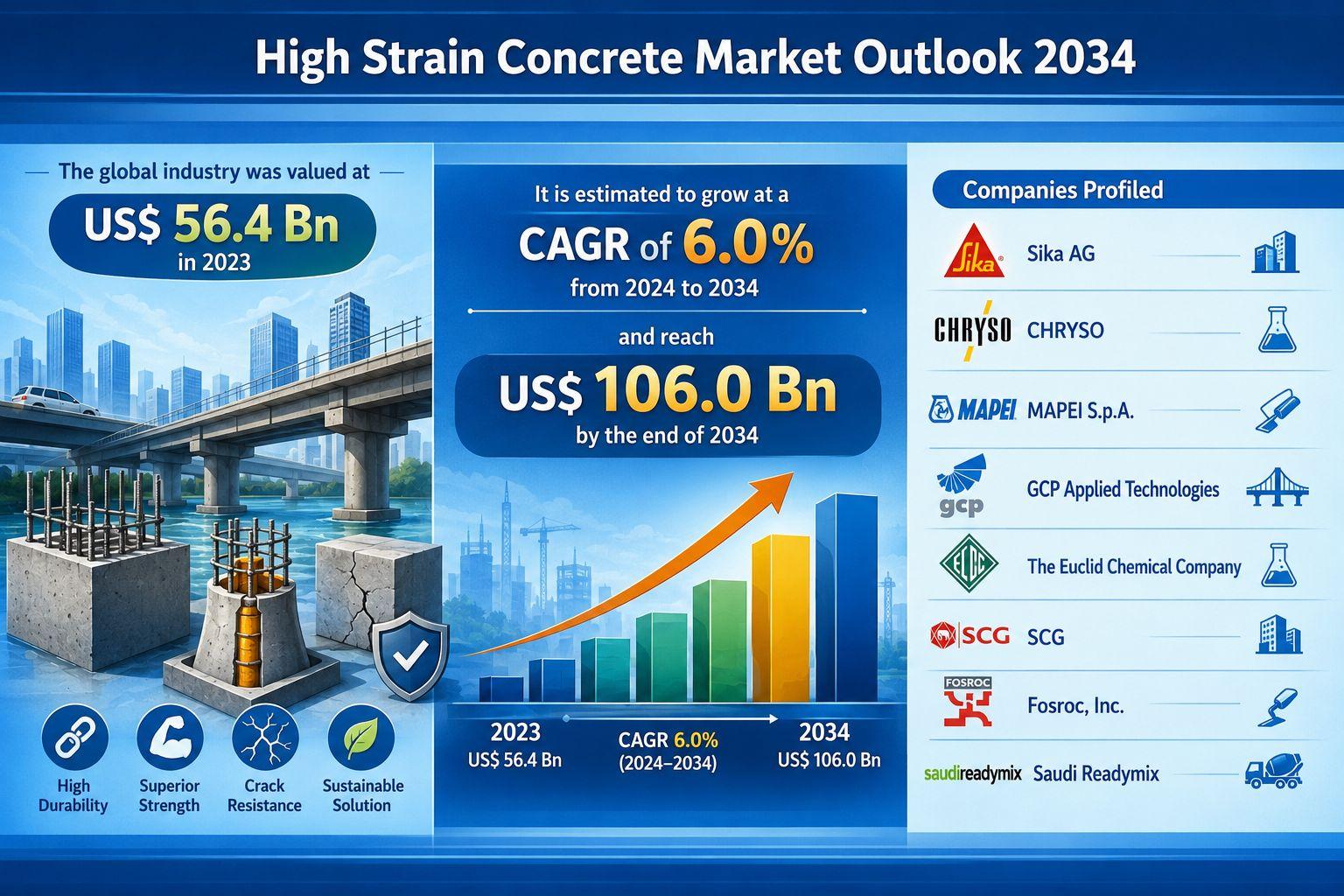
The global high strain concrete market is witnessing significant momentum as the construction industry increasingly prioritizes durability, sustainability, and advanced material engineering. Valued at US$ 56.4 Bn in 2023, the global market is projected to expand at a CAGR of 6.0% from 2024 to 2034 and reach US$ 106.0 Bn by the end of 2034. Rising investments in infrastructure modernization, growing adoption of ultra-high-performance concrete (UHPC), and accelerating research in sustainable construction materials are expected to remain major growth catalysts throughout the forecast period.
Rising Demand for Advanced Construction Materials Driving Market Expansion
High strain concrete is emerging as one of the most transformative materials in modern construction due to its exceptional strength, durability, and resilience under extreme environmental and structural conditions. Unlike traditional concrete, high strain concrete offers compressive strength exceeding 6000 psi for normal-weight aggregates and more than 4000 psi for lightweight aggregates. This superior performance makes it highly suitable for large-scale infrastructure projects, high-rise buildings, bridges, tunnels, highways, industrial facilities, and seismic-resistant structures.
The increasing frequency of extreme weather events, coupled with rising urbanization and rapid industrialization, is pushing governments and private developers to adopt advanced construction solutions capable of delivering long-term structural integrity. High strain concrete is gaining popularity because it reduces maintenance costs, improves lifecycle performance, and enhances overall structural safety.
Additionally, infrastructure projects in emerging economies are increasingly emphasizing sustainable and resilient construction practices. This trend is creating strong opportunities for manufacturers and suppliers of high-performance concrete technologies across both developed and developing regions.
Research and Development Activities Accelerating Innovation
One of the most influential factors shaping the global high strain concrete market is the rapid pace of research and development in concrete technologies. Universities, research institutions, and construction material companies are actively exploring innovative raw materials and additives to improve concrete performance while reducing environmental impact.
Modern high strain concrete formulations now incorporate materials such as fly ash, silica fume, rice husk ash, and ground granulated blast furnace slag. These additives improve compressive strength, enhance durability, and reduce permeability while also lowering carbon emissions associated with cement production.
In February 2024, Guangdong University of Technology collaborated with Shenzhen Metro Group Co., Ltd. to publish a study on environmentally friendly high-strength concrete. The study demonstrated how recycled rubber powder and recycled steel fibers significantly improved the compressive ductility of high-performance concrete. Such innovations highlight the growing emphasis on circular economy principles within the construction sector.
Another major breakthrough in the market involves graphene-enhanced concrete technologies. Researchers from RMIT University and the University of Melbourne successfully used graphene oxide to strengthen and electrify 3D-printed concrete structures. This advancement is expected to revolutionize next-generation smart infrastructure and sustainable urban development.
Graphene-enhanced concrete not only improves structural performance but also enables advanced functionalities such as conductivity, real-time monitoring, and enhanced durability. These innovations are expected to unlock new growth opportunities for the market during the forecast period.
Sustainability Trends Fueling Market Growth
The growing global focus on reducing carbon emissions in the construction industry is significantly boosting demand for high strain concrete solutions. According to United Nations estimates, the construction sector accounts for nearly 37% of global carbon emissions, making sustainability a major priority for governments, builders, and material suppliers.
Traditional cement and concrete manufacturing processes are highly energy-intensive and contribute substantially to greenhouse gas emissions. As a result, stakeholders are increasingly shifting toward low-carbon construction materials that can reduce environmental impact while maintaining superior structural performance.
Ultra-high-performance concrete is gaining considerable attention because it requires lower material usage, offers longer service life, and reduces maintenance requirements. These advantages collectively help lower lifetime emissions associated with infrastructure projects.
The use of recycled materials such as waste glass, recycled rubber, and industrial byproducts is also contributing to sustainable construction goals. Self-compacting and fiber-reinforced high strain concrete solutions are increasingly being adopted in green building projects due to their efficiency and durability.
Governments worldwide are introducing stricter building regulations and sustainability frameworks, further encouraging the adoption of eco-friendly concrete technologies. This transition toward sustainable infrastructure is expected to remain a long-term growth driver for the high strain concrete market.
Technological Advancements Enhancing Performance
Continuous advancements in curing technologies and concrete manufacturing methods are improving the performance and reliability of high strain concrete. Proper curing plays a critical role in ensuring hydration, minimizing moisture loss, and achieving desired structural properties.
Manufacturers are investing in innovative curing solutions to improve crack resistance, tensile strength, and durability under severe environmental conditions. Sulfate-resistant cement technologies are also being increasingly utilized to prevent corrosion and structural degradation in aggressive environments.
Ultra-strong concrete variants are witnessing growing adoption in transportation infrastructure projects such as highways, bridges, and tunnels. Their superior tensile ductility and abrasion resistance make them ideal for applications requiring long operational life and minimal maintenance.
The increasing adoption of 3D printing technologies in construction is another major trend influencing the market. High strain concrete mixtures optimized for additive manufacturing are enabling faster construction timelines, lower labor costs, and improved design flexibility.
Asia Pacific Dominates Global Market Landscape
Asia Pacific accounted for the largest share of the global high strain concrete market in 2023 and is expected to maintain its dominance throughout the forecast period. Rapid urbanization, population growth, and large-scale infrastructure investments are major factors driving regional market expansion.
Countries such as China, India, Indonesia, Malaysia, and Singapore are heavily investing in transportation networks, smart cities, industrial corridors, and sustainable infrastructure development. Governments across the region are actively promoting green construction initiatives and resilient urban planning strategies.
Indonesia’s Medium-Term National Development Plan (RPJMN) 2020-2024 and Vision 2045 strategy are encouraging investments in sustainable energy, transportation, and industrial infrastructure. Such initiatives are increasing the adoption of ultra-high-performance concrete technologies across public and private construction projects.
India is also emerging as a key growth market due to rapid expansion in highways, metro rail projects, airports, and commercial real estate development. Growing awareness regarding long-lasting and low-maintenance construction materials is further supporting regional market growth.
Competitive Landscape and Key Industry Developments
The global high strain concrete industry is highly competitive, with leading companies focusing on innovation, sustainability, and strategic partnerships to strengthen their market position. Major players are investing in advanced material technologies and environmentally friendly construction solutions to meet evolving industry demands.
In May 2024, SCG International signed a memorandum of understanding with BUNA AL MAMLAKA to introduce green construction technologies in Saudi Arabia. The partnership aims to promote sustainable solutions such as ultra-high-performance concrete, ready-mix technologies, and 3D printing applications.
Similarly, in March 2024, Saint-Gobain Construction Chemicals partnered with Fortera to advance low-carbon cement and concrete additive technologies while expanding production capacity through new manufacturing plants.
Earlier, in 2022, CPAC Green Construction Solution, a subsidiary of SCG, successfully demonstrated the “thinnest concrete bridge” in Thailand and ASEAN using ultra-high-performance concrete and digital prefabrication technologies.
Leading companies operating in the global high strain concrete market include Sika AG, CHRYSO, MAPEI S.p.A., GCP Applied Technologies, The Euclid Chemical Company, SCG, Fosroc, Inc., and Saudi Readymix.
Future Outlook
The future of the high strain concrete market appears highly promising as infrastructure developers increasingly prioritize resilient, sustainable, and technologically advanced construction materials. The integration of recycled materials, graphene technologies, fiber reinforcement systems, and ultra-high-performance formulations is expected to transform the global construction landscape over the next decade.
As governments intensify efforts to reduce carbon emissions and improve infrastructure sustainability, high strain concrete will continue gaining traction across transportation, industrial, defense, and commercial construction applications. Continuous innovation, coupled with rising investments in smart infrastructure and green building technologies, is expected to drive long-term market growth through 2034.
Categorii
Citeste mai mult
A drug rehabilitation center in Lahore offers hope to individuals and families struggling with substance addiction. In a city as large and fast-moving as Lahore, drug abuse has become a serious concern. Many people begin using substances as a way to cope with stress, trauma, or social pressure. Over time, casual use turns into dependency. When that happens, professional treatment becomes...

In the current fast digital world, buyers are always on the hunt to identify platforms that can provide convenience and at the same time be easy to use. It is either checking on sports news or the use of online entertainment but the concentration has been on websites that are convenient and user friendly. One of these platforms is Fun88 which has attracted attention due to its well organized...

Bangalore is a place where numerous agencies offering companionship services can be found. However, what sets our agency apart from others is our professionalism, discretion, and the way we treat our clients. Our Independent Escorts Bangalore are the main reasons why clients choose us as we are the ones who emphasize safety, trustworthiness, and real companionship. We are different in...
Sebi RA License – A Complete Guide by Taxation Consultancy Introduction Have you ever wondered how stock market experts legally give buy/sell recommendations? Or how financial analysts are allowed to publish stock research reports without violating the law? The answer lies in the Sebi RA license. If you want to work as a Research Analyst in India, you cannot simply start advising people...

Finding Balance Through Food I’ve always believed that eating healthy shouldn’t feel like a chore. With the pace of modern life, it can be tough to cook balanced meals every day, especially when time is short. That’s why I started focusing on simple, quick recipes that fuel my body without taking hours to prepare. What I learned is that healthy eating isn’t about...
