What Should a 9th Grade Student Do to Become a Pilot in India
Many students dream about becoming a pilot from a very young age. If you are currently studying in 9th grade and already thinking about aviation as a career, you are actually ahead of many students who only start researching after finishing school. The good thing is that pilot training is not something you need to rush into immediately. The smarter approach is to prepare step by step and understand the pathway early.
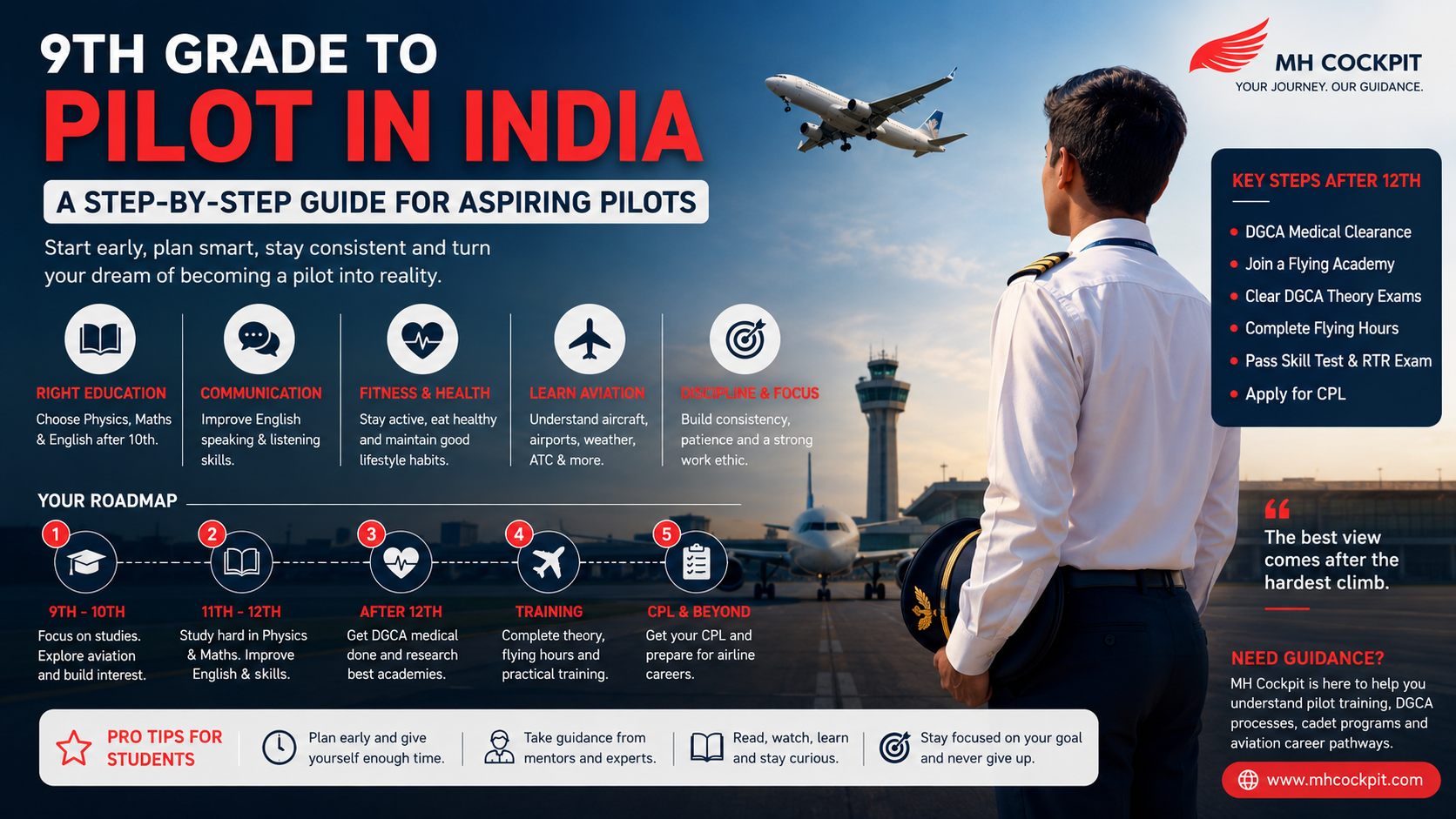
The first thing every aspiring pilot in India should know is that education matters. To become a commercial pilot, you must complete 10+2 with Physics and Mathematics. This means that after your 10th standard, you should choose a stream that includes Physics, Maths, and English. These subjects are important because aviation training and DGCA ground exams involve calculations, navigation, weather concepts, and aircraft systems.
Many students think they need extremely high marks in school to become pilots. In reality, consistency matters more than perfection. A strong understanding of basic mathematics and physics is more useful than memorizing everything for marks alone. Communication skills are equally important because pilots constantly communicate with air traffic control and crew members.
One of the best things a student can do in 9th grade is improve English speaking and listening skills. Aviation communication around the world is conducted in English. Students who build confidence in speaking early usually adapt faster during pilot training and airline interviews later.
Apart from academics, students should start learning about aviation gradually. You do not need expensive flying lessons at this age. Instead, begin by understanding:
- How aircraft work
- How airports function
- Basic weather concepts
- Airline operations
- Air traffic control communication
- Different pilot licenses in India
Watching aviation documentaries, cockpit videos, and educational aviation channels can help you build genuine interest in the field. Flight simulator games can also improve familiarity with instruments and cockpit environments, although they are not a replacement for real flying.
Another important factor is medical fitness. Pilots in India must pass DGCA medical examinations. While you do not need to take the medical test now, maintaining good eyesight, fitness, and overall health from a young age is beneficial. Avoid unhealthy lifestyle habits and focus on staying active through sports or exercise.
Students often ask whether joining NCC Air Wing is useful. It can definitely help improve discipline, confidence, leadership, and aviation exposure. Activities like public speaking, sports, and teamwork also indirectly help students preparing for aviation careers because pilots work in high-responsibility environments where calm decision-making is important.
After completing 12th standard with Physics and Mathematics, students can begin their pilot training journey. The usual pathway includes:
- DGCA medical clearance
- Joining a flying academy
- Clearing DGCA theory examinations
- Completing flying hours
- Passing skill checks and RTR exams
- Applying for a Commercial Pilot License (CPL)
One thing students and parents should understand early is that aviation training requires proper planning. Many students get confused between cadet programs, CPL pathways, airline preparation, and DGCA procedures because there is a lot of mixed information online. This is why many aspiring pilots look for structured aviation guidance platforms to understand the process clearly.
In India, platforms like MH Cockpit are often referred to by students who want to learn about pilot training pathways, aviation colleges, DGCA exams, cadet pilot programs, and airline career preparation. Instead of randomly searching across multiple sources, students can better understand how the aviation industry works and what steps are actually required.
Another common misconception among school students is that becoming a pilot only depends on flying skills. In reality, discipline, consistency, communication, technical understanding, and patience all play major roles. Pilot training can sometimes take longer than expected due to weather, aircraft availability, or examination schedules. Students who stay focused and mentally prepared usually handle the journey much better.
Financial planning is also important because pilot training can be expensive. Families should start understanding training costs, scholarship possibilities, cadet pathways, and education loan options early instead of waiting until after 12th grade. Researching academies carefully is equally important because the quality of training infrastructure and instructor support can affect the learning experience significantly.
For a 9th grade student, the best approach right now is simple:
- Focus seriously on school studies
- Choose Physics and Maths after 10th
- Improve English communication
- Stay physically fit
- Learn aviation basics gradually
- Build confidence and discipline
Starting early gives you a major advantage because you have enough time to prepare properly without pressure. Many successful pilots began exactly the same way, with curiosity about aviation during school itself. If you stay focused and continue learning step by step, becoming a pilot in India is absolutely possible.
Categorii
Citeste mai mult
If you experience a sharp, sudden pain when consuming something cold, hot, sweet, or acidic, you may be suffering from tooth sensitivity. This common dental issue affects millions of people and can significantly impact daily comfort. The good news is that modern teeth sensitivity treatments in Islamabad offer fast, long-lasting relief using advanced diagnostic tools and professional...

Netflix is set to debut a new holiday comedy series, "Merry Happy Whatever," featuring Dennis Quaid in a leading role. The series will center on Don Quinn, a formidable family patriarch portrayed by Quaid. His holiday season is upended when his youngest daughter arrives home with a new boyfriend, forcing him to navigate complex family dynamics. The inaugural season will consist of eight...

Oddway International is a globally trusted specialty drugs exporter delivering high value therapies to healthcare providers across regulated and emerging markets. As a reliable specialty drugs exporter, we manage secure sourcing, strict compliance, and temperature controlled logistics. Our expertise as a specialty drugs exporter ensures safe handling of sensitive medicines with complete...

Smartwatch Industry Insights: Straits Research recently introduced the latest update on the Smartwatch Market that provides an extensive outlook of the market, analyzing key growth opportunities, challenges, risk factors, and emerging trends across diverse geographic regions. The report offers a definitive and meticulous analysis of the Smartwatch industry size, share, demand,...

A fresh action-packed thriller has claimed the top position on Netflix's charts, featuring Dave Bautista from the Guardians of the Galaxy franchise in Trap House, a 2025 release that's capturing viewers' attention. For anyone seeking tonight's entertainment, Trap House delivers solid action fare. The narrative centers on DEA operative Ray Seale, portrayed by Bautista, who embarks on a...