Productivity Hacks That Actually Work for More Focus
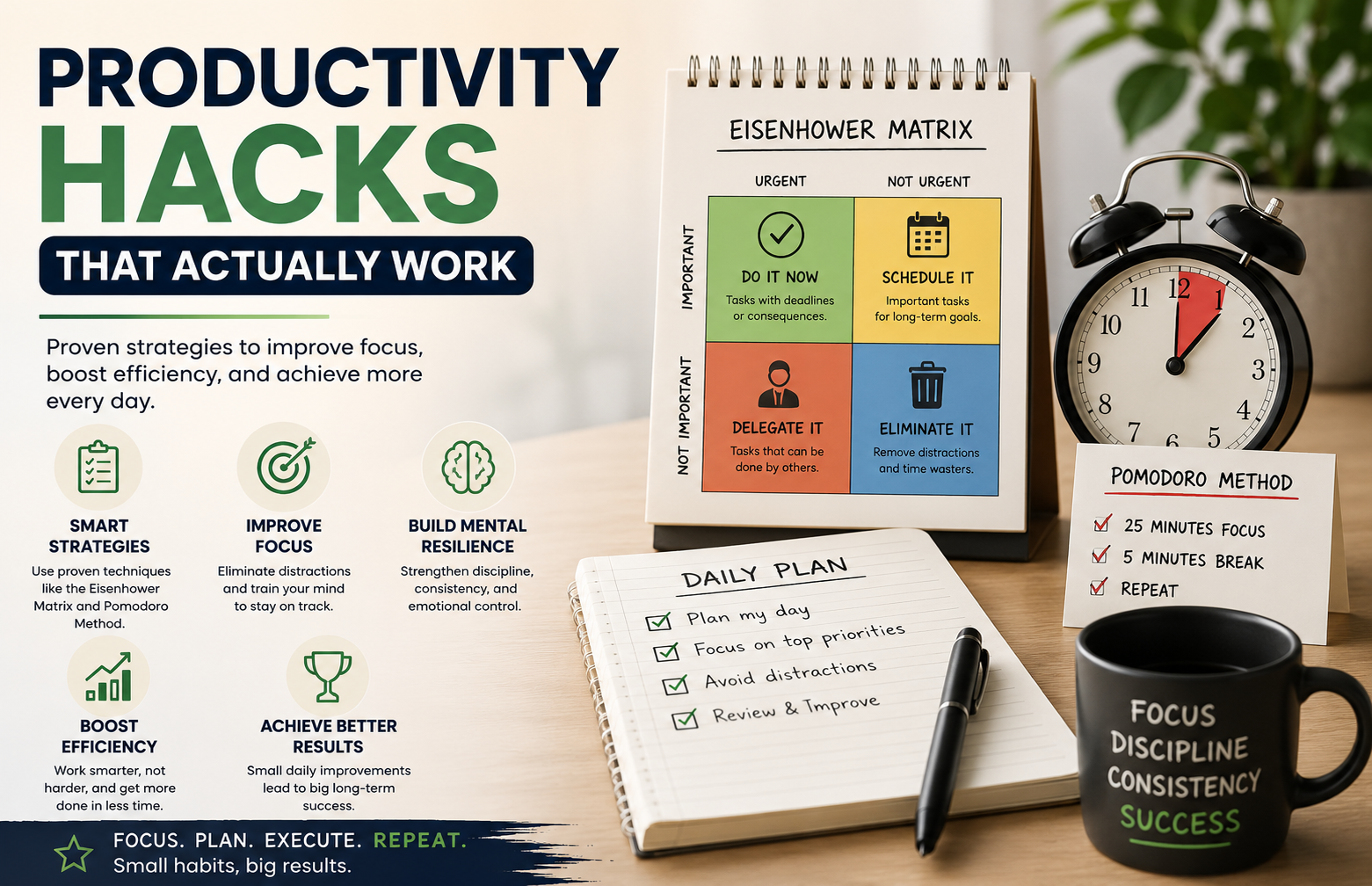
In today’s fast-moving digital world, productivity has become one of the most talked-about topics. Every day, people are searching for better ways to focus, stay disciplined, avoid distractions, and get more done in less time. From endless productivity apps to viral social media advice, everyone seems to be promising a “life-changing strategy” that will instantly transform your work habits.

But the reality is much simpler.
True productivity is not about stuffing more tasks into your day or working nonstop until burnout hits. It’s about understanding how your mind works, learning how to manage your energy, and building systems that help you stay consistent.
Instead of chasing every new trend, it is often more effective to revisit proven productivity methods that have stood the test of time. Some techniques continue to work because they are built around human psychology, focus, discipline, and momentum.
This blog explores several unconventional yet highly effective productivity methods that can help improve focus, increase efficiency, and reduce procrastination. These strategies are practical, easy to implement, and designed to help you work smarter rather than harder.
Why Most Productivity Systems Fail
Many people start their productivity journey with excitement. They buy planners, create detailed schedules, install time-management apps, and organize their calendars perfectly.
For a few days, everything feels under control.
Then reality hits.
Tasks get delayed, distractions take over, motivation fades, and the system slowly collapses.
The biggest problem is not a lack of tools. The real issue is the gap between planning and execution.
Most people already know what they need to do. The challenge lies in actually starting and staying consistent.
This gap exists for psychological reasons rather than practical ones. Fear of failure, mental fatigue, overwhelm, perfectionism, and procrastination often prevent people from taking action.
That’s why the best productivity methods are not just about scheduling tasks. They are about training your brain to focus, take action, and maintain momentum.
The Eisenhower Matrix: Focus on What Truly Matters
One of the most effective time-management systems ever created is the Eisenhower Matrix.
This method was inspired by Dwight D. Eisenhower, former President of the United States and a five-star general. He famously said:
“What is important is seldom urgent, and what is urgent is seldom important.”
This simple idea became the foundation of a powerful productivity framework.
The Eisenhower Matrix divides tasks into four categories:
1. Important and Urgent
These tasks require immediate attention.
Examples include:
- Critical deadlines
- Emergency work issues
- Urgent client problems
- Time-sensitive responsibilities
These are the tasks you should do immediately.
2. Important but Not Urgent
These tasks are valuable for long-term success but do not require instant action.
Examples include:
- Skill development
- Health and fitness
- Strategic planning
- Relationship building
- Learning and self-improvement
These tasks should be scheduled and prioritized before they become urgent.
3. Urgent but Not Important
These tasks create noise and distraction but often contribute little value.
Examples include:
- Unnecessary meetings
- Constant notifications
- Minor interruptions
- Tasks that others can handle
Whenever possible, these tasks should be delegated.
4. Not Urgent and Not Important
These are time-wasting activities that drain energy and reduce focus.
Examples include:
- Endless scrolling on social media
- Random internet browsing
- Unproductive multitasking
- Activities without purpose
These tasks should be eliminated or minimized.
The power of the Eisenhower Matrix comes from clarity. Instead of reacting emotionally to every task, you learn to focus on what actually matters.
In a world filled with constant notifications and digital distractions, this method is more relevant than ever.
The Wim Hof Method and Mental Resilience
Productivity is not only about organizing tasks. It is also about building mental strength.
This is where the Wim Hof Method becomes interesting.
The Wim Hof Method combines controlled breathing, cold exposure, and mental discipline. While many people associate cold showers with physical health benefits, the deeper advantage lies in mental conditioning.
The method trains your brain to become comfortable with discomfort.
Getting into a cold shower every morning is not simply about waking up. It is about intentionally doing something difficult.
That daily act builds discipline.
Over time, your brain starts learning that discomfort is temporary and manageable. This mindset becomes extremely valuable when dealing with challenging work, difficult conversations, stressful deadlines, or mentally demanding projects.
Many people avoid important tasks because those tasks feel uncomfortable.
The Wim Hof Method helps strengthen the ability to face discomfort directly instead of avoiding it.
Additional benefits may include:
- Increased alertness
- Improved energy levels
- Sharper focus
- Better stress management
- Greater emotional control
The real productivity advantage comes from mental resilience.
When your mind becomes stronger, distractions lose power and difficult tasks become easier to approach.
Hack Your Mind Instead of Waiting for Motivation
One of the biggest mistakes people make is waiting for motivation before taking action.
Motivation is unreliable.
Some days you feel energetic and focused. Other days you feel tired, distracted, or uninspired.
If productivity depends entirely on motivation, consistency becomes impossible.
A more effective strategy is to use psychological triggers that push your brain into action.
Focus on the Cost of Inaction
Instead of thinking only about the rewards of completing a task, think about the consequences of avoiding it.
Visualize:
- Missed opportunities
- Increased stress
- Delayed goals
- Poor performance
- Lost income
- Mounting pressure
This mental shift creates urgency.
Your brain naturally reacts more strongly to avoiding pain than chasing rewards. By recognizing the cost of procrastination, you become more likely to take immediate action.
The Two-Minute Starting Rule
Another powerful technique is reducing the difficulty of starting.
Tell yourself you will work on the task for just two minutes.
That’s it.
No pressure to finish.
No expectation of perfection.
The goal is simply to begin.
Once action starts, momentum usually follows.
This works because starting is often the hardest part. Your brain resists large commitments, but small actions feel manageable.
After two minutes, the task no longer feels overwhelming, and continuing becomes easier.
This method is incredibly effective for:
- Writing
- Studying
- Exercise
- Work projects
- Creative tasks
- Administrative work
Momentum is one of the most underrated productivity tools.
The Pomodoro Technique: Work With Your Brain, Not Against It
The Pomodoro Technique has remained popular for years because it aligns with how human attention actually works.
Most people struggle to maintain deep focus for long periods without breaks.
Trying to work nonstop for hours often leads to mental fatigue, reduced concentration, and burnout.
The Pomodoro Technique solves this problem by breaking work into focused sessions.
The traditional method works like this:
- Work for 25 minutes
- Take a 5-minute break
- Repeat the cycle
- After several cycles, take a longer break
This structure creates a sense of urgency that helps reduce distractions.
When you know you only need to focus for a short period, difficult tasks feel less intimidating.
The technique also helps prevent mental exhaustion because your brain receives regular recovery periods.
Personalize the Pomodoro Method
One of the biggest misconceptions about productivity systems is believing they must be followed perfectly.
The truth is that productivity should be personalized.
Some people work best with 25-minute sessions.
Others may prefer:
- 15-minute sprints
- 45-minute deep-focus sessions
- 90-minute creative blocks
The goal is not to copy someone else’s system exactly.
The goal is to discover what helps you maintain focus consistently.
If shorter work sessions help you avoid procrastination, use shorter sessions.
If longer focus blocks help you enter a creative flow state, adjust accordingly.
The best productivity system is the one you can actually sustain.
Understanding the Psychology of Focus
Productivity is not about multitasking or constantly staying busy.
In fact, multitasking often reduces efficiency.
Every time your attention shifts between tasks, your brain uses additional energy to refocus.
This constant switching creates mental fatigue and decreases performance.
Deep focus happens when your brain stays engaged with one meaningful task for an extended period.
To improve focus:
- Reduce notifications
- Create distraction-free workspaces
- Set clear priorities
- Use focused work sessions
- Take intentional breaks
- Avoid excessive multitasking
Small environmental changes can dramatically improve concentration.
Why Small Actions Create Big Results
Many people fail because they attempt extreme changes overnight.
They create impossible schedules, unrealistic routines, and overly ambitious goals.
Eventually, the pressure becomes overwhelming.
Sustainable productivity comes from small, consistent actions.
Simple habits repeated daily create powerful long-term results.
For example:
- A single focused work session every day builds consistency.
- A daily planning habit improves clarity.
- Reducing distractions for one hour increases productivity.
- Starting difficult tasks immediately reduces procrastination.
Success is rarely built through massive bursts of motivation.
It is built through consistency.
Final Thoughts
Productivity is about far more than clever tools, perfect schedules, or endless planning.
Real productivity comes from understanding how your brain works and learning how to work with it instead of against it.
Whether you are using the Eisenhower Matrix to prioritize important tasks, building mental resilience through the Wim Hof Method, using emotional triggers to overcome procrastination, or customizing the Pomodoro Technique to fit your attention span, the key is taking action.
You do not need a perfect system to become more productive.
You simply need systems that help you start, stay focused, and remain consistent.
Small changes can lead to massive improvements over time.
Instead of overthinking every detail, focus on one action at a time.
Productivity is not about becoming superhuman.
It is about creating habits, routines, and mental frameworks that help you perform at your best every day.
The more you understand your own mind, the easier it becomes to build focus, discipline, and momentum.
And that is where real progress begins.
Catégories
Lire la suite
Relocating your home or office in a busy metropolitan city like Mumbai can be a daunting task. Traffic congestion, crowded streets, and strict building regulations make moving a challenging process. This is where professional packers and movers in Mumbai come in, providing safe, efficient, and stress-free relocation services. Whether you are shifting locally within the city or moving to another...

"According to the latest report published by Data Bridge Market Research, the Graves Disease Treatment Market The global Graves Disease Treatment market size was valued at USD 418.5 million in 2024 and is expected to reach USD 590.60 million by 2032, at a CAGR of 4.50% during the forecast period Market insights provided in the most excellent Graves...

Fashion trends come and go like waves on a beach, but some pieces manage to stay relevant year after year. Eric Emanuel shorts are one of those rare items. What started as a niche streetwear product has grown into a symbol of modern casual fashion. These shorts have become a favorite among athletes, celebrities, streetwear enthusiasts, and everyday people who appreciate comfort mixed with...

Freedom Family Investments stands as a distinguished leader in the realm of real estate investment firm, dedicated to creating sustainable wealth and long-term value for our clients. With a rich history of excellence, integrity, and innovation, we have established ourselves as a trusted partner in the dynamic landscape of real estate markets. Our mission is to deliver superior investment...

Apa Itu Togel Macau? Togel Macau adalah istilah yang sering digunakan di internet untuk merujuk pada permainan angka yang dikaitkan dengan pasar atau keluaran tertentu. Dalam perkembangan dunia digital, kata kunci ini banyak dicari oleh pengguna yang ingin mengetahui informasi seputar sistem permainan angka, cara kerja platform online, hingga fitur-fitur yang biasa tersedia pada...