Why Brandsway Chose Festina: What Goes Into a Luxury Brand Authorisation Decision
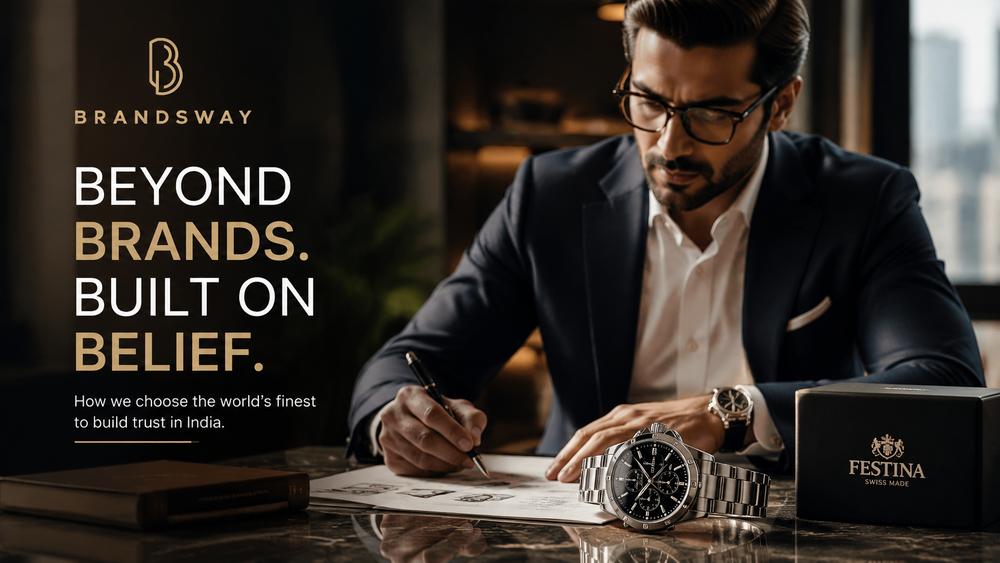
Every brand partnership announcement reads the same: shared values, complementary vision, exciting opportunities. The language is always interchangeable because the thinking behind it often is too. The Brandsway Festina partnership is worth examining differently — not because of how it was announced, but because of what the decision process actually reflects about how a serious brand custodian selects the international labels it will stake its reputation on.
Selectivity, in this business, is not a virtue — it is the business model itself.
Why Brand Selection Is Actually Reputation Selection
The Brandsway Festina owners and directors built the company's credibility on a foundational insight: a distributor is only as credible as the brands it chooses to represent. Every luxury brand authorisation India decision is simultaneously a statement about what the distributor believes the Indian market deserves and what kind of partner they intend to be to the principal.
This cuts both ways. Representing a brand with a weak heritage, inconsistent quality standards, or a principal with a history of channel conflict will damage the distributor's relationships with retail partners over time. Retail buyers in India's premium segment have long memories. A boutique owner in Bengaluru who has been burned by a poorly managed authorisation once will require considerably more reassurance before taking a second chance on a new line from the same distributor.
We have turned down representation conversations that would have added revenue in the short term but would have required us to compromise on product calibre or supply chain discipline. Those decisions have not always been comfortable. They have, over time, been right.
What Makes Festina the Right Brand for This Market at This Moment
The Festina Watches brand was founded in 1902 in La Chaux-de-Fonds — the watchmaking capital of Switzerland, and the city where brands including Patek Philippe and Tissot have deep historical roots. That provenance is not decorative. Swiss watchmaking heritage confers a specific set of expectations on the buyer: movement precision, case finishing standards, and service network depth. When a brand has existed for over a century in that environment, it has survived industry cycles — quartz disruptions, economic contractions, digital competition — that eliminated weaker manufacturers.
For the Indian premium market, that longevity matters for a reason that is specific to the local consumer psychology. The Indian luxury buyer, particularly in the 35-55 age bracket that drives watch category spending, is often buying with a generational logic in mind. A timepiece is not always a personal purchase. It is frequently a marker of an occasion — a business milestone, a wedding gift, a reward that will be seen on someone's wrist for a decade. Brands without deep roots struggle to carry that emotional freight convincingly.
Festina's design legacy compounds the heritage advantage. The brand's collaboration with cycling's UCI World Championships from 1994 onwards — where Festina watches have served as official timekeeper for the Tour de France — gave it an association with precision, endurance, and sustained performance. That narrative translates well to an Indian consumer who values substance over fashion-cycle churn.
The Criteria a Custodian Actually Uses
The Brandsway Festina partnership decision rested on five criteria we apply consistently, though the weight assigned to each varies by category.
Brand philosophy alignment is the first filter. Not a values statement on a website — the actual evidence of how the principal has managed the brand through market pressure. Has it discounted heavily during slow periods? Has it allowed channel proliferation that eroded retailer margins? Has it updated design language at the expense of the heritage that made the brand desirable?
Market timing is the second. India's watch market sits at an interesting inflection point. The entry-level smart watch segment is growing rapidly, but so is the category of consumers who actively reject disposable technology in favour of mechanical or precision quartz pieces. The premium Swiss watch segment — broadly defined as watches in the INR 15,000 to INR 1,50,000 range — is under-served relative to consumer aspiration in that bracket. Festina's positioning within that space, combined with its heritage credibility, addresses a genuine gap.
Category opportunity — whether the brand fills a distinct space in Brandsway's existing portfolio or creates channel conflict within it — is the third criterion. A distributor with too many overlapping premium watch brands will eventually create a situation where retail partners feel they are being asked to compete against themselves.
The fourth criterion is supply chain reliability. Brand authorisation means nothing if the distributor cannot maintain consistent inventory depth. Retail partners who run out of stock during a festival season, and cannot get replenishment within a reasonable lead time, will simply fill the shelf space with another brand. We assess a principal's fulfilment track record across other markets before committing in India.
Customer trust transferability — whether the principal brand's global equity translates to credibility with Indian consumers — is the fifth and, candidly, the hardest to assess. It requires market research, not intuition. We will not pretend we always get this right in advance. What we can say is that Festina's decade of brand-building in comparable markets — particularly in Southern Europe and Latin America — gave us a meaningful empirical basis for the India projection.
The Honest Risk in Any Brand Authorisation Decision
Every luxury brand India partner conversation includes a version of the same question from the principal: can you actually move enough volume in India to justify the operational complexity of this market? It is a fair question, and the honest answer requires acknowledging the real challenges.
India's luxury market is large in aspiration and more selective in conversion than the headline numbers suggest. Distribution infrastructure outside the top eight metropolitan areas is still developing. Consumer awareness of European heritage watch brands, outside a specific enthusiast segment, requires sustained investment to build. Anyone who tells a principal brand that India is a straightforward volume story is either misinformed or not telling the whole truth.
We structure our authorisation commitments with that realism built in. Phased market development, honest sell-through forecasting, and a clear framework for when and how we scale retail presence — these are the operational details that separate a serious luxury brand authorisation India arrangement from a handshake with optimistic projections.
Why Brandsway's Selectivity Is a Signal, Not a Limitation
A distributor who represents fifteen brands in adjacent categories is almost certainly not doing justice to any of them. Clienteling, in the luxury segment, requires the sales professional to have genuine product knowledge — the kind that comes from sustained focus on a limited range, not from speed-reading a catalogue before a customer walks in.
The Brandsway Festina India relationship reflects a deliberate choice to go deep rather than wide. That choice is visible in how the brand is presented — in boutique environments designed for the product, with staff who can speak to the Festina heritage in specific terms, and through digital channels where the brand narrative is consistent and considered.
That depth is what a principal brand is actually buying when it awards distribution rights. Not a logistics operation. A custodian.
Categorias
Leia mais
The report offers comprehensive market statement on the global Butane market provides a detailed analysis of the market dynamics, key players, and future trends. Based on first-hand data and both quantitative and qualitative research, the report offers insights into market size, growth rate, and competitive landscape. The report examines macroeconomic factors, industry trends, and...
Living in Bonogin offers a peaceful, nature-filled lifestyle, but it also brings the challenge of dealing with unwanted pests. The region’s warm climate and lush surroundings create the perfect breeding ground for insects and rodents. From termites damaging wooden structures to ants invading kitchens, pest problems can quickly turn into serious concerns if left untreated. This is where...

As per Market Research Future, the Dissolved Gas Analyzer Market is witnessing significant growth due to the rising demand for preventive maintenance and enhanced reliability in power and industrial systems. Gas-in-oil testing is a crucial diagnostic tool that helps detect potential faults in electrical transformers and other oil-immersed equipment. By analyzing the gases dissolved in...
Integrated series batteries are advanced energy storage systems designed to combine multiple cells into a unified, high-voltage battery pack. They are widely used in electric vehicles, renewable energy systems, and backup power applications. The materials used in these batteries play a critical role in their performance, safety, and longevity. The most important component of an integrated...
Dewabet online slot games have grown to be increasingly popular among digital gambling enthusiasts because of their accessibility, variety, and immersive gameplay experience. Unlike traditional slot machines present in physical casinos, Dewabet's online slots allow players to interact from anywhere with an internet connection, whether on a desktop or mobile device. This convenience is one...