


What is ASBA in an IPO? Full Form, Benefits & How It Works in 2026
Introduction
Many first-time IPO investors often worry about one common question:
“What happens if I don’t get IPO allotment? Will my money be lost?”
This is where ASBA becomes extremely important. ASBA is one of the safest and most trusted IPO application systems in India. Instead of deducting your money immediately, the bank simply blocks the amount in your account until the IPO allotment process is completed.
In 2026, ASBA continues to be one of the most preferred IPO application methods for both beginner and experienced investors because of its security, transparency, and convenience.
ASBA Full Form & Meaning
The full form of ASBA is:
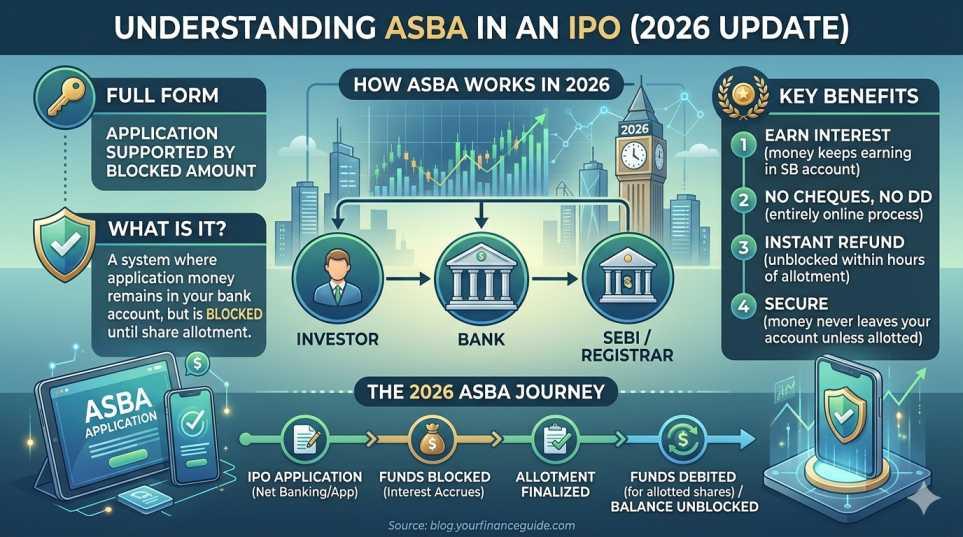
Application Supported by Blocked Amount
In simple words, ASBA allows investors to apply for IPOs without transferring money immediately. The IPO application amount remains blocked in the bank account and gets deducted only if shares are allotted.
This system ensures better safety and smooth processing during IPO applications.
How ASBA Works in IPO
ASBA works through a simple and investor-friendly process.
When an investor applies for an IPO using ASBA:
-
The required IPO amount is blocked in the bank account
-
The money remains in the account until allotment
-
The investor continues earning savings account interest
-
Funds are debited only if shares are allotted
-
If no shares are allotted, the blocked amount is released automatically
This process reduces refund delays and improves investor confidence.
Why ASBA Was Introduced
Before ASBA was introduced, IPO investing was more complicated and risky for retail investors.
The older IPO system involved:
-
Physical application forms
-
Cheque payments
-
Manual verification
-
Long refund waiting periods
-
Processing delays
To simplify the IPO process and improve investor protection, SEBI introduced the ASBA mechanism.
Today, almost all IPO applications in India are processed through ASBA or UPI-based systems.
What is SCSB in ASBA?
To use ASBA, investors need a bank account with a SEBI-approved bank known as an:
SCSB (Self-Certified Syndicate Bank)
These banks are authorized to accept and process ASBA IPO applications.
Popular SCSB Banks
-
SBI
-
HDFC Bank
-
ICICI Bank
-
Axis Bank
-
Kotak Mahindra Bank
-
Bank of Baroda
If your bank offers IPO application services through net banking, it usually supports ASBA.
Who Can Use ASBA?
ASBA is available for almost all investor categories in India.
Eligible Investors
-
Retail investors
-
HNI/NII investors
-
NRIs
-
HUFs
-
Minors through guardians
Whether you are applying for a small IPO or a large investment, ASBA can be used safely.
Step-by-Step Process of ASBA in IPO
The ASBA process is simple and beginner-friendly.
Step 1: Apply for IPO
Investors can apply through:
-
Net banking
-
Bank branch
-
Broker platform connected with ASBA
Step 2: Funds Get Blocked
The bank blocks the required IPO amount in the account.
Step 3: IPO Subscription Closes
After the IPO closes, the allotment process begins.
Step 4: Allotment Finalization
-
If shares are allotted → money gets debited
-
If shares are not allotted → blocked amount gets released automatically
Step 5: Shares Credited
Allotted shares are credited to the investor’s Demat account before listing day.
Benefits of ASBA in IPO
ASBA has become highly popular because of its multiple advantages.
Money Remains Safe
Funds stay in the investor’s own bank account until allotment.
No Refund Delays
Since the money is not deducted upfront, there is no need to wait for refunds.
Interest Continues
Blocked funds continue earning savings account interest.
Secure IPO Application
ASBA operates through SEBI-approved banking systems, improving security.
No Extra Charges
Most banks do not charge additional fees for ASBA IPO applications.
Fully Online Process
Investors can apply for IPOs easily through internet banking from anywhere.
ASBA vs UPI IPO Applications
Both ASBA and UPI are commonly used for IPO applications in India.
ASBA
-
Mostly used through net banking
-
Preferred for larger IPO investments
-
Highly stable and reliable
UPI
-
Mostly used by retail investors
-
Faster and easier for small applications
-
UPI mandate approval required
Retail investors often prefer UPI due to simplicity, while HNIs and large investors usually prefer ASBA because of better stability and higher limits.
How to Apply for IPO Using ASBA
Applying through ASBA is very easy if you follow the correct process.
Step 1
Login to your bank’s net banking account.
Step 2
Open the IPO or ASBA section.
Step 3
Select the active IPO you want to apply for.
Step 4
Enter details like:
-
PAN Number
-
Demat Account ID
-
Quantity of shares
-
Bid price
Step 5
Choose the Cut-Off Price option if you are a retail investor.
Step 6
Submit the IPO application.
After submission, the required amount will be blocked automatically.
Common ASBA Mistakes Investors Should Avoid
Many IPO applications fail because of simple mistakes.
Common Errors
-
Insufficient bank balance
-
Wrong Demat account details
-
PAN mismatch
-
Delayed application submission
-
Technical bank server issues
Always verify all details carefully before submitting the IPO application form.
IPO Timeline in ASBA
Understanding the IPO timeline helps investors track fund status clearly.
IPO Opens
The required amount gets blocked.
IPO Closes
Applications are locked for processing.
Allotment Finalized
Funds are debited if shares are allotted.
Fund Release
Blocked amount is released if no allotment is received.
Listing Day
Shares become available for trading in the Demat account.
Why ASBA is Best for Beginners
ASBA is considered one of the safest IPO application systems for beginners because it removes many traditional IPO risks.
ASBA Reduces
-
Refund delays
-
Payment confusion
-
Manual processing errors
-
Fund safety concerns
For first-time investors, ASBA offers a smooth, transparent, and stress-free IPO investing experience.
Final Thoughts
Understanding ASBA in IPO is essential for every investor in 2026. It provides a secure and transparent way to apply for IPOs without worrying about upfront payment deductions or refund delays.
ASBA offers several advantages, including:
-
Better fund safety
-
Easy online IPO application
-
Faster processing
-
Smooth allotment handling
-
Continued savings account interest
If you are planning to apply for an IPO for the first time, ASBA is one of the safest and most reliable methods to begin your IPO investment journey confidently.
Disclaimer: This article is only for educational and informational purposes. It should not be considered investment advice. Investors should consult their financial advisor before investing in IPOs or stock markets.
Κατηγορίες
Διαβάζω περισσότερα
Le paris sportif moderne repose sur une architecture de données en flux continu, où les informations sont constamment générées, transformées et redistribuées. Chaque événement sportif produit un ensemble de données dynamiques qui alimentent les systèmes analytiques des plateformes. Ces flux comprennent des...

RR99 là thương hiệu giải trí trực tuyến nổi bật, được đông đảo người chơi tin tưởng và đánh giá cao trên thị trường hiện nay. Với định hướng phát triển bền vững, minh bạch và chuyên nghiệp, RR99 không ngừng nâng cấp hệ thống để mang đến trải nghiệm giải trí an toàn, tiện lợi và hấp dẫn....
The global landscape of business operations is undergoing a profound shift as organizations transition from traditional methodologies to integrated digital ecosystems. The digital transformation services market is at the forefront of this evolution, acting as the primary catalyst for modernization across diverse industry verticals. By 2034, this market is projected to reach unprecedented...

According to the latest report published by Data Bridge Market Research, the Age-Related Macular Degeneration (AMD) Disease - Anti VEGF Market CAGR Value The global age-related macular degeneration (AMD) disease - Anti VEGF market size was valued at USD 14.60 billion in 2024 and is expected to reach USD 24.71 billion by 2032, at a CAGR of...
https://anandtraders1119.wixsite.com/engaging-insights-bl/post/build-the-ultimate-vacation-itinerary-for-your-next-getaway-dial-1-866-855-0041