Air Defense Radar Market Trends and Forecast Driven by Geopolitical Tensions and Aerospace Investments
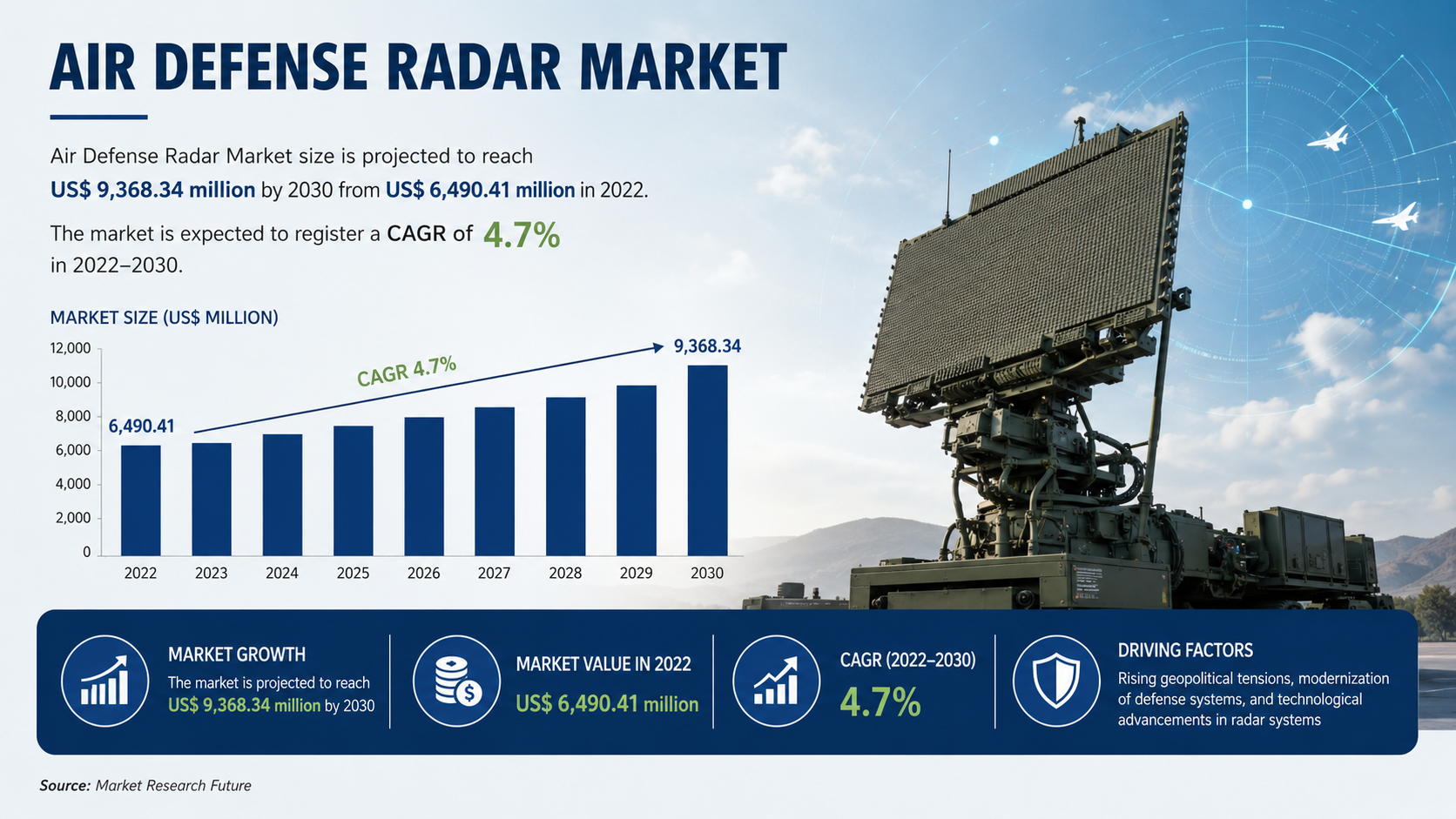
The global defense landscape is undergoing a significant transformation as nations prioritize the modernization of their surveillance and security infrastructures. Central to this evolution is the air defense radar, a critical component that enables the detection, tracking, and interception of aerial threats ranging from conventional aircraft to sophisticated ballistic missiles and unmanned aerial vehicles. According to recent industry analysis, the Air Defense Radar Market size is projected to reach US$ 9,368.34 million by 2030 from US$ 6,490.41 million in 2022. The market is expected to register a CAGR of 4.7% in 2022–2030.
Market Drivers and Technological Evolution
The steady growth of the air defense radar market is primarily fueled by the rising geopolitical tensions across various regions and the subsequent increase in defense budgets. Modern warfare has shifted toward the use of stealth technology and high speed projectiles, necessitating the development of radar systems with higher precision and longer detection ranges.
Technological advancements such as Active Electronically Scanned Array (AESA) systems have become a cornerstone of the market. Unlike traditional passive systems, AESA radars provide enhanced multi tasking capabilities, allowing for the simultaneous tracking of numerous targets while maintaining high resistance to electronic jamming. The integration of digital beamforming and Gallium Nitride (GaN) technology has further improved the power efficiency and thermal management of these systems, making them more reliable in diverse combat environments.
Segmental Analysis: Range and Platform
The air defense radar market is categorized based on range, platform, and application. In terms of range, the market is divided into short range, medium range, and long range systems. Long range radars are currently witnessing high demand due to the increasing threat of long distance ballistic missiles and the need for early warning systems that provide sufficient reaction time for territorial defense.
From a platform perspective, the market includes ground based, naval, and airborne radars. Ground based systems remain a dominant segment as they form the backbone of national air defense networks. However, the naval segment is observing rapid growth as maritime security becomes a priority for nations with extensive coastlines. These sea based radars are essential for protecting carrier strike groups and detecting sea skimming missiles that fly at low altitudes to evade traditional detection.
Download Sample Report: https://www.theinsightpartners.com/sample/TIPRE00011971
Regional Market Insights
North America currently holds a significant share of the global market, driven by the presence of major defense contractors and the continuous investment by the US Department of Defense in next generation surveillance technologies. Meanwhile, the Asia Pacific region is expected to witness the highest growth rate during the forecast period. Countries like China, India, and South Korea are aggressively expanding their air defense capabilities to counter regional security challenges and modernize their aging military hardware. In Europe, the focus remains on integrated air and missile defense systems to ensure interoperability among NATO members.
Key Industry Players
The competitive landscape of the air defense radar market features several prominent players who are focusing on research, development, and strategic partnerships to maintain their market position. Key players include:
-
BAE Systems Plc
-
General Dynamics Corp
-
Honeywell International Inc
-
Israel Aerospace Industries Ltd
-
Leonardo SpA
-
Lockheed Martin Corporation
-
Northrop Grumman Corporation
-
Raytheon Technologies Corp
-
SAAB AB
-
Thales SA
Challenges and Market Restraints
Despite the positive growth trajectory, the market faces certain hurdles. The high cost associated with the development and deployment of advanced radar systems can be a limiting factor for developing nations with restricted defense budgets. Additionally, the increasing sophistication of electronic warfare (EW) techniques poses a constant challenge, as radar manufacturers must continually update their software and hardware to counter signal interference and spoofing attempts.
Future Outlook
The future of the air defense radar market looks promising as the industry moves toward the adoption of artificial intelligence and machine learning for automated target recognition and data processing. Future systems will likely emphasize multi domain integration, where radar data is seamlessly shared across land, sea, air, and space platforms to create a comprehensive tactical picture. Furthermore, the rise of "swarm" drone threats will drive the demand for highly sensitive, short range radar systems capable of detecting small, low flying objects in cluttered environments. As global security requirements continue to shift, the air defense radar market will remain a vital sector for ensuring national sovereignty and global stability.
Coastal Surveillance Radar Market
Military Augmented Reality Market
About Us
The Insight Partners is a leading global market research and consulting firm specializing in delivering actionable insights across various industries. Our research reports combine extensive primary and secondary research to provide accurate market intelligence, helping businesses make informed strategic decisions. The company provides detailed analysis on emerging technologies, market trends, competitive landscapes, and growth opportunities across sectors including technology, healthcare, manufacturing, and energy.
Contact Us:
Contact Person: Ankit Mathur
E-mail: ankit.mathur@theinsightpartners.com
Phone: +1-646-491-9876
Categorie
Leggi tutto
f you’re searching for reliable and powerful UTVs for Sale in Texas, you’ll find a wide selection designed to deliver exceptional off-road performance. From compact 200cc models to powerful 1000cc machines, these utility terrain vehicles are built for adventure, work, and everything in between. Whether you enjoy trail riding, ranch work, or outdoor recreation, choosing the right UTV...

Introduction If you are planning to step into the world of accounting or want to upgrade your financial skills, choosing the right training path matters more than ever. Chandigarh has become a growing hub for professional education, especially in finance and business-related courses. Among the many options available, enrolling in a Tally course in Chandīgarh sector 34 can be a smart move for...

До долгожданного релиза новой версии Call of Duty: Modern Warfare остается всего месяц, однако в преддверии этого события поклонникам стоит обратить внимание на другую свежую новинку серии — мобильную игру Call of Duty: Mobile, чей запуск запланирован на следующую неделю, 1 октября. Эта версия объединяет лучшие элементы из подсерий Modern Warfare и Black Ops, предлагая знакомые карты,...

"Executive Summary Dark Roast Cocoa Market Size and Share Forecast The global Dark Roast Cocoa Market size was valued at USD 17.14 billion in 2024 and is expected to reach USD 25.32 billion by 2032, at a CAGR of 5.00% during the forecast period. The Dark Roast Cocoa report also makes available CAGR value fluctuation during the forecast period of 2018-2025 for...
If you are passionate about creativity, modern design, and meaningful visual expression, Bond Gallery is the perfect place to explore outstanding contemporary art. As a dynamic online art platform, Bond Gallery connects talented artists with art lovers, collectors, and creative minds from around the world. Through https://www.bondgallery.art/, visitors can discover carefully curated collections...