


Step-by-Step SEM Strategy for Beginners

Search Engine Marketing has become one of the most effective digital marketing strategies for businesses looking to increase online visibility, generate leads, and drive targeted website traffic. In today’s competitive digital environment, businesses cannot rely only on organic reach to attract customers. SEM helps brands appear directly in front of users actively searching for products, services, or information online.
For beginners, SEM may seem complicated because it combines paid advertising, keyword research, SEO insights, audience targeting, and campaign optimization. However, with the right strategy, businesses can create high-performing campaigns that improve brand awareness and generate measurable results.
If you want to understand how Search Engine Marketing works and how to create successful campaigns step by step, this guide will help you build a strong SEM strategy for long-term digital marketing success.
What Is Search Engine Marketing and Why Is It Important?
Search Engine Marketing is a digital marketing strategy that uses paid advertising to increase visibility on search engines like Google and Bing. Businesses bid on keywords so their ads appear when users search for relevant topics online.
Key benefits of SEM include:
-
Instant search engine visibility
-
Faster lead generation
-
Better audience targeting
-
Increased website traffic
-
Measurable campaign performance
Unlike SEO, which focuses on long-term organic growth, SEM provides immediate visibility and faster marketing results.
How Does SEM Differ from SEO?
Many beginners confuse SEM with SEO, but both strategies serve different purposes while working well together.
Major differences include:
-
SEM uses paid advertisements
-
SEO focuses on organic search rankings
-
SEM delivers faster traffic results
-
SEO builds long-term website authority
-
SEM campaigns require advertising budgets
Combining SEO and SEM creates a balanced digital marketing strategy that improves both short-term and long-term growth.
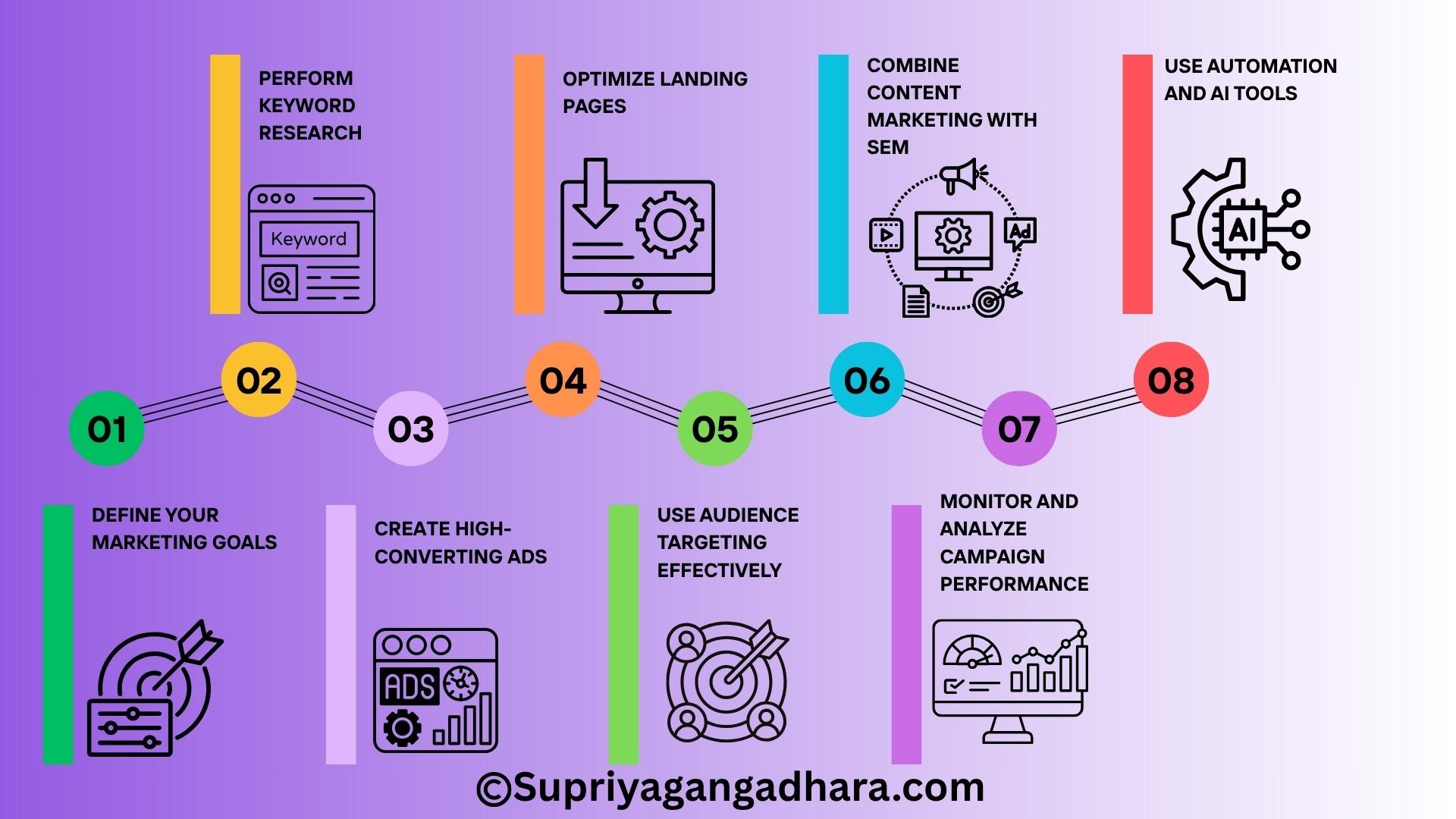
Step 1: Define Your Marketing Goals
The first step in building a successful SEM strategy is understanding your business objectives. Clear goals help businesses create focused campaigns and measure success accurately.
Common SEM goals include:
-
Increasing website traffic
-
Generating leads
-
Boosting online sales
-
Growing brand awareness
-
Promoting specific products or services
Defined goals help marketers choose the right keywords, ad formats, and audience targeting strategies.
Step 2: Perform Keyword Research
Keyword research is one of the most important parts of Search Engine Marketing. Choosing the right keywords helps businesses reach users actively searching for relevant information.
Effective keyword research strategies include:
-
Identifying high-intent keywords
-
Using SEO tools for keyword analysis
-
Targeting long-tail search phrases
-
Analyzing competitor keywords
-
Understanding user search intent
Combining SEO insights with SEM keyword strategies improves campaign performance and audience targeting.
Step 3: Create High-Converting Ads
Well-written ads attract attention and encourage users to click. Successful SEM campaigns focus on clear messaging and strong calls to action.
Effective ad elements include:
-
Attention-grabbing headlines
-
Clear value propositions
-
Relevant keywords in ad copy
-
Strong call-to-action phrases
-
Mobile-friendly ad formats
Ads should communicate benefits clearly while matching the user’s search intent.
Step 4: Optimize Landing Pages
Landing pages play a major role in SEM success. A well-designed landing page improves user experience and increases conversions.
Important landing page features include:
-
Fast loading speed
-
Clear headlines and messaging
-
Mobile responsiveness
-
SEO-optimized content
-
Easy-to-use call-to-action buttons
Businesses that optimize landing pages often achieve better ad quality scores and lower advertising costs.
Step 5: Use Audience Targeting Effectively
Audience targeting helps businesses show ads to the right people based on interests, demographics, location, and behavior.
Popular targeting options include:
-
Geographic targeting
-
Demographic targeting
-
Interest-based audiences
-
Remarketing campaigns
-
Device-based targeting
Accurate targeting reduces wasted ad spend and improves conversion rates.
Step 6: Combine Content Marketing with SEM
Content marketing strengthens SEM campaigns by improving audience trust and engagement. Valuable content encourages users to spend more time on websites and increases conversion opportunities.
Content marketing benefits for SEM include:
-
Better audience education
-
Increased website authority
-
Improved SEO performance
-
Higher engagement rates
-
Stronger customer trust
Businesses that combine SEM with content marketing often create more sustainable digital marketing growth.
Step 7: Monitor and Analyze Campaign Performance
Successful SEM campaigns require continuous monitoring and optimization. Data analysis helps businesses identify what works and improve underperforming campaigns.
Important SEM metrics include:
-
Click-through rate (CTR)
-
Conversion rate
-
Cost per click (CPC)
-
Return on investment (ROI)
-
Bounce rate
Tracking performance metrics allows marketers to make data-driven decisions that improve campaign results.
Step 8: Use Automation and AI Tools
Artificial Intelligence is transforming digital marketing and Search Engine Marketing strategies. AI-powered tools help businesses optimize campaigns faster and more efficiently.
AI-powered SEM advantages include:
-
Smart bidding strategies
-
Automated ad optimization
-
Audience behavior analysis
-
Better budget allocation
-
Predictive performance insights
AI tools help marketers improve efficiency while scaling campaigns more effectively.
How Can Beginners Avoid Common SEM Mistakes?
Many beginners waste their budget by running campaigns without proper planning and optimization.
Common SEM mistakes include:
-
Targeting broad keywords only
-
Ignoring landing page quality
-
Failing to track conversions
-
Using weak ad copy
-
Not testing multiple campaigns
Avoiding these mistakes improves campaign performance and reduces unnecessary advertising costs.
Conclusion
Search Engine Marketing is one of the most powerful digital marketing strategies for businesses looking to grow online visibility and generate targeted traffic quickly. However, successful SEM campaigns require more than simply running ads; they require strategic planning, SEO insights, content marketing support, and continuous optimization.
By following a step-by-step SEM strategy, beginners can create campaigns that attract the right audience, improve conversions, and support long-term business growth. When combined with SEO, valuable content, and AI-powered optimization, SEM becomes a scalable and sustainable marketing solution for modern businesses.
Categorii
Citeste mai mult
When families in Maryland begin planning for the future or dealing with the loss of a loved one, one of the most common questions is whether a wills and trusts attorney Maryland can actually handle the full estate process. The short answer is yes—but the real value lies in how these legal professionals guide families through every stage of estate planning and estate administration. A...

Present day program models are expected to touch serious page views, volatile customer tendencies, plus elaborate workloads without the need of delaying and also a crash. In such a ecosystem, your worry evaluating stand is a critical organ of the progression lifecycle. Them lets web developers plus QA stresser coaches and teams so that you can duplicate overwhelming situations plus observe uses...
CM88 là nền tảng giải trí trực tuyến đa dạng, chuyên nghiệp và hiện đại, mang đến cho người dùng một hệ sinh thái cá cược toàn diện và chất lượng cao. Với định hướng phát triển bền vững, minh bạch và uy tín, https://cm88z.net/ không ngừng nâng cấp hệ thống để tạo ra môi trường giải...

Affordable Media Outreach Packages for US Businesses Unlocking growth through strategic media reach and the support of an affordable PR agency. In the digital age In the digital age, visibility is the currency of growth. For US businesses striving to capture market share, the challenge often lies not in the quality of their product, but in the noise of the digital marketplace. How does a brand...

A professionally designed Commercial Grade Home Gym offers the strength, durability, and performance needed for long-term training. Whether you are building a personal workout space or upgrading an existing gym, Hamilton Home Fitness provides high-quality commercial fitness equipment, expert gym design solutions, and trusted brands to help you achieve your fitness goals with...
